
School Committee Updates Bullying Prevention and Intervention Plan
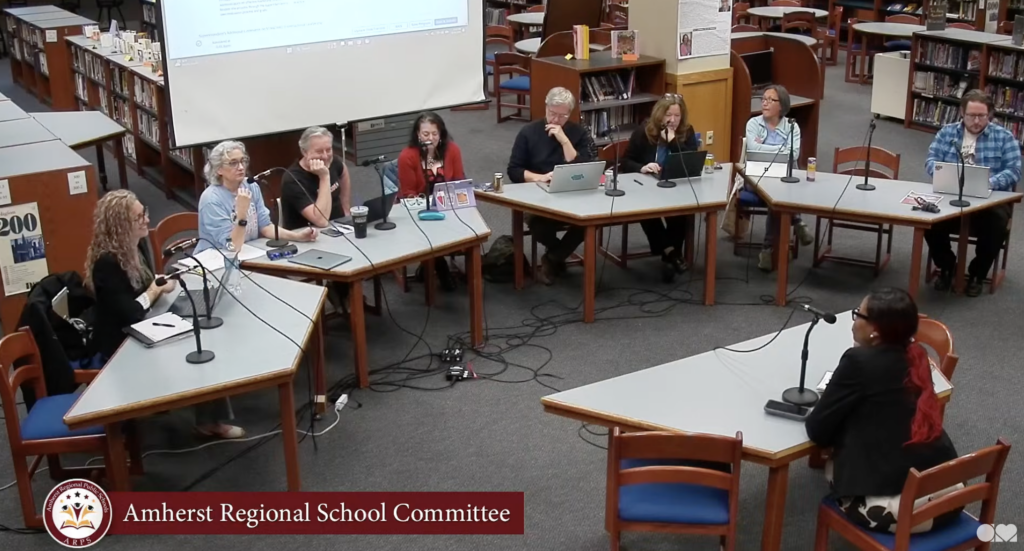
Amherst Regional School Committee Meeting April 30, 2026. (L_R, rear) Sarahbess Kenney (Chair), Deb Leonard, William Sherr, Laura Jane Hunter, Andrew Hart, Bridget Hynes, Anna Heard, Tim Shores. (front table) E.Xiomara Herman (Superintendent)
Report on the Joint Meeting of the Regional School Committee and the Amherst School Committee, April 30, 2026
This meeting was held in a hybrid format at Amherst Regional High School and was recorded.
Bullying Prevention and Intervention Plan Updated
The new administrator of mental health and behavioral services, Colleen Bogonovich, has worked to update the district’s Bullying Prevention and Intervention Plan during her first six weeks on the job. Bogonovich introduced herself to the Regional School Committee on April 30, noting her experience in health and systems-level policy work to align community input data with regulatory and statutory requirements.
She presented data from all seven schools in the district on potential bullying incidents as recorded in the Bullying Reporting, Intervention, and Monitoring software (BRIM). Bogonovich said that from Feb. 1 through March 31, 36 reports of potential bullying incidents were filed: five were confirmed as bullying, nine were in progress, eight were closed as unfounded, eight were duplicate filings, four were unable to be investigated, and two had no status recorded. Nineteen of the 36 incidents occurred in the classroom. Over the entire school year, 187 reports were filed, with 20% confirmed as bullying.
Bogonovich said it was a good sign that the BRIM system was being used, but she noted some problems. The most glaring was that 72% of the reports had no investigator listed. She hypothesized that this is because there is a designated investigator for each school, but noted that it is important to explicitly name the person responsible.
In analyzing the submitted data, Bogonovich and her team identified additional issues. A working group composed of students, families, staff, law enforcement partners, and community mental health workers identified five key themes that were also flagged in the data analysis:
- Trust and safety are barriers to reporting
- Inconsistencies across buildings
- Unclear process for families
- Equity gaps for vulnerable groups
- Inconsistent follow-up and communication
The changes in the updated draft included inserting mandatory language from the Department of Elementary and Secondary Education regarding professional development and investigation timelines. Bogonovich stressed that a safety plan must be put in place immediately whether bullying has been confirmed or not, and that follow-up is needed at approximately 30 days. She also said she wants to develop a social-emotional learning work plan that integrates with the bullying plan to avoid parallel systems.
Regarding implementation, Bogonovich cited the need for a reporting liaison in each building and outlined four phases:
- The updated plan is posted on the website and included in staff handbooks.
- All administrators and counselors are trained on system usage protocols.
- Student and family handbooks are updated and distributed annually and made accessible to all types of learners and speakers of prevalent languages.
- Each summer, implementation will be integrated into the following year’s professional development calendar for all staff. Professional development should cover self-awareness, self-management, social awareness, relationship skills, and responsible decision-making — skills that staff can model and teach to students.
Feedback from School Committee Members
Anna Heard (Shutesbury) noted that the committee had deliberately not specified locations of bullying incidents that must be reported, because all bullying is prohibited and cyberbullying can occur anywhere and still affect students and the school environment.
Bridget Hynes (Amherst) said the investigation timeline is very important to families, and they should be encouraged to contact the person in charge if they have not heard of any progress within three days of filing a report.
Deb Leonard (Amherst) said families of students with special education plans who are involved in a report should be notified immediately.
Laura Jane Hunter (Amherst) requested feedback from staff about where they see gaps in policy and implementation, since incidents are often first observed by staff. She said staff should be assured that when they bring something to an administrator’s attention, it is being addressed. She also suggested working with students on bystander intervention, which has proven effective — especially when introduced at a young age.
William Sherr (Pelham) said he wanted to make sure the district is also tracking harassment — behavior that does not meet the definition of bullying. He also advocated for letters to families regarding investigations to be consistent across schools and to use a gentler tone, because harm may still have occurred even if bullying was not confirmed. He suggested that the Policy Subcommittee of the Regional School Committee meet with Bogonovich to work out the details of the plan.
Superintendent E. Xiomara Herman said the Department of Elementary and Secondary Education requires her to submit a quarterly report on bullying, and that digitizing the information will help with that process. She said Bogonovich is working to create a dashboard that could flag certain fields — such as whether a student has an individualized education plan — and identify trends in the frequency and types of bullying. Herman also noted that the department has a Safe Schools Initiative with grant funding available, and that a state-level site council for LGBTQ students has been established.
Superintendent Evaluation Tool Finalized
Both the Regional School Committee and the Amherst School Committee unanimously approved the superintendent evaluation tool for the 2025-26 school year. The document will be distributed to staff and families and used to assess how Herman has met the goals set by the school committee.
Policy Updates Approved
The policy subcommittee of the regional schools is reviewing all existing policies. The following updated policies were unanimously approved by the Regional School Committee and the Amherst School Committee:
- ADC — Tobacco and Marijuana Products on School Premises Prohibited
- GBEE — Personnel Use of Technology
- GBEB – Staff Conduct
- GBJ — Personnel Records
- GBGC — Staff Health and Physical Examinations
- GCBB — Employment of Principals and Administrators
- GCO — Evaluation of Professional Staff
- GCQF — Suspension and Dismissal of Employees
- GDO — Evaluation of Support Staff
- GCK — Professional Staff Assignments and Transfers