
Citizens Bank is Parting Ways with Two ICE Contractors
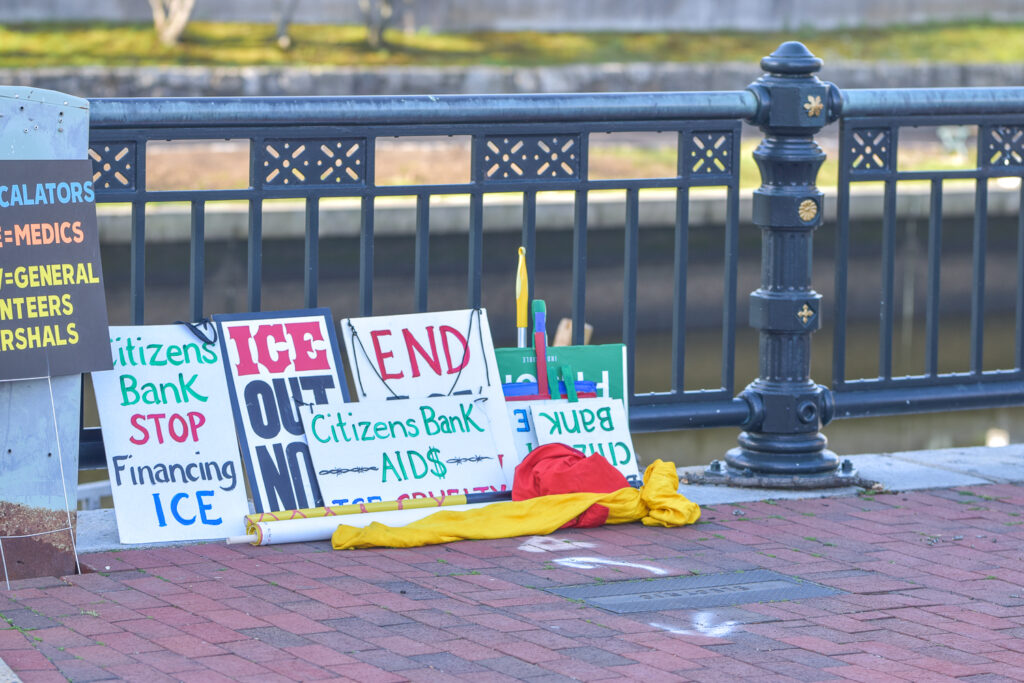
Signs protesting Citizens Bank’s financial relationships with private prison companies are seen placed along a fence outside the company’s Providence headquarters on April 23, 2026. Photo: Christopher Shea/Rhode Island Current)
by Christopher Shea
The following article appeared originally in the Rhode Island Current on July 17, 2026. It is reposted here under Creative Commons license (CC BY-NC-ND 4.0), and as part of our series, A Better World is Possible.
Indy editor’s note: Activists and regional groups—including Indivisible Northampton—have, since at least the Fall of 2025, organized demonstrations outside local branches of Citizens Bank, such as the location on King Street in Northampton and sites spanning Holyoke, Springfield, and East Longmeadow. These actions were allied with a coordinated statewide and national push by the De-ICE Citizens Bank Coalition.
See Related: A Better World is Possible: Here’s How We Pressured an Airline to End Its Contract With ICE (Truthout)
Following months of protests outside its branches and Providence headquarters, Rhode Island’s largest bank announced Friday it is cutting its financial ties with two for-profit prison operators that have detained immigrants on behalf of the Trump administration.
Citizens Bank, in a statement, said it will end its credit facilities with GEO Group and CoreCivic, two of the biggest contractors for the U.S. Immigration and Customs Enforcement (ICE). The company said the move was purely a business decision “based on changed commercial circumstances.”
CoreCivic recently sold two of its California properties to the U.S. government, and the chief executive officer of GEO Group indicated in a May earnings call that the Florida-based company is considering selling some of its properties to ICE.
CoreCivic, which runs more than 40 prisons and has won contracts with ICE totaling more than $2 billion, has been a Citizens client since 2011. The GEO Group, which operates about 50 prisons and correctional facilities with more than 60,000 beds nationwide, has worked with Citizens since 2018.
Citizens has around 1,000 branches across 14 states concentrated mostly in the northeast and mid-Atlantic, along with the District of Columbia. The public company reported $233.8 billion in assets as of June 30.
Citizens’ relationship with the private prison led to the creation of a coalition that has organized numerous protests against the Rhode Island financial institution, including a demonstration outside its headquarters the day of its annual shareholder meeting in April.
During the demonstration, the union representing working graduate and undergraduate students at Brown University announced it planned to pull around half a million dollars it held in the bank. Michael Ziegler, president of AFT-RIFT Local 6516, said in an email Friday the union had not yet found a new bank and called Citizens’ decision “very good news.”
See Related: Brown Union to Pull $500K from Citizens Bank over ICE Ties. Boston Faith Leaders May Follow. *(Rhode Island Current)
The Greater Boston Interfaith Organization withdrew $3 million in protest over the last two months. In recent weeks, the governments of Montclair and Jersey City in New Jersey pulled a collective $300 million.
“Regardless of the rationale, this is the outcome that was needed,” the Most. Rev. Dr. Ray Hammond, a pastor at the Bethel A.M.E Church in Boston and former Citizens’ board member, said in a statement Friday. “Our immigrant friends, neighbors and allies deserve to know that community institutions they may have counted on are not directly enabling a system that has brought irreparable harm to neighborhoods across the country.”
The De-ICE Citizens Bank coalition issued a statement Friday afternoon calling the bank’s decision to end lending relationships with CoreCivic and GEO Group “an important victory for the people who refused to let a major bank finance human suffering brought on by ICE detention activities.”
“While Citizens Bank frames this exit as a purely ‘business decision’ dictated by evolving commercial circumstances, the reality is clear: public conscience and community resistance matter and have paid off,” the coalition said. “As we have said from the beginning, doing some good does not cancel out the harm caused by these business relationships.”
Throughout the protests, Citizens refrained from commenting directly on its relationships with the two private prison firms, citing the importance of protecting client privacy. But given the decision to finally sever its financial ties, the company said now was an appropriate time to comment.
“Citizens has been disappointed that the activists have dragged it into what is largely a political matter,” the company stated. “Public characterizations of Citizens by activist groups, including as it relates to our commitment to immigrants and to communities, do not reflect who we are or the record we have built.”
The bank donates to 140 nonprofit partners serving immigrant communities across multiple markets, according to the Citizens’ statement. Citizens also highlighted that it provides $2 billion in community development funding to support affordable housing and local economic growth.
“None of these virtues seem to matter to the activist groups, as they have tried to define us through a narrow lens inconsistent with who we are,” the company said.
While applauding the company’s decision, the De-ICE Citizens’ coalition said it will continue pressing the bank for written confirmation that it has ended — and will not resume — any banking relationship with CoreCivic or GEO Group.
“Until we get all questions answered, we expect this will continue as customers align their personal values with banks they do business with,” the coalition said.
Steve Owens, a spokesperson for CoreCivic, said in an emailed statement the Tennessee-based firm remains “focused on delivering safe, high-quality services for our government partners and delivering quality outcomes, which is where we believe our emphasis should be.
“CoreCivic is a lawful business that has served government partners at the federal, state and local levels, under administrations of both parties, for more than 40 years,” Owens said. “Our financial position is the strongest it has been in the company’s history, and we value very much our diverse set of financial partners that help support the company’s capital needs.”
A spokesperson for the GEO Group did not immediately respond to a request for comment.
Christopher Shea covers politics, the criminal justice system and transportation for the Rhode Island Current. Rhode Island Current is part of States Newsroom, the nation’s largest state-focused nonprofit news organization.
A Better World Is Possible” is an occasional Indy feature that offers snapshots of creative undertakings, community experiments, innovative municipal projects, and excursions of the imagination that suggest possible interventions for the sundry challenges we face in our communities and as a species. Have you seen creative approaches to community problems or examples of things that other communities do to make life better for their residents that you think we should be talking about? Send your observations/suggestions to amherstindy@gmail.com. See previous posts here.