
Opinion: Here’s a Quick Fix to Amherst’s Budget Problem – Reduce Library Spending to the State Average
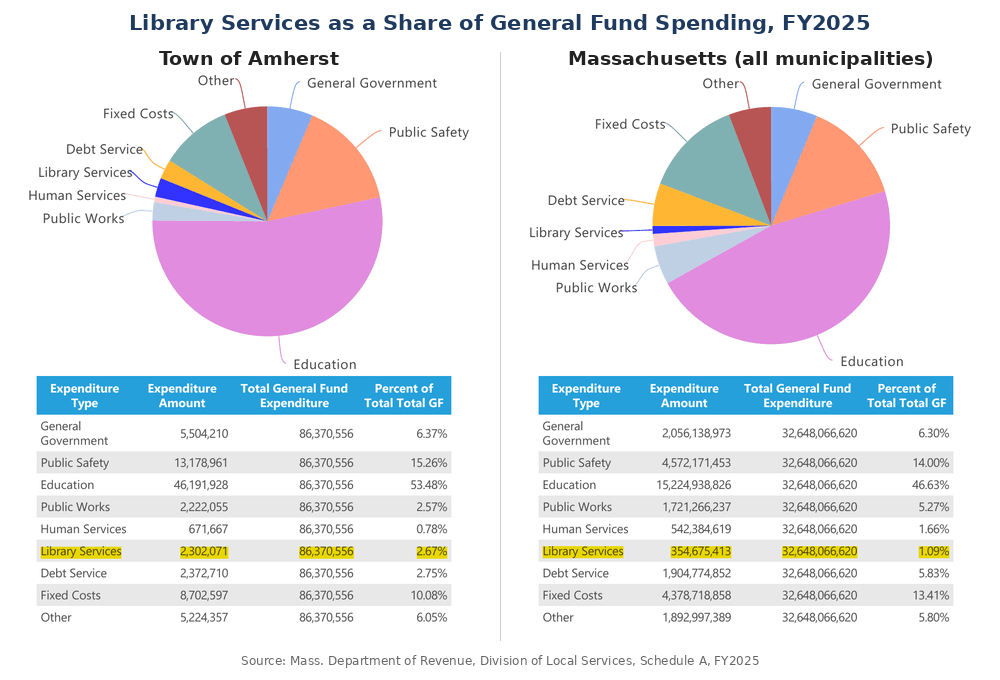
Amherst puts 2.67 percent of its general fund into library operations; the statewide figure is 1.09 percent. Bringing the town to the state average would free roughly $1.3 million a year, more than the structural deficit the town has forecast.
As the Finance Committee debates how to distribute what is projected to be a meager 2.75% spending increase to the elementary schools, regional schools, Jones Library, and municipal government, it may be constructive to focus on what is arguably the most discretionary of the town’s spending categories. Amherst is heading into a budget cycle with a projected long-term structural deficit, public schools needing more than the town can provide, and long-awaited public works and public safety capital projects continuing to stand in line. In this setting, it is fair to ask how Amherst’s contribution to Jones Library, Inc.’s operating budget compares with what other communities spend, and what the difference is worth. This analysis uses Massachusetts Department of Revenue (DOR) data and is limited to library operations. The $15.8 million plus roughly $11 million in interest that the town has committed to the Jones Library Renovation-expansion is part of the capital budget and is out of scope.
Amherst Compared with the Rest of the State
DOR’s Schedule A reports break each town’s general fund spending into categories, library services among them. For fiscal 2025, the latest full year reported, Amherst spent $2,302,071 on library services out of $86,370,556 in general fund expenditures, or 2.67 percent. Across all Massachusetts municipalities, library services took $354.7 million of $32.6 billion, or 1.09 percent.
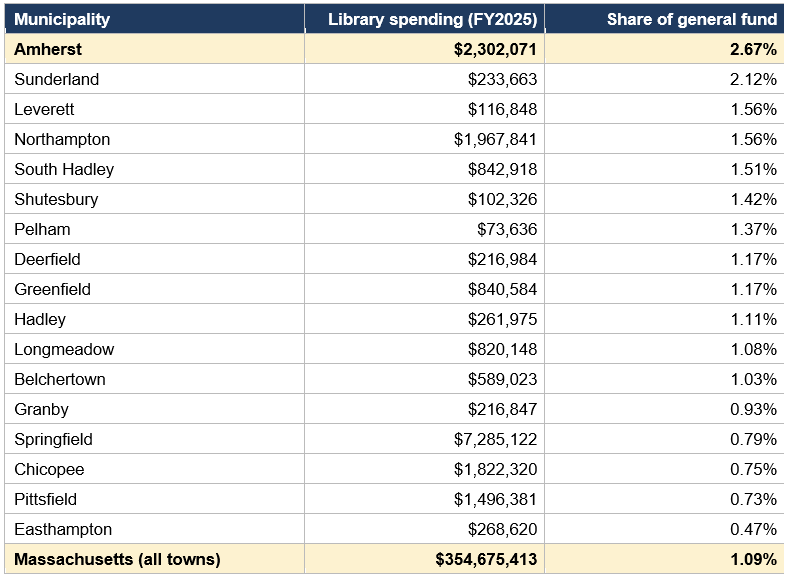
Amherst’s share is about two and a half times the statewide figure. The table below shows 16 nearby or comparable towns ordered by the percentage of each town’s general fund allocated to its public library. Amherst is highest by a considerable margin. The list includes three communities, South Hadley, Greenfield and Hadley, that have recently completed multi-million-dollar library renovations. These towns devote no more than 1.51% of their general funds to their libraries.
The pattern holds in the current year. Preliminary FY2026 figures show Amherst budgeting $2,394,154 for the library, 2.50 percent of a $95.7 million general fund. Not every town has reported, so the FY2026 state total is partial, but reporting towns so far average 1.18 percent.
Library Demand Does Not Support Extraordinarily High Expenses
Amherst’s 2025 Housing Production Plan reports that 65 percent of the town’s population consists of university and college students. These roughly 26,000 students have campus libraries of their own and an abundance of programming opportunities at their institutions. Furthermore, usage data shows that Jones Library annual attendance has fallen to less than half what it was at its peak in 2006.
This demographic and attendance profile calls into question why such a huge investment in public library operations is necessary.
The Library Once Cost Taxpayers Nothing
There is certainly historical precedent for spending less local tax money on the library.
The Jones Library was not designed as a line in the town budget. Samuel Minot Jones left about $662,000 in his will to create a free public library, and the library was incorporated in 1919. The building opened in 1928, paid for from the bequest, with no contribution from the town’s budget, relying entirely on private donations. By the account of library historian and former trustee Frank Prentice Rand, Town Meeting did not begin appropriating money for operations until 1954, at $6,500 a year. Since then, the town contribution to library operations has seen a meteoric rise. In 1967 the town raised its annual contribution to $11,500. By FY2024 the appropriation was $2,213,530 and by FY2025 about $2.3 million.
What the Town Could Save
If Amherst funded library services at the state-average share of its general fund, the arithmetic would be:
- FY2025: 1.09 percent of $86.4 million is about $938,000, against $2.30 million actually spent, a difference of roughly $1.36 million.
- FY2026: the partial state figure of 1.18 percent of $95.7 million is about $1.13 million, against $2.39 million budgeted, a difference of roughly $1.26 million.
In short, the town would save about $1.3 million a year. This is more than enough to erase the $1 million structural budget deficit that Finance Director Sean Mangano recently warned Amherst faces for the foreseeable future.
Members of the Finance Committee have pointed out that some town services are more critical than others, and offerings such as public education are mandated by law. The Jones Library is a beloved resource, but it is simply not as essential as police, fire and ambulance support, public works and the schools.
Absorbing the Pain
The Jones Library, Inc. trustees will resist any cut, and they will have reasons. They answer to the library, not to the town’s financial needs. A reduction in town funding will have to be made up from other sources: the endowment, state aid, and fundraising.
The $9.4 million endowment, they may argue, is already in jeopardy. Despite generous contributions from private donors toward the expansion project which, according to the trustees, total more than $10 million, the library still owes the town $7.6 million. This payment is expected to come due sometime in the next year. Whatever cannot be generated by fundraising must be made up from the endowment.
A depleted endowment will prevent the continuation of annual $300,000 draws for operations. It may sound harsh, but the trustees have put themselves in this hole by undertaking such an expensive renovation-expansion project and vastly overestimating their fundraising ability. Town leaders must also accept responsibility for allowing the Jones Library to be put in this position.
However, the goal is not to blame, but to fund Amherst’s mission critical services. With Amherst residents saddled with some of the highest taxes in the state, bringing a bloated library operations line item down to a level that Massachusetts towns typically pay is the most direct way to avoid more teacher layoffs, the continued disintegration of our roads, and further languishing of our DPW and central fire station capital projects.
Jeff Lee is a career computer programmer and regular observer of local government. He has lived in Amherst since 1994 and in the Pioneer Valley since 1973 when he began grad work in mathematics at UMass. He formerly served on the Amherst Redevelopment Authority and as a member of Town Meeting.