
Scaled-Down East Amherst Local Historic District Still Meets Opposition from Planning Board
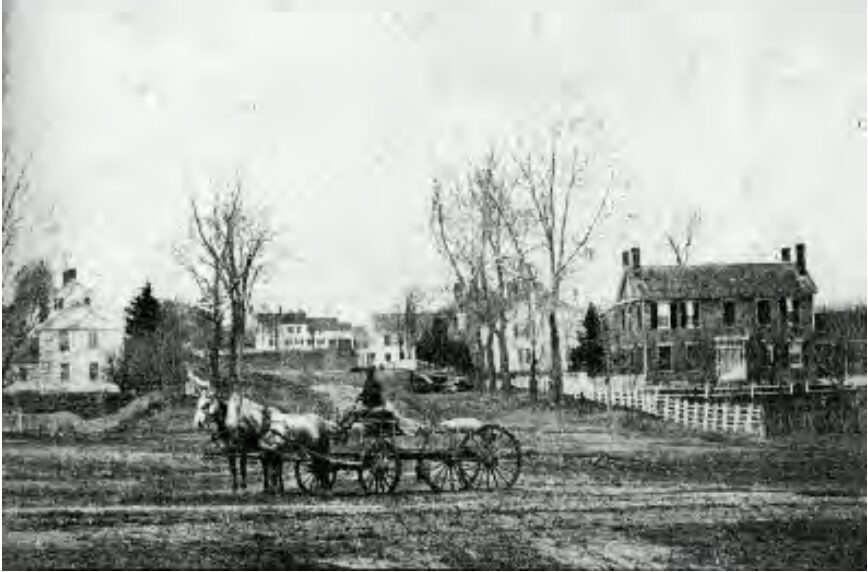
Historic East Amherst Village. Photo: amherstma.gov
Report on the Meeting of the Planning Board, August 5, 2026
This meeting was held over Zoom and was recorded.
Present
Doug Marshall (Chair), Bruce Coldham, Fred Hartwell, Roy Johnson, and Jerah Smith. Absent: Jesse Mager and Angus McLeod.
Staff: Walker Powell (Planner) and Pam Field Sadler (Planning Assistant)
Proposed East Amherst Local Historical District Includes Only 22 Properties
After the proposal to establish an East Amherst Local Historic District received an unfavorable reception from the Planning Board in April, the Local Historic District Commission (LHDC) narrowed the scope of the district to 22 core properties, but was still not assured of the Planning Board’s support. Support from the Planning Board is not required for the Town Council to establish the district, but would buoy the LHDC’s case.
Planner Walker Powell emphasized that the proposed local historic district does not overlap with the potential East Amherst overlay district that the town is now studying. That district, if created, would allow denser housing in the area.
LHDC members Steve Bloom and Elizabeth Sharpe explained that East Amherst is the oldest part of Amherst, and, with the exception of the East Amherst School and the town common, all of the 22 properties included in the proposal were constructed before the Civil War, and most are located around the intersection of North and South East Streets and Main Street. The included properties are in their original locations and have not been significantly altered.
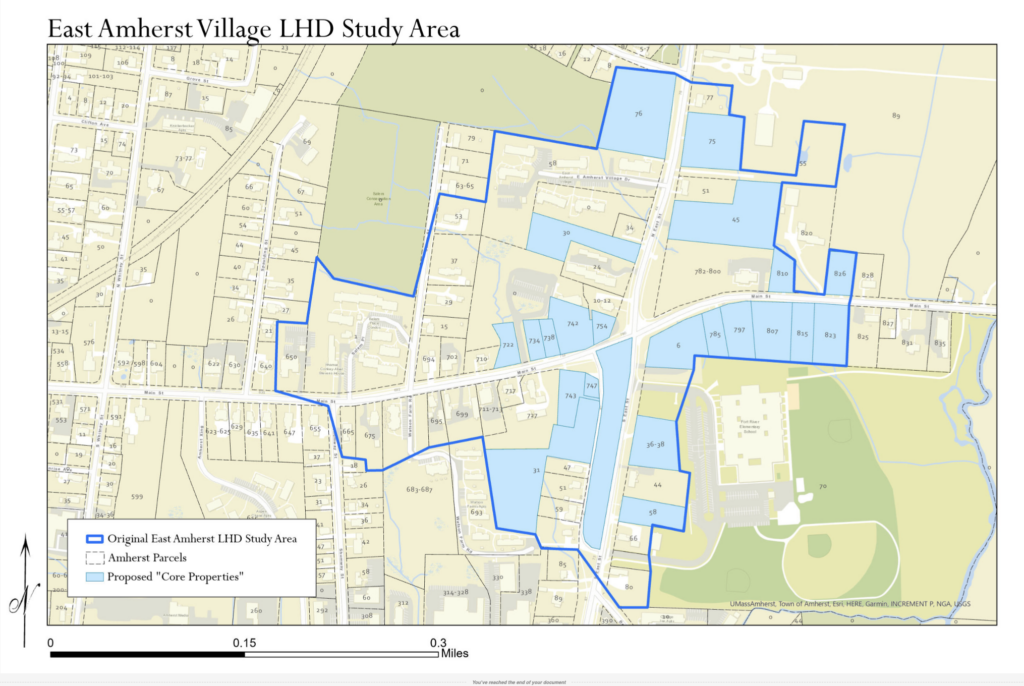
Bloom stated, “History is a major part of our brand and appeal. Character, charm and uniqueness attract prospective residents and visitors alike.” He noted that in the other two local historic districts in town, Sunset-Fearing and Emily Dickinson, the effort to establish them was initiated by the residents of the district, but the East Amherst initiative was brought forth at the suggestion of the town manager, who expressed concerns about the increasing vulnerability of Amherst’s oldest and most historic existing structures. The resulting proposal is the result of three years of research and deliberation, with modifications based on the Planning Board’s reservations that the broad district would interfere with development and increase costs for owners and renters. The final proposal was narrowed to only the most significant properties.
Sharpe, the co-director of Historic Northampton, added, “The fact that the East Amherst Historic area is still intact and looks the way it does is pretty unusual for most towns, so it should be celebrated and embraced.” She pointed out that two of the buildings predate the separation of Amherst from Hadley in 1759. The proposed district contains the first post office and the original town common. The Jewish Community of Amherst building was the second Congregational church, also termed the Patriot Church, which, in 1784, broke off from the church on the West Common where most of the loyalists in town worshiped. She said that the planning of Shay’s Rebellion took place across from the common where Fort River School is now. In the early 19th century, sites associated with the town’s early industry continue to co-exist with the pre-Revolution sites in East Amherst.
While long-time LHDC member and current Planning Board member Bruce Coldham voiced strong support for the scaled-down local historic district, other board members still had reservations. Jerah Smith thanked the LHDC for the revised plan but stated, “It’s really hard to raise a family right now financially, particularly in Amherst, and I’m only able to do that because of an extraordinary amount of privilege. And so, it is my prerogative as a member of this planning board to make it easier for people who are not as privileged to be able to grow a family here. These regulations relating to local historic districts invariably add a layer of time and review that make it more challenging to redevelop properties, so they are less likely to be affordable. When I saw this, I became frustrated because I felt like my peers are not being represented in this policy.” He asked why, in a time of great need for housing, we would prioritize a policy that would make it more challenging for people to live in Amherst, calling the proposal “tone deaf”.
Bloom submitted a detailed rebuttal to the arguments raised by Smith and fellow Planning Board member Angus McLeod in April. At this meeting, he replied, “With all due respect, 22 properties is not going to stop anyone from moving here. In fact, preserving the character is going to get people to want to move here, because this place has some character. Most of these structures are actually not residential. ADU is by right. Anything that can’t be seen from the public way can be erected.” He said that the only thing the LHDC has not allowed in the historic districts is vinyl siding.
Planning Board Chair Doug Marshall asked whether the LHDC prohibited the construction of a multiunit structure on Fearing Street. However, Coldham said the proposal was not denied but was withdrawn by the applicant after the LHDC suggested modifications. He said that with the Sunset/Fearing apartments and the proposed Amherst Media building on Main Street (which was never built), the LHDC asked for design modifications and the applicants complied, resulting in improved designs in both cases. In the case of a property on McClellan that was beyond repair, the commission allowed demolition with construction of a new building and ADU. Marshall continued to express concerns about the LHDC’s ability to prohibit change and development, even if this has not occurred before.
Angus McLeod, another strong critic of the proposal, was absent from this meeting, so the board decided to continue the discussion at a subsequent meeting. Smith thought it would also be good to hear from the consultant about plans to rezone the area of East Amherst near Route 9 to allow more housing to balance out Smith’s concerns about the historic district.
Public Comment Supports Local Historic District
Town Councilor Andy Churchill said he supported the creation of the local historic district, but wanted to make sure that its creation would not interfere with Way Finders’ plan to create affordable housing at the East Street School or with any possible alterations to the common necessitated by the opening of Amethyst Brook Elementary School in the fall. Powell assured him that projects already permitted, such as the Way Finders project, will not be affected by the local historic district regulations, and that the LHDC has no jurisdiction over parking and traffic.
Samuel Bedree, a Hampshire College student, supported the proposed historic district. He related that in his hometown of Cincinnati, most of the houses in the German Quarter, home to many early immigrants to the city, were demolished to make way for newer buildings. He said, “I just don’t understand for the life of me why the deferred maintenance isn’t done. It would be foolish to do anything else but fix the buildings. I think there’s a way to work this out for everyone.”
Former Historical Commission member Hetty Startup agreed that Amherst can both have more affordable housing and “have our history preserved.”
Ken Rosenthal, a resident of the Sunset/Fearing local historic district (LHD) emphasized that an LHD does not freeze change. “Too few people realize that East Amherst is really early Amherst. It must be identified as such, recognized, not frozen and preserved in ice, but recognized and well-managed as Amherst LHDs are.”
Town Councilor Jennifer Taub, a former member of the LHDC and resident of the Sunset/Fearing LHD, noted that her neighborhood is one of the most active residential areas for development of all types, including new housing, in town.
Concerns Raised About Subdivision Plan for University Drive
Attorney Tom Reidy of Bacon, Wilson represented developer Barry Roberts in Roberts’ plan to purchase the office/medical building at 100 University Drive and subdivide the property into two lots. This plan would allow Roberts to sell the lot with the building and develop the larger second parcel. Because both proposed lots have the required 100 feet of frontage, a Planning Board hearing and vote would not ordinarily be needed.
However, several issues were raised by board members. The way the lots were divided left most of the area, including most of the parking, in lot 2. Reidy said that the office building would have an easement for parking on the second lot, or be given parking at another site. He said that the plan was approved by the building commissioner, although documentation was not provided to the Planning Board before this meeting. Closing on the purchase was scheduled for the following week, so he wanted the board to sign off on it at this meeting.
Marshall, Coldham and Fred Hartwell did not want to hold up the sale, and gave permission for Marshall to sign the subdivision plan once they received documentation that the plan met the required building and lot coverage specifications and was accepted by the building commissioner. Reidy said that he would forward that information to the board. Roy Johnson continued to express reservations about the plan.
The property is zoned Office Park, and is in the University Drive overlay district. Reidy hinted that it should be rezoned to Limited Business.
According to the First Church archives, the East Amherst patriots broke off to found their own congregation due to the Tory sentiments of their Reverend David Parsons. They built a typical “colonial” structure with a bell tower on the east facade. A drawing of it was found in the Church Parsonage. About fifty years later, having outgrown their church on the East Street Common, they built the current Greek Revival structure in 1839. Since this was before the separation of church and state, one can assume the church was the (governing) meetinghouse.
I believe the building mentioned as having been on the Fort River School site might have been the Conkey Tavern where the Shay’s Rebellion was hatched. It now serves as a museum in England.
Oh the historic taverns I have known! (Smile emoji here.) The Conkey Tavern was in Pelham not in Amherst – and yes, it is now at Claverton Manor, in Bath UK [https://www.americanmuseum.org/about/museum-and-exhibitions/] at the American museum which probably played quite a large role in nurturing my love affair with the US as a young teenager. Amherst’s Baggs Tavern – 6 SE Street – is now the law office, and the Clapp Tavern was apparently on the north side of the East Common. This one no longer exists as a building but is documented in other records. Taverns were as important as meeting houses and churches as community hubs in the late 1700s as they could offer a space to share news especially from beyond the local area. This was also true at the Barnard Tavern, a place we can visit today, where there was a second floor assembly room [https://www.historic-deerfield.org/house/barnard-tavern/]. The tavern was where Deerfield met the outside world of the 1790s.
What was not mentioned is that when Jennifer Taub was quoted as saying that her local historic district was active for housing development, this was in reference to ADU development. Unfortunately, while a good thing, the development of ADUs is not adequate to address the scale and urgency of the housing crisis in Amherst. Denser housing than ADUs are needed.
Triplexes, quadplexes, rowhouses, townhomes, cottage courts, all forms of more housing on less land are needed, and the LHD would restrict the development of these in the future by virtue of its very existence adding another review layer.
What was not said is that extra layers of review and permitting often stop many projects before they can begin. And an LHD is not a layer of permitting that is necessary for safety – only for aesthetic concerns. These concerns – “aesthetic”, “neighborhood character”, “historic character”, etc. are completely outweighed by the real and pressing need for housing. The need for adequate housing supply is not an abstract concern, it is a very real one that is currently enacting dire consequences on many of our neighbors.
The issue is that this and other LHDs stifle the future development of denser housing by adding another layer of administrative red tape. Even if an LHD is reasonable and well-managed for a period of time, who’s to say its future members won’t be more restrictive? When a structure of power is created, the intents of its members can shift over time as people come and go. On this, I wholeheartedly agree with Doug Marshall.
In response to Mr. Mascis, when I spoke during public comment at last Wednesday’s Planning Board meeting, I wasn’t just referring to the construction of ADUs in the N. Prospect-Lincoln-Sunset Local Historic District (LHD). There have been multi-family developments constructed in the LHD as well, including the Sunset-Fearing apartments at 180 Fearing Street. The N. Prospect-Lincoln-Sunset LHD is home to duplexes. triplexes, apartments, and condominiums as well as single-family houses.
With respect to how the LHD Commission is “managed,” there are strict parameters in terms of what the Commission is permitted to do and what it cannot do, just as there are for the town’s many other commissions and boards.
We can do both. We can keep beautiful old buildings and build denser housing and businesses. I agree that an LHD adds another layer to the permitting process, but it can facilitate denser development and gain neighborhood support. When a new project or addition is well-designed or fits in it adds to a neighborhood. It’s an also part of economic development. People want to visit, live in, walk around historic buildings and towns. Why would Amherst allow the tearing down of its oldest houses and buildings and let them be replaced by cheap, ill-designed buildings? America has enough of that.
I ask Mr. Mascis to supply hard data to support his assertions I ask because I doubt that such data exist.