
Planning Board Opposes Creation of East Amherst Historic District
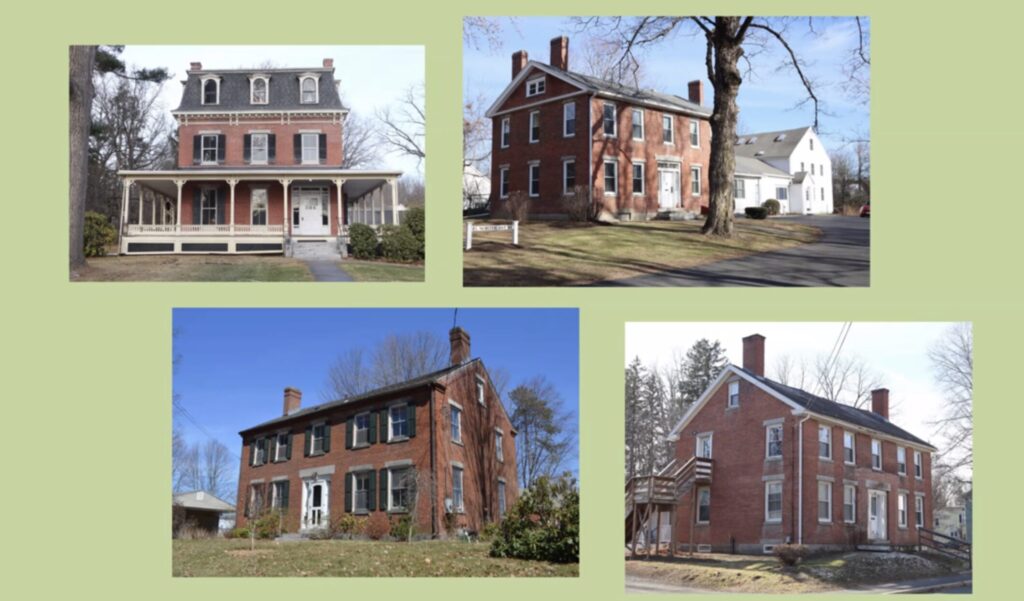
Clockwise from top left. Ithamar Conkey-Stevens House (1840), 664 Main Street, H. Kellogg House (ca. 1840), 45 North East Street, James Kellogg House (1836), 807 Main Street, Rev. Charles Woodworth Hourse (ca. 1850), 75 Northeast Street. Photos: amherstma.gov
Report of the Meeting of the Planning Board, April 22, 2026
This meeting was held over Zoom and was recorded.
Present: Doug Marshall (chair), Fred Hartwell, Jesse Mager, Angus McLeod, Johanna Neumann and Jerah Smith. Absent: Bruce Coldham. Staff: Nate Malloy (assistant planning director), Pam Field-Sadler (assistant).
Planning Board Does Not Recommend Creation of an East Amherst Local Historic District
At the request of the town manager, the Local Historic District Commission (LHDC) hired historian Chris Skelly to report on historically significant buildings in East Amherst, with the goal of establishing a third local historic district (LHD) in town, in addition to the Dickinson and Lincoln-Sunset-Fearing LHDs. Skelly produced a detailed report on 50 historically significant properties in East Amherst, which was the original town center of Amherst. If the LHD were created, the LHDC would need to approve any modifications visible from the street on any building in the district and could prevent demolition of properties. By contrast, the Amherst Historical Commission can only impose a one-year demolition delay for significant properties — as illustrated by the impending demolition of the 19th-century Blair House on Northampton Road.
Most Planning Board members felt that creating the East Amherst LHD would interfere with developers’ plans to build more housing, raise costs and create more red tape for property improvements. The board voted 5-1 against recommending the LHD to the Town Council, with only Fred Hartwell favoring creation of the district.
Board member Jesse Mager asked whether there is any evidence that the Lincoln-Sunset-Fearing LHD has affected development since it was established eight or 10 years ago. Planner Nate Malloy replied that he could recall perhaps two projects that did not advance, though neither had filed official applications. He added that staff research “couldn’t find any substantial literature on the dampening of development in LHDs. And property values were stabilized, not reduced.” He acknowledged that in some communities LHDs may deter development, but said that in Amherst “we’re not so strict.” He noted that accessory dwelling units are being built in the historic district and suggested it is zoning, more than the LHD, that limits what can be built.
Angus McLeod said that, as a historian, he found it enjoyable to learn about the historic properties in the area by reading Skelly’s report, but he remained skeptical about the historic district. Despite Skelly’s argument that a local historic district is intended not to limit development but to shape it, McLeod felt historic districts do create more hurdles for development. “It’s important for the Planning Board to be clear-eyed that the area that’s proposed here is an area that is potentially ripe for redevelopment,” he said.
Jerah Smith echoed that view: “The very nature of (the LHD’s) existence is a disincentive for anybody interested in redeveloping that property into something different — their primary purpose being preserving that property. There are a variety of properties in that district that I don’t feel are worthy of that level of protection. Mission-driven developers are not going to look in historic districts to build affordable housing, because it’s going to take longer, which costs them money.” He suggested that the Town Council reject the establishment of a local historic district and instead direct planning staff to develop a policy for site-specific preservation.
Board Chair Doug Marshall also worried that another LHD would dampen development, though he conceded that an LHD would preserve the character of the area better than a site-specific plan. He cited the Paul Revere House in Boston’s North End as an example of a preserved building whose surroundings have changed dramatically. “That’s, I think, what a district is intended to prevent,” he said.
Board members also noted that most houses in the designated area are student rentals and not well maintained. Johanna Neumann pointed to the modern design of the new Amethyst Brook Elementary School, saying, “It feels strange to me to lock the surrounding neighborhood into historic design standards. There are a couple of really amazing buildings, like that Shays Tavern building. I don’t know. In order to save that one building, do we have to enshrine the whole neighborhood into a historic district?”
Smith suggested exploring other ways to preserve historic buildings, such as a town-funded trust to acquire them at market value “rather than letting it go to the sharks of the private market.” He said he wanted to preserve these properties, but not as “some crazy, discontiguous neighborhood,” which he said the proposed East Amherst LHD would be.
Hartwell was the only board member to support creating the East Amherst LHD. “It will not be a major impediment to development,” he said. “The historical record over the last decade or so, I think, pretty conclusively demonstrates that, and we will end up preserving some buildings that otherwise may not be preserved.” He closed by quoting Joni Mitchell: “You don’t know what you’ve got till it’s gone.”
In public comment, Jennifer Taub, who lives in the Lincoln-Sunset LHD, said, “I can say with no reservations that in no way has this local historic district prevented development from happening. I think, in the precinct I live in, there’s probably been more new development than in any other residential district or area in town.” She pointed to accessory dwelling units under construction and the new Sunset-Fearing Apartments as examples.
Taub also noted that beyond the Shays Tavern, East Amherst contains other historic buildings, including the Jewish Community of Amherst, and that Way Finders has plans to create affordable housing while preserving the East Street School.
Kestrel Land Trust to Acquire Salamander Crossing Area on Henry Street
Betsy and Philip Matthews have applied to divide their large lot at the corner of Henry and Pine streets into two lots. They will keep the smaller house lot on the corner and donate the 2.3 acres along Henry Street to the Kestrel Land Trust. Mark Wamsley of Kestrel confirmed that this is the site of the well-known Henry Street salamander crossing, with tunnels maintained by the Hitchcock Center. Wamsley said that although there is no formal conservation restriction on the property, it may eventually be combined with adjacent town land, or Kestrel could hold it in perpetuity.
Staff Shortage in Planning Department May Affect New Zoning Changes
With Malloy leaving in a few weeks to become town administrator for Hadley, Marshall noted that there will be fewer staff to support drafting new zoning amendments and meeting the statutory deadlines to advance them. He said the Downtown Design Standards and Clean Energy Bylaw are close to completion, but that other initiatives — such as allowing housing in the Professional Research Park (PRP) — may have to wait until staffing improves before being referred to the Town Council.
Mager disagreed with that approach: “I do not want to add more to staff plates than they can handle. At the same time, I’m very disappointed if that’s the approach we need to take. Most of us are on the Planning Board because we see a real need to make changes, and it’s a huge mistake to tell the Planning Board to stop planning. Who else is going to do it?”
The board agreed that, until a replacement for Malloy is found, the housing and zoning subcommittee would not meet separately but would fold its discussions into regular Planning Board meetings, avoiding the need for a separate meeting posting and recording. Board members also agreed to take on more of the background research themselves.
Housing in the PRP
McLeod has been working to amend the zoning in the three Professional Research Park zones to allow certain types of housing. While an overlay district is one option, he said amending the use table in Article 3.3 to allow apartments and mixed-use buildings by site plan review would be more straightforward. Malloy noted that the total amount of developable land in the PRP is limited. The three PRP zones are associated with the Mitchell property in North Amherst, the Cooley Dickinson property at 170 University Drive, and a property on Belchertown Road. McLeod said he will continue working on amendments to the Zoning Bylaw for the PRP.
Upcoming Issues for the Planning Board
Malloy asked board members to review a draft updated Open Space and Recreation Plan, which prioritizes protection of drinking water and other water resources, safe walking routes to schools, well-maintained recreation facilities, existing playgrounds, hiking trails, improvements at Puffer’s Pond and vibrant village centers. The plan also includes an implementation matrix. Originally presented to the Planning Board two years ago, it has undergone substantial revisions since then. The state requires the Planning Board to review the plan and make a recommendation in order for the town to be eligible for certain grants.
A revised mixed-use building bylaw was referred to the Town Council on March 18, but upon review by planning staff, problems were found in applying the new standards for non-residential space to some smaller properties — in some cases actually increasing the amount of required non-residential space. Staff recommended that the Planning Board revise the draft before sending it to the Town Council, and the board voted unanimously to retract the referral.
Dodson and Flinker Landscape Architects are still presenting their three-volume report on downtown design standards to various town committees and are seeking comments from boards and the public. Malloy stressed that feedback is being sought on the general concepts underlying the four design zones downtown, and that details such as district boundaries can be revised later. He recommended that board members focus on the design character of each zone and the appropriate build-out for downtown. The town must also determine how the guidelines will be incorporated into the general bylaw and the Planning Board’s rules and regulations.
The Town Council is expected to refer the proposed Clean Energy Bylaw back to the Planning Board for a public hearing.
Thoughts on the Closing of Hampshire College
McLeod expressed “deep disappointment and sadness” about Hampshire College’s decision to close at the end of the year. “When we were informed that Archipelago had pulled its plan for the area around Atkins, I raised some concerns about how that could impact Hampshire,” he said. “It’s clear that Hampshire had long-term challenges, but I can’t help but feel that the town, and especially the different committees that were involved in that decision at some level, failed to take into consideration the full scope of what a negative outcome for that sale would mean for Hampshire in the short term.”
He added: “I just wanted to register my disappointment in all the stakeholders across our town in failing to do what we could to help that institution. It’s obviously an enormous loss to our town, to the intellectual vitality of the whole valley. But it’s also a huge loss to higher education. It’s a unique place whose loss is going to be felt very deeply.”
Marshall agreed that “it’s a challenging time to be offering that kind of a program,” but said the Planning Board will likely return to the issue of Hampshire College in the future. “It seems like there are a lot of moving pieces at the moment, and some of the chips need to fall before that,” he said.
I am disappointed in the Planning Board’s vote on the East Amherst Historical District. Of course we need more housing, especially for families, but we also need families to want to live in Amherst. Cost of housing is surely a major consideration, but also coming to a town that is both mindful and respectful of its architectural history and its landscapes, streetscapes and skyscapes is more attractive than a town focused on density and infill alone. Perhaps, rather than voting Historic Districts up or down, we could consider design standards for them, as we are doing for downtown.
1. Good call on EAHD. Wise board.
2. The Kestrel land being acquired on Henry Street is downhill , on the west (important vernal pool) side of the road.. It is rather the Salamander Crossed side of the road. The uphill silt fenced land leading to the tunnels remains private.