
What Is the Future of the Wildwood School Building?
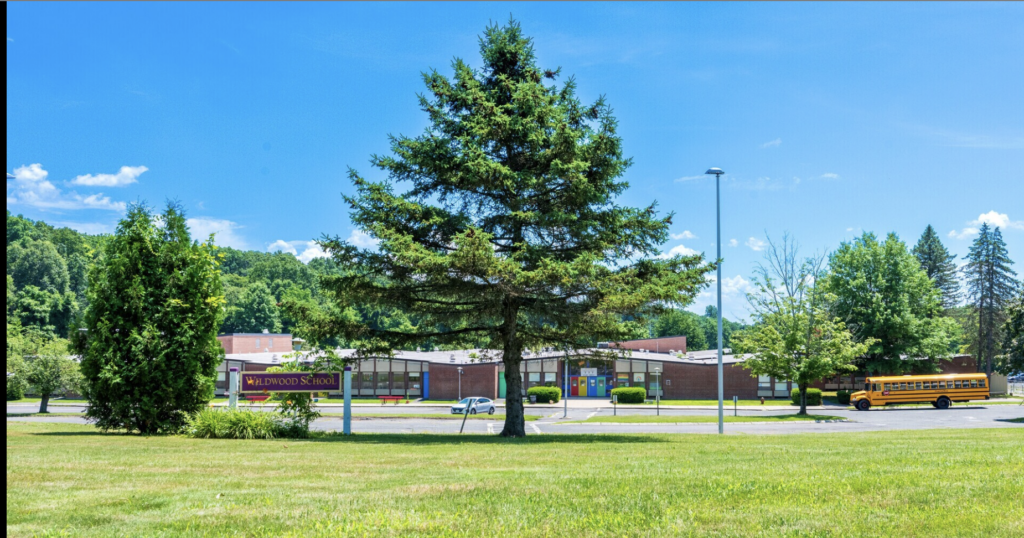
Wildwood Elementary School. Photo: amherstma.gov
Report on the Meeting of the Town Council and Special Meeting of the Finance Committee, Aug. 17, 2026
The meeting was held in a hybrid format in the Town Room of Town Hall and was recorded.
Present
Mandi Jo Hanneke (president, at large), Jill Brevik and Cathy Schoen (District 1), Lynn Griesemer (District 2), Hala Lord and George Ryan (District 3), Jennifer Taub and Pam Rooney (District 4), Sam MacLeod and Ana Devlin Gauthier (District 5). Absent: Andy Churchill and Ellisha Walker (at large), and Amber Cano-Martin (District 2).
Staff
Dave Ziomek (assistant town manager) and Athena O’Keeffe (clerk of council).
Changing Plans for Wildwood School
The regional schools asked the recreation department to leave its offices in the middle school in June because the space was needed for other uses. At that time, the Bangs Center was still being renovated, so the department moved to Wildwood School. However, recreation department employees were not happy with the facilities at Wildwood and are now being relocated to the second floor of the Bangs Center. Consequently, the Town Council and Finance Committee were presented with a reduced appropriation for school building maintenance. The building will be turned over to the town in September.
New estimates for maintenance at Wildwood are $143,000 for operating expenses and $50,000 for capital, reductions of $81,000 and $50,000, respectively. The original estimates were based on a full-time custodian and building upgrades needed if the recreation department had been based there. The new amounts cover a half-time custodian and reduced utility costs.
The Finance Committee held a special joint meeting with the Town Council prior to the council’s regular meeting to discuss the revised budget. Nonvoting Finance Committee members Kathleen Mitchell and Jeffrey Robert joined. Assistant Town Manager Dave Ziomek, Finance Director Sean Mangano, and Facilities Manager Jeremiah Laplante answered questions about the school’s future and its interim needs.
Staff members noted that although the recreation department offices will move to the Bangs Center, they will still need Wildwood to store equipment and will probably use the gym for sports programs. The Wildwood gym has been used for sports programs in the past, and eliminating that space would likely create a shortage. Also, because the building is no longer used as a school, it is available for daytime programs that cannot be accommodated at the other schools when they are in session.
Wildwood could also be used as temporary swing space for the Department of Public Works (DPW) until its new facility is completed. A decision on the site for the new DPW facility is expected by the end of the year. If the current site is chosen and needs to be vacated during some or all of the construction, workers could be relocated to Wildwood.
For these reasons, staff felt it was important to keep the building available. A Wildwood working group charged with discussing the school’s possible fate is expected to form this fall, under Director of Planning and Economic Development Jeff Bagg.
See Related:
Indy Rewind: Wildwood School Building Can Meet Town’s Pressing Needs For More Civic Space (Amherst Indy)
Opinion: Keep Wildwood as a Town Building (Amherst Indy)
Laplante emphasized that shutting down the heating, ventilation and air conditioning (HVAC) system for more than a year would make the school difficult to use in the future. Even short-term shutdowns could result in frozen pipes and poor air quality due to mold. He suggested that keeping systems online at reduced capacity would be more cost-efficient than shutting everything down, which would require draining the pipes and infusing them with nitrogen gas to prevent rust. He said permanently decommissioning the building would cost far more than $50,000.
Ziomek noted that the gym offers daytime availability for possible use by Senior Center programs, pickleball, and adult pickup basketball.
He also stressed the shortage of storage space in town. The former North Amherst school is available but is being considered as a possible site for a child-care program following the closure of the Hampshire College Early Childhood Center. That site, however, is not as close to other recreational program locations as Wildwood is.
Members of the Finance Committee then voted unanimously for the reduced appropriations. Committee member Lynn Griesemer added a requirement that the council receive monthly reports from the town manager on the use and plans for the former school. The full council passed the new appropriations as part of the consent agenda.
Questions Raised About Protection of Drinking Water and Wildlife in Clean Energy Bylaw
The council held a first reading of the draft Clean Energy Infrastructure bylaw as approved by the Planning Board, the Community Resources Committee (CRC), and the Governance, Organization and Legislation Committee (GOL). The council will vote on the bylaw Sept. 14. Councilors raised some concerns about the draft at this meeting.
CRC Chair Pam Rooney summarized the three components of the proposed bylaw. The first addresses the consolidated permit process, allowing a multifaceted application to be approved or denied within a year. The second is solar siting requirements, and the third is battery energy storage system (BESS) siting requirements. She stated, “The purpose of the bylaw is to facilitate clean energy development by providing a clear path for proceeding, but also providing enforceable standards for the placement, operation, and removal that maintain public safety.”
Sustainability Director Stephanie Ciccarello was unable to attend the meeting but will answer submitted questions if the councilors and staff involved in creating the bylaw are unable to.
Griesemer noted that many houses in the northeast part of Amherst have private wells that share the same underground water resources and thus face the same risk. She asked, “Why would we not treat private wells and clusters of private wells with the same distance requirements that we do public wells?” Rooney replied that solar panels themselves are not perceived as a source of pollution or contamination, but BESS are treated differently, with a much larger offset distance from water supplies.
Griesemer also asked why, after completion of a solar and battery storage installation, it is inspected only after a year and after major weather events, such as 1 inch or more of rain. She wanted to ensure that hazard insurance would be sufficient to compensate the town and landowners for possible hazardous waste that could leach into water supplies, especially from damage to BESS. She also pointed out that hail could damage solar panels, allowing hazardous components to enter the atmosphere and groundwater.
Although Hanneke could not answer Griesemer’s specific questions, she noted that state guidelines do not address water supply at all. Ziomek said he would forward Griesemer’s concerns to Ciccarello.
George Ryan asked whether the extensive regulations in the bylaw would hinder rather than promote the construction of solar and BESS installations, and whether the regulations might “run into problems with the state or the courts.” Hanneke said the state guidelines were similarly rigorous and that the town’s attorney felt the bylaw complied with them. “There could always be a lawsuit,” Hanneke said, “but the attorney thought that what we had drafted was solid.”
The Amherst bylaw includes a short section on agrovoltaics and extends the distance solar installations must keep from wells. The state guidelines are 20 pages long, and Amherst’s bylaw is 14 pages long.
Ana Devlin Gauthier expressed concerns about the impact of the arrays on wildlife, with fences disrupting migration patterns and glare confusing birds, which may mistake large solar arrays for a lake. She said developers can apply decals and coatings to solar panels to lessen the negative impact on birds and that she would like to see those measures required by the bylaw.
Ziomek said 8 to 10 inches of space under a fence is enough for most small animals to pass through while still keeping people, especially children, out. He said he will pass along these questions to Ciccarello as well.
Rezoning of Hampshire College to Be Topic of Aug. 31 Council Meeting
Hanneke announced that the Aug. 31 council meeting will be a working session on the rezoning of Hampshire College. Consultants from MassDevelopment will be present. She recommended that councilors review the July 21 presentation (see also here) to the public.
Meeting With UMass About Student Housing Set for Aug. 25
Hanneke announced that town staff and Town Council leadership will meet with UMass personnel Tuesday, Aug. 25, to discuss student housing and provide an update on the P3 agreement that UMass entered into with American Campus Communities in May. UMass staff requested the meeting. Hanneke, Ellisha Walker, and Cathy Schoen will represent the council at the meeting. Hanneke invited other councilors to submit questions before the meeting.
Saying that UMass houses more than 60% of its students on campus does not settle the housing issue for Amherst. Even at that level, thousands of students still need apartments and houses off campus—in a town with only about 39,000 residents, more than half of whom are renters or live in Amherst only part of the year.
Amherst is not Madison or College Park. It is a small town with a housing market already heavily shaped by rentals and student demand. UMass enrolls more than 31,000 students, so the real question is not where it ranks nationally. The question is how many students are left to find housing in Amherst, and what that means for rents, family homes, neighborhoods, and town services.
UMass should add on-campus housing to be good stewardly stakeholders, particularly for juniors, seniors, graduate students, and student families—the groups most likely to look for housing in town. Amherst should also negotiate a stronger, enforceable PILOT agreement. UMass’s tax-exempt status does not eliminate the costs its population creates for the town. Amherst should not have to absorb those costs, or lose its year-round housing, in order to accommodate university growth.
I am compelled to respectfully push back against Ira here.
He is right in one sense, Amherst is not like its peers as a college town – because it falls devastatingly short on housing when compared to peer municipalities (small towns with big universities).
Saying “X is not Y” in an attempt to stop the conversation of taking good ideas from elsewhere is a non-starter argument designed to terminate further thought and discussion. Example: Amherst is not Los Angeles. Los Angeles has roads, and we are not Los Angeles, therefore we should not have roads. Gotcha! You could use this argument on anything. Cambridge has bike lanes and we are not Cambridge, so we should not have bike lanes. Atlanta has a sewer system and we are not Atlanta, thus we should not have a sewer system.
Take West Lafayette (WL), IN for example. It is home to Purdue University. It has a similar population to Amherst (44,595 vs 39,263). It also has a similar median income. The difference? It has roughly 1.5 times the amount of housing units (16,309 vs. 10,400), and homes that are roughly 30% more affordable. The difference? Downtown WL has more progressive housing policy, a full-time director of housing whose role is to foster sustainable housing growth in order to keep the city affordable.
I sympathize with the sentiment of Amherst becoming more unaffordable, and the effects of what we see every day: homes in neighborhoods being bought up and stuffed with students for rentals. However, the solution is not to focus our efforts on asking UMass to house more students on campus. UMass is out of our control, and I say this as a lifelong resident. What is in our control is to build more housing in town so that everyone can afford a place to live. This would also bring the town more property tax revenue to fund our schools, our DPW, our fire department, etc.
Additionally, consider that Amherst is and has always been a college town (technically since 1821). In my mind, it is paradoxical to not recognize that UMass (and Amherst College) are the main economic drivers of our town and to adapt our housing supply accordingly.
Keep in mind that LLCs and investors love a restricted housing market – the less supply there is, the more control they can exert over Amherst’s housing market as a whole.
Housing scarcity is not progressive, and it is detrimental to Amherst in both the short and long-term. When housing is scarce, we all lose – our property taxes are higher per resident, our public services are worse funded,
My message is this: Amherst need not cut off its nose to spite its face. Its current approach to housing is doing just that. The remedy is to build more housing in town.
Here’s an image of what downtown W. Lafayette looks like:
https://greaterlafayetteind.com/2023/12/19/landmark-project-brings-downtown-feel-to-west-lafayette-levee
Further sources:
https://www.westlafayette.in.gov/government/housing
https://www.purdueexponent.org/city_state/general_news/chad-spitznagle-housing-director/article_4a9696ab-f056-42d6-b42a-fc39f5f3acf7.html
https://www.census.gov/quickfacts/fact/table/westlafayettecityindiana/PST045225
https://www.amherstma.gov/3687/Explore-Census-Data
My internet search showed that there are 46,000 students that attend Purdue’s West Lafayette campus with another 46,000 residents so it’s hard to understand how this town is comparable to Amherst. Wondering how students and year round residents are counted or separated out. Happy to be corrected on stats.
Okay a bit more: Lafeyette Indiana sits across the river from West Lafayette and Purdue and has a population of 70,000 and is part of a metro marea of over 236,000 people. So not a good comparison town for Amherst.
Also, the cost of living and the cost of housing in Indiana are much lower than the cost of living and housing in MA, so the comparison is hardly apt. Currently, median home values in IN are about 60% below median home values in MA.
https://www.rentcafe.com/cost-of-living-calculator/us/in/
I thought we built a whole new school because the floor plan of Wildwood and Fort River were unsuitable for teaching, in that there are few floor to ceiling walls to keep sound within a used space. So wouldn’t any use of the building still suffer from that flaw, unless of course money was spent to build the walls up to the ceiling? And doesn’t the roof leak, too? I think that the building should be torn down and the land sold to Beacon Properties (or whatever their name is) so that they can build a four or five story apartment building on the site. The height would be less noticeable there because of the high ridge that runs east of the land; town infrastructure is already present; there can be access from both Strong and Chestnut Streets; the site is within walking distance of the town center and public transportation; and the property sold would join the tax rolls. Building low income apartments at this location would be a better use of the plot that as a giant storage shed.
Or maybe more senior housing, like the Clark and Whalen Houses?
I want either a hospital or TALL apartment buildings. Give our downtown businesses foot traffic for once.
Let’s try to think of a good use for this property. Selling the property to private development could be a way to bring some money back to the town. Those funds could be used to pay some of the town’s debt, caused by recent overspending and reduce the load on taxpayers.
Removing the existing, dysfunctional building seems reasonable. So many people in town have issued various complaints for years and years. That problem would be solved.
Encourage a plan that uses the location to build something beautiful and helpful, that does NOT require taxpayer money or town government involvement.
Perhaps some very high end condos might be nice there? It has a very nice southern exposure and a great view. It is close to town and to the University. It is a pleasant neighborhood and could attract interested buyers who would contribute to the tax base of Amherst.
It’s also walking-distance to the rail station, should Amherst ever get it’s act together and restore passenger rail service here!
There’s your real economic and environmental “game-changer,” allowing folks — from students to seniors — to travel into and from the Amherst area without having to bring more and more cars…