
Planning Board Narrowly Recommends East Amherst Local Historic District
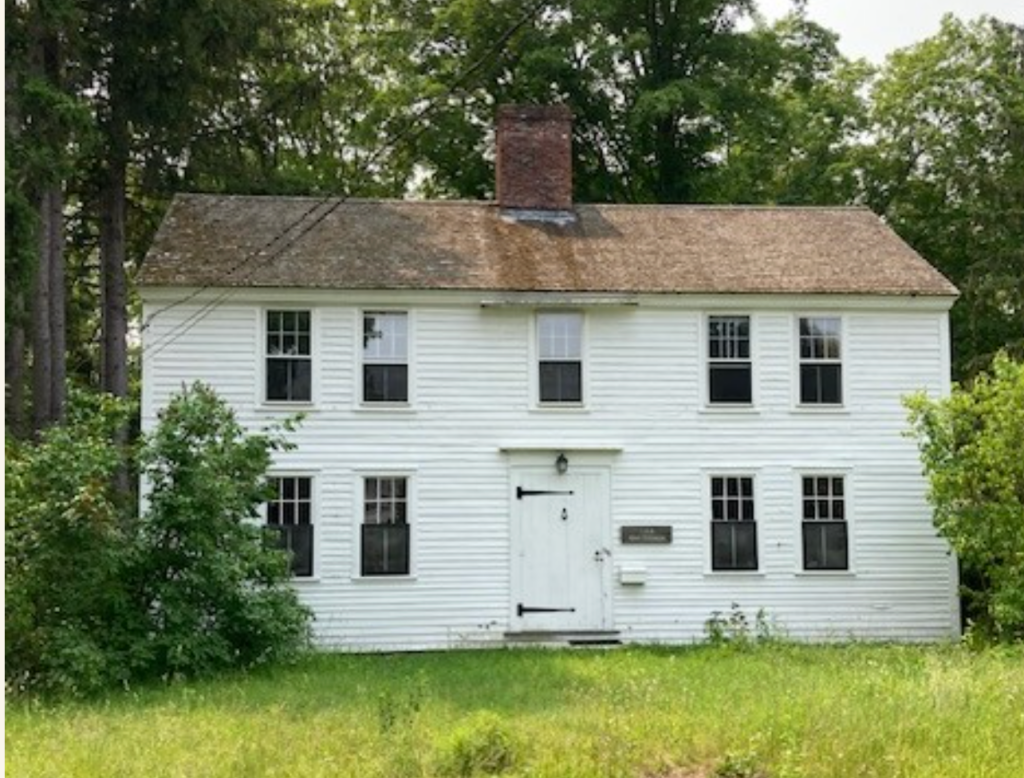
The Noah Dickinson House, 743 Main Street, Amherst, MA. (1754), is one of 22 properties proposed for inclusions in the East Amherst Local Historic District. Photo: East Amherst Local Historic District Preliminary Study Report, Amherst Historic District Commission.
Report on the Meeting of the Amherst Planning Board, August 19, 2026
This meeting was held over Zoom and was recorded.
Present
Members: Doug Marshall (Chair), Bruce Coldham, Fred Hartwell, Roy Johnson, Jesse Mager, Angus McLeod, and Jerah Smith. Staff: Walker Powell (Planner) and Pam Field Sadler (Assistant)
Spirited Debate Between Advocates and Opponents of East Amherst Local Historic District
The revised proposal for creation of an East Amherst Local Historic District (LHD), which reduced the size of the district from 51 to 22 of the most historically significant properties near the intersection of Main Street with South East Street and North East Street, received a 4-3 vote to recommend from the seven-member Planning Board. The proposal for a larger district lost 5-1 at the April 26 Planning Board meeting. The Town Council must approve the local historic district.
Both advocates and opponents of the district were passionate in their arguments. Planning Board member Angus McLeod continued his opposition to creating the new LHD. While he complimented the Local Historic District Commission (LHDC) for creating a record of significant properties to help people understand the East Amherst area better and for reducing the size of the proposed LHD, saying it “is more consistent with balancing a number of different priorities that the town has, including historic preservation,” he nonetheless did not think this is the right time to move forward with an LHD. He cited the changes being considered for the commercial area along Route 9 that is being considered for rezoning. He wanted to see what the board’s vision for the whole area would be.
McLeod also maintained that “any additional regulation, zoning or otherwise, naturally reduces new construction. It’s something that I am hesitant to run with without deep consideration. I think this is an area that is ripe for infill, and I’d like us to be thinking about how we can change the zoning to make that more possible.”
Bruce Coldham, who is a member of both the Planning Board and the LHDC, noted that McLeod had cited several studies to support his views, but Coldham felt “they were not entirely relevant to our situation, because they’re mostly centered on large metropolitan areas.” He stated that the LHDC’s purview “is absolute in the sense of whether it grants a certificate of applicability; it is narrow in the sense of how it can exercise that discretion,” being limited only to what is visible from the street.
He also worried that if the decision on the LHD was delayed, all the work that went into the proposal would be lost.
Planning Board Chair Doug Marshall argued that, based on his personal observation of a couple of projects that have had to interact with the LHDC, it may end up with a better aesthetic product, but it takes more time, and if consultants are involved, time is money. He questioned, “How much of the town do we want to have under a local historic district?”
Jesse Mager said he opposed the larger district but liked the idea of identifying specific properties to protect. He added that he lives in an LHD and has not seen the designation to be a big barrier to development or infill. Fred Hartwell agreed that the properties designated were certainly worth protecting.
The newest Planning Board member, Roy Johnson, said that he was recently in Boston and went by the Old State House, where the Boston Massacre happened. “It really hit home that preserving some of these buildings is so important. Can you imagine if they had torn that one down, and there were these skyscrapers all around it?” He added that he might feel differently if the owners of the buildings to be protected asserted that the LHD would negatively affect their property values.
Public Comments Strongly Support Proposed LHD
Local Historic District Commission (LHDC) member Steve Bloom sent a letter to the board pointing out that “some members of the Planning Board give the impression that they are opposed to Local Historic Districts of any size, shape, or form and view historic preservation of any kind to be elitist and obstructionist. Most of the discussion has been about questioning the very validity and utility of LHDs themselves, which is not within the Planning Board’s purview.” He maintained that the Planning Board just needs to determine if the designated properties are worthy of protection, if the proposed LHD balances the town’s dual goals of protecting historic legacy as delineated in the Master Plan as well as the need for growth, and if the LHD is in the best interests of the town as a whole.
At the meeting, Bloom asked board members opposed to the proposal, “What is your vision for this area? Is it a vision that there would be smaller buildings of infill behind these historic structures, or are you hoping to have massive apartment buildings made possible by the demolition of 200-year-old buildings?”
LHDC Chair Nancy Ratner reminded the board members that, even though the properties are in a national historic district, that designation only identifies them; it does not protect them. She stated, “Very few towns have the history we have. These houses are all pre-Civil War. They involve important figures in history.” She also said that many of the documents developed about 10 years ago on these properties had to be redone for the current study, so approving the historic district now was important to avoid wasting that work.
Hetty Startup, an architectural historian, argued that the 22 buildings “contain some of the most interesting architectural styles and history and materials that we have in our town. You will not see those kinds of buildings ever again in terms of how much that kind of craftsmanship would cost today. It is part of the texture of this town.”
Kitty Axelson-Berry cited the need for “diversity of architecture. I would hate to be surrounded by the canyons and the monotony that are created by certain types of development, in particular when it’s development for one age group only.” She referred to the Master Plan’s goal of honoring the “historical, cultural character, and beauty of our neighborhoods.” She also maintained that there was ample opportunity for development and densification along Route 9.
Hilda Greenbaum asserted that her house, built in 1737, will last longer than any of the new buildings in town. She said she resented that two members of the Planning Board, McLeod and Jerah Smith, who are fairly new to town and knew little about the history of the Main Street area. She asserted that people like living in old houses with character. She stated her family purchased old run-down houses and fixed them up, and they became quite valuable.
The only public opposition to the LHD came in a letter from Cinda Jones, who recently purchased a duplex included in the proposal. She objected to the noncontiguous nature of the proposed district, calling it “spot zoning” and incorrectly asserting that the Daniel Kellogg house was not included. Greenbaum pointed out that Cinda Jones’ mother, Ruth Owens Jones, was active in early efforts to protect old houses in Amherst and authored several books on the history of houses and barns in town.
In the end, Coldham, Mager, Hartwell, and Johnson voted to support the plans to create the LHD. Marshall, McLeod, and Smith voted against it.
Planning Board Moves Forward with Allowing Housing in the Professional Research Park Zone
The proposal to rezone the three Professional Research Park (PRP) zones in town to allow housing received a favorable reception from Building Commissioner Rob Morra when Planner Walker Powell raised the possibility with him. Johnson spoke to five of the six property owners of the parcels, and all were enthusiastic about rezoning to allow for over-55 housing, mixed-use buildings, or affordable housing.
The next step would be for the Planning Board to prepare a memo to the Town Council detailing the history of the PRP zones and the fact that their envisioned development has not materialized. The memo should summarize the background discussion and include a draft of the proposed bylaw changes.
Johnson agreed to begin work on the memo with McLeod. He will consult with former Planning Director Christine Brestrum and current Planning and Economic Development Director Jeff Bagg. Powell offered to help with formulating the legal language for the proposed bylaw. Eventually, the draft bylaw will go before the Community Resources Committee of the Council and the Planning Board before needing to be approved by the Town Council.
Planning Board Updated on Plans for Hampshire College Rezoning
The first hour of the Planning Board meeting was dedicated to a presentation from Bagg, along with Nate Kelly from the Horsley Witten Group and Peter Flinker from Dodson & Flinker, on the town’s plans to rezone the Hampshire College campus. The ideas are detailed in a memo to the Planning Board. A similar presentation was given to the public on July 21 and will be presented at the Town Council’s working session on August 31.
The plan involves gathering public input through charrettes and focus groups during the fall, doing a fiscal analysis of the site, and developing a plan to rezone the area to allow for uses other than educational ones by the end of the year. The town has identified housing of a variety of types, small business development to generate more tax revenue, and protection of sensitive habitats as top priorities. About 200 of the campus’s 600 acres are suitable for housing development.
The consultants are looking at similar redevelopment projects elsewhere, such as Village Hill in Northampton on the grounds of the former state hospital, the Raytheon property in Sudbury, and the site of the former Bard College in Great Barrington. All have different zoning and permitting processes. The plan is to find what fits best with Amherst’s needs and priorities.
Bagg stressed that until the property is sold, Hampshire College will decide its use, but the town wants to be ready with proposals when that time comes. He said that the town is in communication with Hampshire, and that educational uses can be allowed even if the zoning is changed.
Marshall suggested that the village center envisioned for Atkins Corner could be located at Hampshire College. He also thought that more dense condominium development, such as Amity Place, would be more desirable than small homes on individual plots. McLeod advocated for more commercial development, such as a grocery store. Mager thought that applying streamlined zoning such as 40R for affordable housing or 40Y for smaller lots and houses could be suitable for the property.
How about before adding more apartments to North Amherst, the town and Wayfinders build the planned apartments on town land in East Amherst that were promised years ago. That project was announced and the town purchased the land for it before the now-completed Valley CDC project for first time home buyers in North Amherst was even on the drawing board. AND what’s happened to the town’s plans to build a multi service shelter and apartment complex on the old VFW property on Main Street? It’s now an ugly equipment parking lot (the parking lot, not the equipment, is ugly). The North Amherst PRP zone that underlays this whole “let’s build houses there” discussion was designated as such by Town Meeting and, Hilda can correct me if I’m wrong, seems to have been some kind of retirement fund for the farmers who own that land and haven’t been able to sell it because it really is a small hill surrounded by a big wetland. It is not needed for housing before the two aforementioned projects are completed, in my opinion so let’s concentrate on getting those done first.
Local historian Ruth Owen Jones was a member of the Historic Commission that founded the East Amherst National Historic District fifty years ago.
North Amherst is the one and only place where every development goes while the rest of the town is empty. And North Amherst doesn’t even have enough housing either.