
Town Explores Zoning Options for Hampshire College Campus
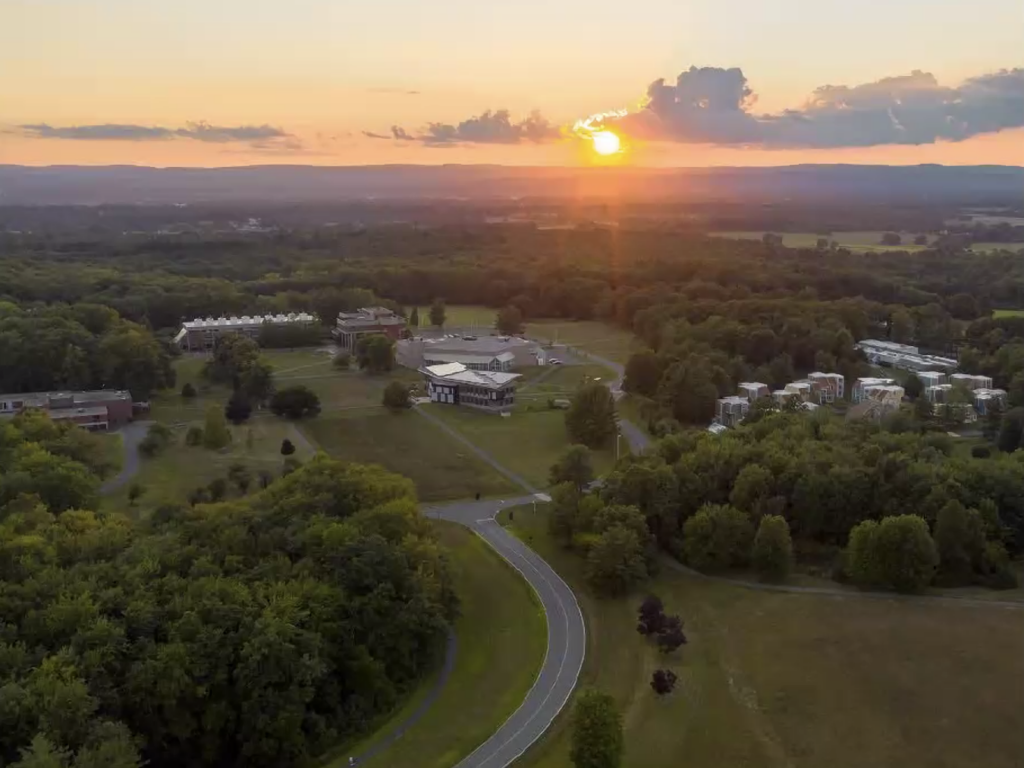
Hampshire College. Photo: amherstma.gov
Consultants See Possibility for as Many as 2,400 New Housing Units
The town of Amherst held its first public information session on its study of rezoning options for the Hampshire College campus on July 21. The meeting was held over Zoom, and more than 150 people attended online. The session was recorded. (Look here for the slide presentation.)
The study was initiated by the town amid the Hampshire College Board of Trustees’ efforts to sell the 800-acre campus, following the announcement in April that the college would close permanently at the end of the calendar year.
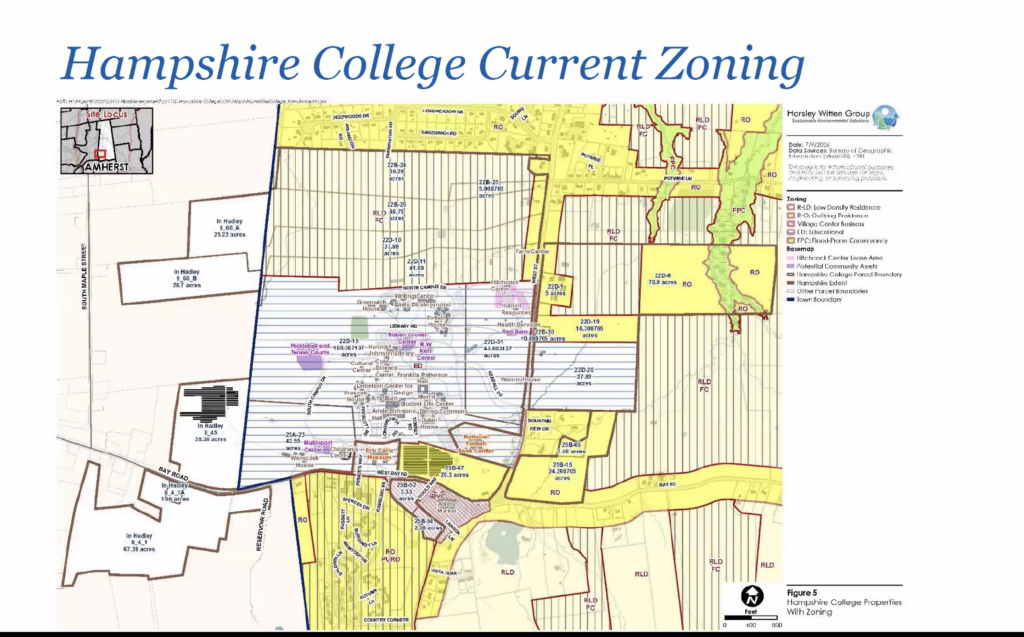
The study aims to provide an understanding of which parts of the campus are developable, the capacity of existing infrastructure (water, sewer, roadways), housing market demand, economic development opportunities, and possibilities for future reuse of existing buildings. The campus is currently zoned almost entirely as ED (education) and any use other than education will require rezoning. Town Manager Paul Bockelman emphasized that while the town’s preference would be to see housing developed where possible, the study is not an attempt to determine for the Hampshire College trustees how the land should be used, nor is it an attempt to limit the options available for such use.
The town has obtained a grant from MassDevelopment to help with the study, which is being conducted in collaboration with MassDevelopment, the Horsley Witten Group (advisers on sustainable environmental solutions), U3 Advisors (advisers on real estate development), and Dodson & Flinker Landscape Architects (advisers on landscape architecture and planning).
Bockelman noted that the study is being undertaken in coordination with the town of Hadley, where 220 acres of the campus are located, and he identified the campus’ three independent property owners/leaseholders — the Yiddish Book Center, the Hitchcock Center for the Environment, and the Eric Carle Museum of Picture Book Art — as partners in the project. He also emphasized that the intent of the study is to help the town and the college understand what development options are available, and that final decisions on any changes in zoning will be made by the Amherst Planning Board and, ultimately, the Town Council.
The session involved consultants summarizing the following:
- Town needs and priorities
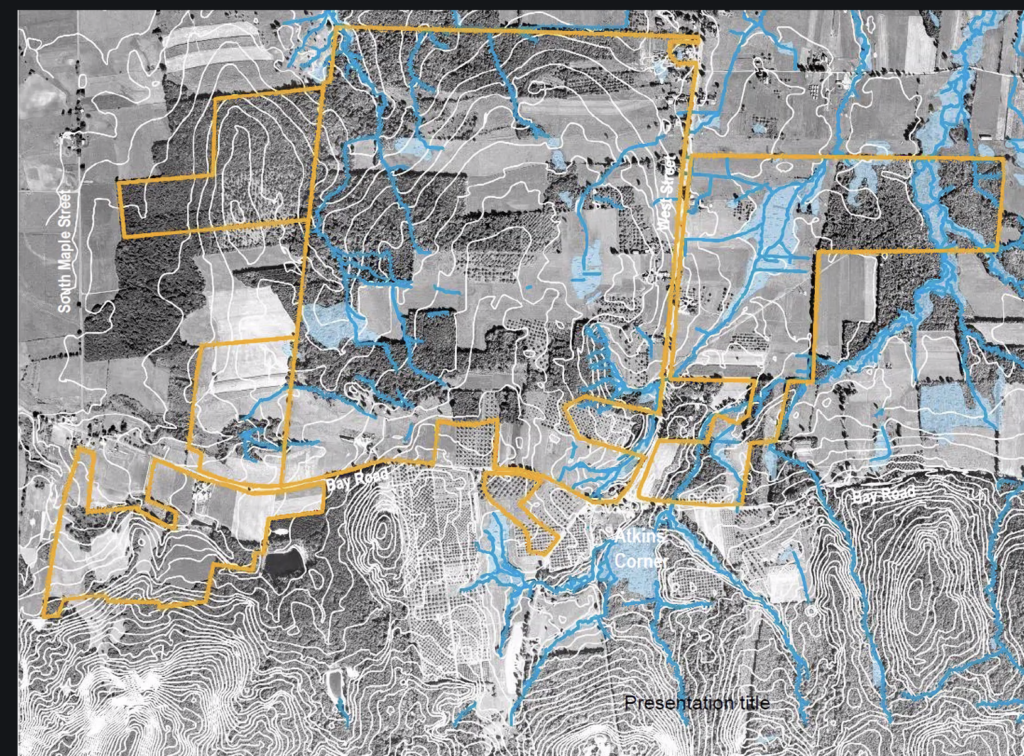
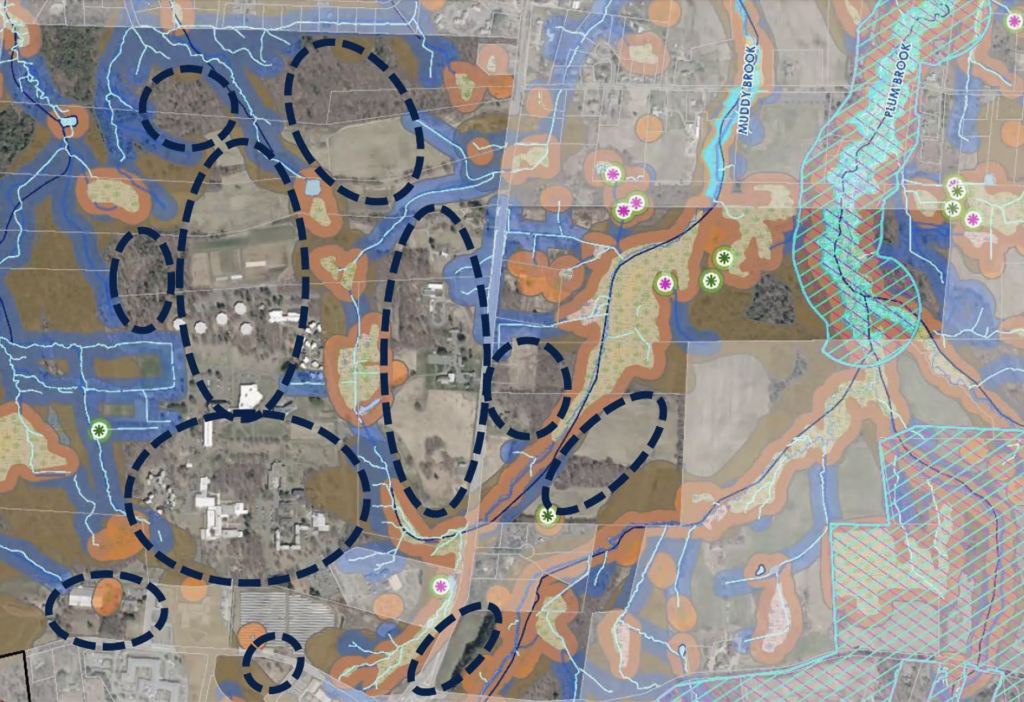
- Site review, including a discussion of topography, drainage, wetlands, utilities, and infrastructure, and the way these factors limit potential development and redevelopment
- Opportunities for development of housing
- Demand for housing
- Constraints on development
This was followed by a lengthy question-and-answer session, with consultants and town staff responding to questions that had been submitted in advance by the public.
Town Priorities
The consultants cited priorities established by a Town Council vote on June 1, 2026:
- Buildable land should be prioritized for housing, small-business development, and other appropriate tax-revenue-generating uses.
- Balance should be sought between preserving sensitive habitat, farming, or resource areas, and potential redevelopment areas.
- Housing development should prioritize a wide range of housing types, as reflected in the town’s 2021 Comprehensive Housing Policy and the 2025 Housing Production Plan.
- The town’s need for space dedicated to services or facilities should be considered.
Site Review
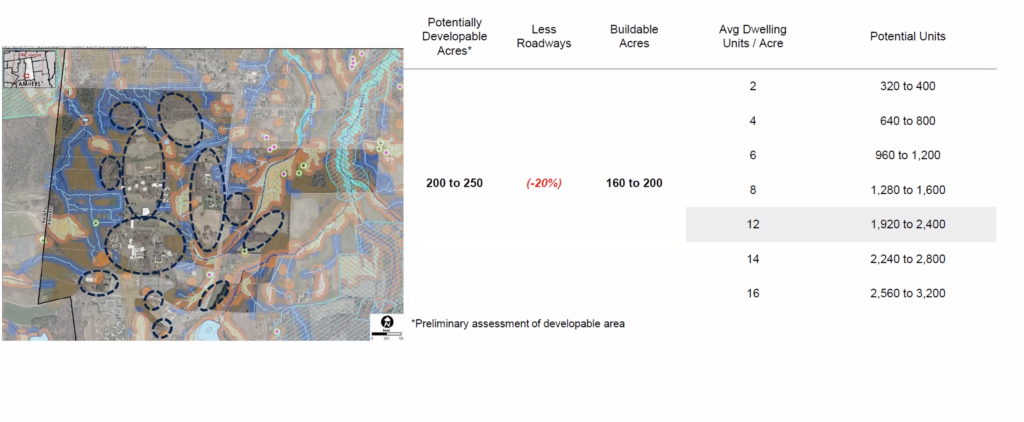
The site contains substantial areas of wetlands and/or wetland buffer zones where development is unlikely. Preliminary studies suggest that the prime areas for possible housing development are within the existing core campus (see the maps below). Preliminary estimates are that about 200 acres would be suitable for housing development.
Housing and Development Constraints
Consultants reported that there is considerable demand for housing in Amherst, driven by multiple overlapping markets and not just students. A major question that the study aims to answer is how much development can be accommodated?
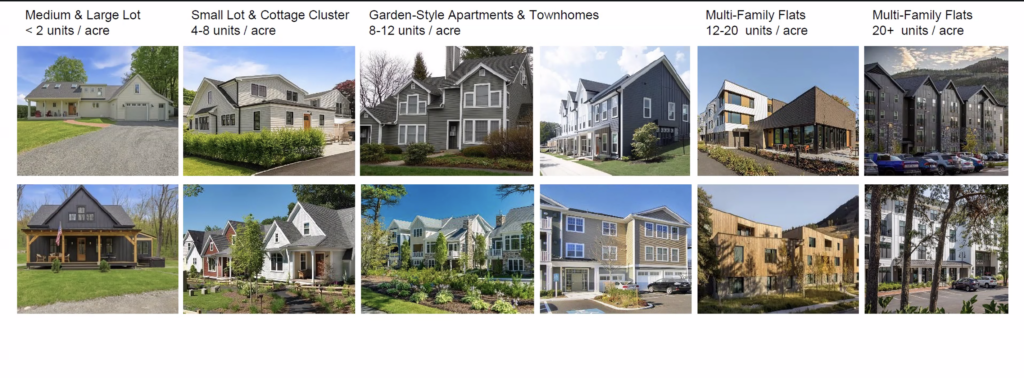
Bockelman emphasized that the town would like to see a mix of different housing types. The table below suggests that with the inclusion of some low-rise apartment buildings, the campus could accommodate more than 2,000 new housing units. Such development would greatly assist the town in advancing its 2025 Housing Production Plan.
The consultants noted that there is plenty of capacity for development on the campus, suggesting that adding another 1,800 to 2,000 units is possible without major stress on water, sewer, utilities, roads, and schools. For example, in the case of water and sewer, there are no immediate concerns about physical capacity, but the town is near its permitted limit, and any development proposal will likely require updated permitting as well as updated water and sewer infrastructure. Hence, any development proposal will require infrastructure improvements, and these should be further identified and factored into any development plan.
Financing was listed as another constraint to be considered. Construction costs in Amherst are comparable to those in greater Boston, but the local market cannot support equivalent rents. The consultants suggested that creative financing structures may be needed to support the development of new housing, particularly at attainable price points for renters and buyers.
What’s Next?
The goal is to produce a set of recommendations for future reuse and redevelopment of the Hampshire College campus and to draft new zoning for the campus by January 2027.
Analysis of housing markets, infrastructure capacity and needs, and the potential for reuse of existing buildings still needs to be completed.
Community engagement will continue throughout the coming months. This will include ongoing collection of, and response to, feedback on the project website, and an in-person meeting early in the fall. Consultants gave assurances that all submitted questions will be answered in writing in a timely manner. The public is encouraged to stay up to date on the project by:
- Signing up for email communications
- Submitting further questions or comments
- Viewing updated FAQs
- Reviewing past plans and documents
- Learning about future opportunities for community engagement
- Reviewing draft materials as they become available
- Visiting the project webpage at www.HampshireCampusZoningStudy.com
Questions and Answers
More than half of the nearly two-hour meeting was devoted to answering questions submitted in advance. Questioners were not identified when the questions were read.
Q: What is the role of the Amherst Conservation Commission in determining the future use of the campus? Dave Ziomek (town conservation director): The Conservation Commission has a regulatory role, through state wetlands laws and regulations and our local laws and regulations, for any resource areas that come under its jurisdiction. The commission has historically supported the protection of prime farmland, and there may be a role for the commission and other town boards to protect Hampshire’s farmland resources as well.
Q: Would the town be willing to consider commercial development? Jeff Bagg (director of planning and economic development): This could be allowed, and what we’re trying to look at now is the demand for such development. We want to make the zoning as flexible as possible and include possibilities for the reuse of existing buildings. We’re trying to broaden the uses possible.
Q: If the college sells to another educational institution, will the town continue the rezoning project? Bagg: Yes, the town is committed to completing the study. It gives more flexibility — for example, operating the Red Barn as a commercial venue, or a campus selling off one of its buildings. Under current zoning, the Red Barn would have to be operated wholly by the educational institution.
Q: Is the town confident that there is enough housing potential here to relieve the housing pressure in town? Bockelman: Yes. The presentation and the Housing Production Plan showed that the demand is there.
Q: Is there any interest in the town developing parts of the campus for recreational uses? Bockelman: Yes. The college has been very generous in sharing its facilities — courts, pool, trails. The town is interested in maintaining access to those recreational assets; the town has a need for more recreational assets, so there is certainly an interest.
Q: What about open space, working farms, forests? Ziomek: We’ll take our cues from the Town Council, and they have said that housing is a priority.
Q: What is the town’s position on data centers? Bockelman: The town has not taken a position on data centers. We’ve seen the opposition in other communities, and we’re aware of their potential drain on water and energy resources.
Bagg: We’re pretty sure we’re not going to put them on the menu. Right now, it doesn’t look like a preferred use in terms of the town’s priorities.
Q: What is the extent of campus lands? Is there anything east of West Street? Bockelman: Yes, there are several parcels east of Route 116, with the largest being 76 acres. See the map
.Ziomek: Several years ago, Hampshire College partnered with a developer on a senior housing, learning, and retirement community, Veridian Village. It went through the regulatory process, but the timing was bad — the economy hit a downturn and the project never moved forward.
Q: What’s the outlook for population growth for Hampshire County? Jon Trementozzi (U3 Advisors): Hampshire County is expected to see a slight decline in population at the county level in the coming years.
Peter Flinker (Dodson & Flinker): We know that household size is shrinking across the state, and what we really need is smaller housing units for smaller households.
Q: How many people were living on the Hampshire College campus? Bockelman estimated, with caveats, that perhaps 2,000 students and faculty were living there when he was a student, in the college’s early days.
Q: Does the town own and operate a wastewater treatment plant? Bockelman: Yes. It’s located in the town of Hadley.
Q: What method will you use to ensure that you’ll be hearing from more than just the usual crowd? Bockelman: We’ll be doing targeted outreach and will be working on that, and we welcome suggestions.
Q: Can you explain how colleges contribute to local taxes, or not? Bockelman: The bulk of the money coming into town is from property taxes. Our revenue increases about 3% to 3.5% a year, and our budgetary needs increase about 5% a year. College campuses are not taxed. The PILOT commission is ongoing; our representatives are looking at PILOTs (payments in lieu of taxes) as a possible source of more revenue for the town. We do have strategic partnership agreements with the colleges — targeted donations, based on negotiated agreements for each budget year.
Q: What steps can the town take to ensure more affordability for all kinds of buyers? Bagg: We’re going to be looking at that. We have the potential to create pockets of zoning that would create a mix. The town does have an inclusionary zoning bylaw; we might be able to do something with that. We could incentivize affordable housing. There are some tools we can look at to ensure that we get a mix of housing.
Bockelman: Higher density often produces more affordability, and that’s something the town is going to have to struggle with.
Q: Should the town be doing this study before the sale or after the sale? Why not wait? Bagg: We need time to assess the property, talk to the community, and consider possibilities, and we think this can happen in parallel with what the college is doing.
Bagg noted that once the land is sold, things can happen very fast, and it is better for the town to study its options than to find itself rushed into decisions without time for due diligence.
Q: How are you coordinating with the town of Hadley? Nate Kelly (planner, Horsley & Witten): Hadley is working closely with us. Amherst can only zone for Amherst, but we are keeping communications open, and we are making sure that Hadley is in the loop.
Q: How will public transit serve an increased population on campus? Bockelman: The PVTA already serves the campus, and Peter Pan used to as well. PVTA is open to additional routes, though it’s a bit complicated because the routes in Amherst are largely subsidized by the Five Colleges.
Poll
The event opened and closed with a poll asking attendees whether they favored or opposed the rezoning of the campus, or were unsure. The results suggested that there was already support for efforts to rezone the campus, and that support increased following the public presentation.
Support Before the forum: 55% After the forum: 64%
Oppose Before the forum: 8% After the forum: 6%
Unsure Before the forum: 37% After the forum: 30%
One of the issues I didn’t hear addressed at this meeting was how the south Amherst fire station is being factored into planning. The need for a fire station in the southern part of town has been known for decades, yet it is not being talked about by the Town Manager or Town Council. Aside from the financial issues about how to get it built, it needs to be part of any discussion of new uses for the Hampshire College campus. Adding a large number of additional residents and/or commercial development to south Amherst will increase the need for a station nearby. There should also be public discussion about whether siting the fire station on one of the parcels that they are planning to re-zone is feasible. There are many things to consider about the use(s) of this land, and they should be addressed thoroughly and publicly, and the south Amherst fire station should not be allowed to just fall off the radar.
Also not mentioned: How many school children and of what ages might live in 2000-2400 new residences. New schools in the greater Boston area cost more than $500,000,000 last year. And high schools cost more than elementary schools.
Family housing does not pay its way for the required services, particularly schools. Once schools are built they have to be staffed and maintained. Amherst has a poor record in that regard. Hadley has figured out that senior housing brings in the tax bucks while requiring few services. We could open up neighborhoods in town for more families if we old folks had a smaller place to live.
Will local taxpayers insist that any new development be tax neutral? That sufficient space be reserved for compatible commercial structures to offset the cost of housing?