
Regional Agreement Up for Review at Four Towns Meeting Sept. 26
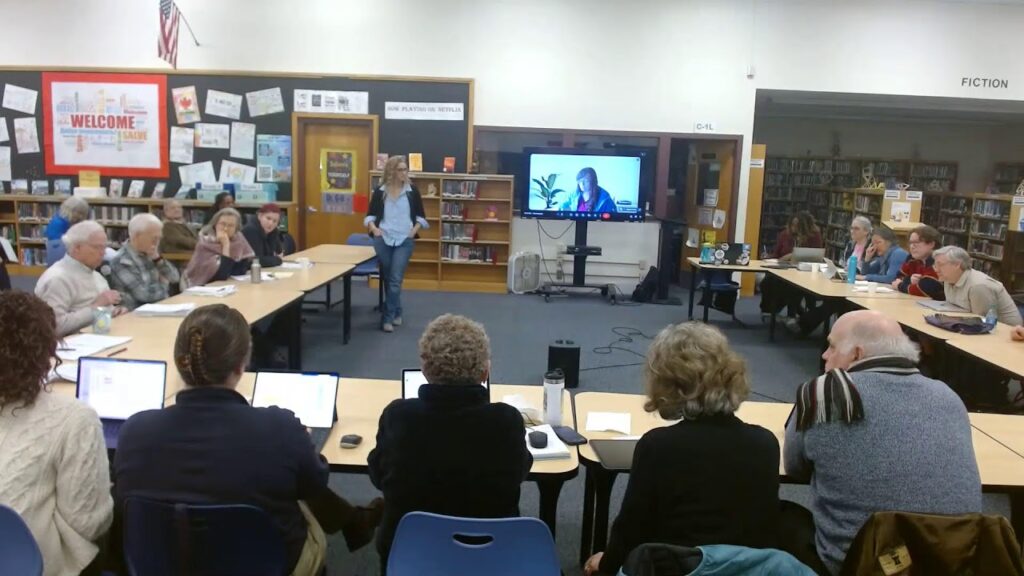
Four Towns Meeting, March 14, 2026, Amherst Regional High School. Photo: YouTube /ARPSTube Channel
Note: This meeting will be held in the Amherst Regional High School library and is open to the public.
The first Four Towns Meeting of the school year will begin at 9 a.m. Saturday, Sept. 26, in the Amherst Regional High School library. Previous Four Towns Meetings have focused on the regional budget, but this one will start the process of updating the 2008 regional agreement that governs the Amherst-Pelham Regional School District, which serves Amherst, Leverett, Pelham, and Shutesbury.
Representatives from the state Department of Elementary and Secondary Education (DESE) and the Massachusetts Association of Regional Schools (MARS) will attend. Michelle Griffin and John Sullivan of DESE will give an overview of regional agreements and the changes the Amherst-Pelham agreement needs. Jay Barry of MARS will then outline the process for updating it.
The four towns will then select representatives to serve on a committee that will review and update the 18-year-old agreement.
History of the Issue
In March 2025, during development of the fiscal 2026 regional school budget, the Amherst Town Council rejected a proposed budget with a 6.5% assessment increase for each of the four towns. Superintendent E. Xiomara Herman, then in her first year, realized that the district’s nonstandard method of calculating each town’s assessment put it at risk of sanctions from DESE that would result in having to start fiscal 2026 without a budget. To help the Regional School Committee understand state rules on regional agreements, Herman invited Griffin and Sullivan, of DESE’s budgeting division, to a March 2025 meeting to explain how the agreement needed to be amended to comply with state regulations.
In fiscal 2025, the state education commissioner gave the district a one-year approval to amend the assessment method in the agreement. According to Sullivan, the district had not followed the assessment method in its regional agreement for the previous seven years, and DESE would not approve further exceptions. The district had calculated each town’s assessment using a five-year rolling average of enrollment, then added “guardrails” to keep the smaller towns from facing large increases when their enrollment changed.
The guardrails shifted more of the district’s costs to Amherst. When DESE required the district to use the statutory method for the fiscal 2026 budget, Leverett and Pelham faced double-digit increases. The district used the same method for fiscal 2027.
At the March 2025 meeting, Griffin gave a brief overview of how a regional school budget is typically developed. The district first identifies all revenue sources other than grants, such as state aid and the minimum local contribution required of each town. The remaining cost of providing the education the district wants for its students is then apportioned among the towns according to the regional agreement.
A district may use an alternative assessment method only if the method is specified in the regional agreement and approved by the education commissioner by Dec. 31 of the preceding fiscal year. The Regional School Committee can decide each year whether to use the statutory method or an approved alternative. All four towns must approve a budget that uses an alternative method, while only three must approve one that uses the statutory method. Because the region has no approved alternative method, it must use the statutory method unless all four towns agree to an alternative.
Read More
Regional School Budget Basics (The Amherst Current)
School Budgeting Basics and FAQ (Amherst Regional Public Schools)