
Letter: Protect Amherst’s Significant Architectural Resources
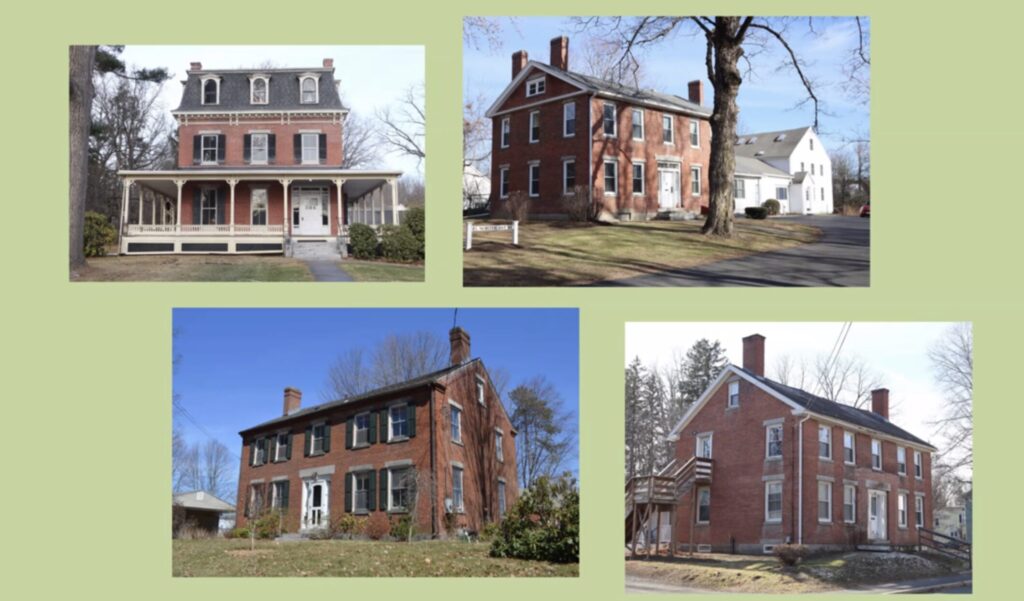
Clockwise from top left. Ithamar Conkey-Stevens House (1840), 664 Main Street, H. Kellogg House (ca. 1840), 45 North East Street, James Kellogg House (1836), 807 Main Street, Rev. Charles Woodworth Hourse (ca. 1850), 75 Northeast Street. Photos: amherstma.gov
The following letter was sent to the Amherst Town Council on Sept. 23, 2026.
I hope the Town Council will support the carefully formulated proposal for an East Amherst Local Historic District and vote to protect the town’s significant historic and architectural resources. A local historic district would not prevent accessory dwelling units or any compatible new construction. In fact, when I was on the Amherst Historical Commission, I was excited to see plans from our Planning Board for two different housing projects on both Route 9 and adjoining the old East Amherst school.
As you probably already know, the Local Historic District Commission (LHDC) narrowed the proposed LHD from 55 properties to 23, including the South East Street Common, which the town already owns. After deliberation, the properties were deemed among the most historic, most architecturally significant, and, together, most representative of the entire National Register District for East Amherst, the oldest part of our town. In addition, non-conforming properties and open spaces within the reduced boundaries were excluded as much as possible, particularly the empty lot on the northeastern corner of North East Street and Main Street, for future, unencumbered development. It would be wonderful to see a signature building here, especially for affordable housing, which our town so badly needs.
As Ira Bryck avers, “The proposed district is not an attempt to place an overly broad area under review [or freeze an area for all time.] It is a fair & practical compromise, focused on the smallest coherent… properties that… preserve the historic character of this important crossroads.”
Please also consider that what remains here from the 1700s is that the district is also a crossroads in history, coinciding with America’s Revolution and the Shays Rebellion years. This doesn’t privilege this era over others in the past; it simply recognizes that it still materially exists today. Let’s help save it for future generations.
Except for one property, the East Street School (a favorite building of mine in town, which I wrote about in the Amherst Indy), which was erected in 1894, the properties date from the early to mid-1800s before the Civil War, while four date back to the 1700s. They include homes and civic or religious structures that show the development of Amherst – and Amherst’s architectural history – from the colonial period through the 19th century.
And if you want to see how successful a local historic district can be, please drive up or down McClelland St. to see the two new homes on the south side that work so well within the Lincoln-Sunset Local Historic District.
Hetty Startup
Hetty Startup is an architectural historian who lives in Amherst. She previously served on the Amherst Historical Commission. She is a frequent contributor to the Amherst Indy.