
Letter: East Amherst Local Historic District is a Wise Move
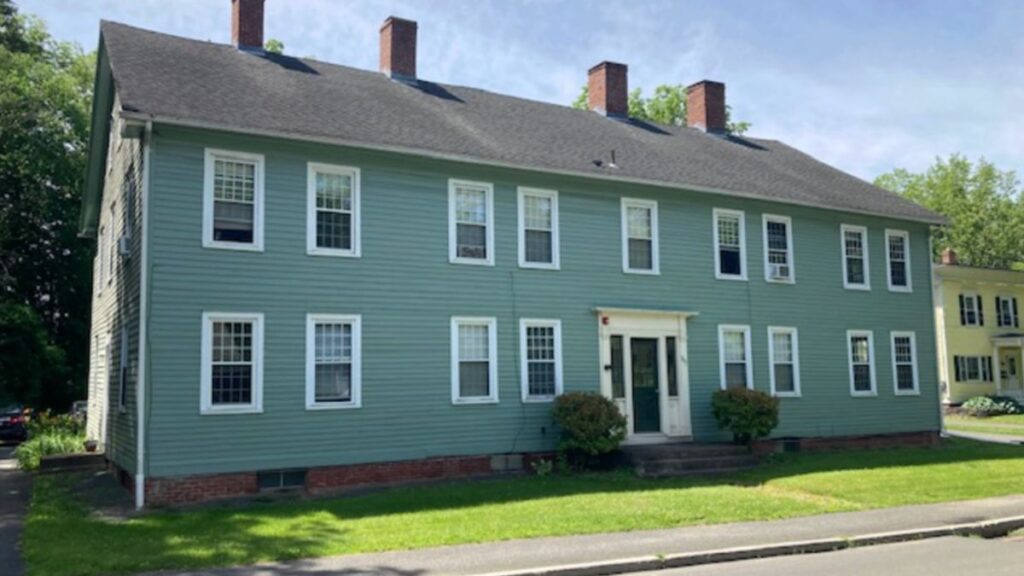
The Smith House East, 797 Main Street. A residential dwelling built in 1815 to house workers in Amherst's manufacuring sector. It is still residential housing today. Photo: amherstma.gov
The following letter was sent to the Amherst Town Council on Sept. 19, 2026.
I am writing in support of approval of the proposed East Amherst Local Historic District.
The proposal now before you is a measured and carefully reduced one. After review and deliberation, the original 55-property proposal was narrowed to a compact core of 23 properties, including the town-owned South East Street Common. The district centers on the historic convergence of Main Street, North East Street, and South East Street—the original downtown area of Amherst. Wherever possible, properties that do not fit the historic character of the district, as well as open spaces, were excluded. In particular, the vacant lot at the northeast corner of North East Street and Main Street was left outside the district so it can remain available for future development without historic-district restrictions.
That refinement matters. The proposed district is not an attempt to place an overly broad area under review. It is a fair and practical compromise, focused on the smallest coherent group of properties that can preserve the historic character of this important crossroads.
The buildings selected are among the town’s oldest, most architecturally significant, and most representative historic resources. Except for the East Street School, built in 1894, the included properties date from the early or middle 19th century or earlier. Four date to the 18th century. They include homes and civic or religious structures that together show Amherst’s development from the colonial period through the 19th century.
These are not isolated old houses scattered across town. They form a close and visible historic setting: the original center of East Amherst, clustered within a short distance of one another. Their value lies both in the individual buildings and in the way they collectively create a recognizable historic place.
That place is also under real pressure. The area is increasingly crowded with student rentals and faces the ordinary pressures of conversion, alteration, demolition, and redevelopment that come with a growing college town. Student housing and preservation need not be in conflict, but the concentration of historic buildings in this small area deserves an appropriate level of protection. Decisions made one property at a time can gradually change an entire streetscape. Once a historically significant house is demolished or altered beyond recognition, that loss cannot be undone.
A Local Historic District is not a ban on change, housing, or appropriate development. It does not replace zoning, and it does not prevent accessory dwelling units or compatible new construction. Its purpose is to ensure that changes to historically important buildings and streetscapes receive thoughtful local review. It provides a reasonable process for considering renovation, additions, replacement construction, and, where proposed, demolition.
The district’s limited boundaries are especially important in this regard. Amherst can continue to pursue housing opportunities and growth across town while protecting this very small concentration of irreplaceable historic resources. Preserving the historic core is not inconsistent with development; it ensures that development does not unnecessarily erase the qualities that make Amherst distinct.
Amherst’s history is central to its identity. The town’s historic buildings, streets, cultural associations, and sense of continuity contribute to its appeal for residents, students, visitors, and future homeowners. This crossroads is a gateway to the oldest part of Amherst and an important approach to the new elementary school. Its historic character should be treated as a community asset.
Approval of the East Amherst Local Historic District would not freeze the area in time. It would help guide inevitable change with care, preserve neighborhood stability, and protect a small but exceptionally meaningful group of historic properties. This is, in practical terms, the bare minimum necessary to safeguard the surviving historic fabric of Amherst’s original downtown.
I respectfully urge the council to approve the proposed East Amherst Local Historic District. Doing so would preserve an irreplaceable part of Amherst while allowing the town to continue to evolve responsibly. It would also help Amherst retain the historic gravitas it has earned and deserves.
Ira Bryck
Ira Bryck has lived in Amherst since 1993, ran the Family Business Center for 25 years, hosted the “Western Mass. Business Show” on WHMP for seven years, now coaches business leaders, and is a big fan of Amherst’s downtown.