Budget Coordinating Group Kicks Off FY28 Budget Season

Photoi: Blue Diamond Gallery
The Town of Amherst officially launched its Fiscal Year 2028 budget development process on Wednesday, September 30, when the Budget Coordinating Group (BCG) convened its first meeting of the season. The session offered a preliminary look at the financial pressures, systemic uncertainties, and modest cost-saving opportunities facing municipal departments, public schools, and the library system over the coming fiscal year.
What is the Budget Coordinating Group?
Established under Section 5.2 of the Amherst Town Charter, the BCG is mandated to meet prior to the start of each annual budget cycle. Its charter-defined purpose is to review the town’s overall financial condition—including revenue projections, expenditure forecasts, and economic indicators prepared by the Town Manager—in order to build coordinated budget guidelines, establish a unified calendar, and foster joint communication across major town entities before formal departmental budgets are finalized.
While the committee has historically functioned primarily as an information-sharing forum rather than a policymaking body, town officials outlined plans to give the BCG a more active, structured role early in this year’s process. Under a revised fall timeline, the group will meet multiple times in November to provide direct feedback to the Finance Committee before initial budget guidelines are drafted and submitted to the Town Council for a vote.
BCG Membership
By charter, the BCG brings together key elected leaders, executive officials, and key financial staff across all municipal sectors:
- Town Government: Town Manager Paul Bockelman, Town Council President Lynn Griesemer (who also serves as Vice Chair of the Finance Committee), Councilors Mandy Jo Hanecke and Amber Cano-Martin, and Finance Director Sean Mangano.
- Public Schools: Amherst School Committee representative Sarah Marshall, Regional School Committee member Anna Heard, and School District Finance Director Shannon Bernacia.
- Jones Library: Library Trustee Vice Treasurer Nat Larson and Library Director Sharon Sharry.
At the start of the September 30 meeting, the committee selected Finance Director Sean Mangano to serve as Chair and School Finance Director Shannon Bernacia as Vice Chair for the FY28 season.
Headwinds and Budgetary Challenges
The meeting offered a sobering peek at rising cost drivers that threaten to strain town finances:
- Health Insurance Inflation: Health insurance premiums continue to be a primary cost driver. Town officials reported that double-digit medical trend inflation—currently hovering around 11% nationwide due to hospital, pharmaceutical, and behavioral health service costs—could trigger another steep double-digit percentage increase in local health care premiums for FY28.
- Sluggish New Growth: Revenue from new property tax growth, which historically provided a dependable source of annual budget expansion, has slowed. After falling significantly short of budget targets in FY26, preliminary indicators for FY27 and FY28 suggest new growth will remain at depressed levels.
- Tight Departmental Margins: Final reports for the recently closed FY26 budget revealed exceptionally low “turnback” (unspent funds) across municipal departments and school operations, signaling that staff and operating budgets are stretched thin.
- Energy, Fuel, and Paving Expenses: Electricity rates are projected to jump 10% to 20% upon contract renewal, driven largely by broader regional grid demand. High diesel and heating fuel prices also continue to impact school transportation, municipal fleets, and facility maintenance. Hanneke pointed out that higher oil prices also raise paving costs. She said Amherst was already struggling to find the approximately $5 million a year needed to maintain roads at an average condition of “fair,” and that rising costs could make that amount insufficient.
- Borrowing Costs: Persistent interest rates above 4% mean a larger share of the town’s capital allocation must be dedicated to debt service, reducing available funding for future municipal infrastructure projects like a new Department of Public Works (DPW) facility.
- Salary Increases: Mangano noted upcoming firefighter labor negotiations affecting FY2028.
- School & Regional Pressures: Bernacchia’s school concerns included increased charter-school enrollment, more ninth graders attending Smith Vocational and Franklin County Technical schools, upcoming contracts for drivers, maintenance, custodial, and food-service workers, and uncertainty surrounding federal education grants. Transportation contract rates will also increase as the district enters the contract’s third year. Griesemer warned that financial pressures extend across the regional school district’s member towns. At least one might need an override to support an existing budget, she said, while others face growing taxpayer resistance to additional taxes.
Other unresolved school costs included responsibility for track maintenance and the fuller cost of the Chestnut Street Academy lease. Heard flagged a possible superintendent search, including search expenses and an unknown future superintendent salary.
Jones Library Faces Day of Reckoning
The financial condition of the Jones Library took center stage during the discussion of long-term vulnerabilities. The library expansion project, which has drawn intense community scrutiny due to spiraling costs and capital commitments, presents a looming challenge for the town’s operating budget in FY28.
Library Director Sharon Sharry reported that while FY26 closed smoothly and FY27 remains manageable, “things start to get icky in FY28.”
Sharry used the library’s preferred measuring stick in describing the library’s obligation to the town, alluding to a fundraising gap of $5.5 million. However, Mangano reported to the Finance Committee last month that the amount owed by the library to the town stands at $8.4 million.
Sharry said the Massachusetts Board of Library Commissioners (MBLC) is expected to disburse another $1 million in grant money to the town by the end of the current fiscal year, followed by a final $1.7 million sometime in FY2028. At that point, she said, the trustees would owe the town the remainder of their share of the project cost.
The library’s endowment currently holds $9.6 million. Sharry said reducing the endowment by half would also cut its annual draw in half—from approximately $400,000 to $200,000. That income supports ordinary operating needs, including supplies.
“That’s a problem,” she said.
Larson said the renovated library is expected to open in FY2028 which begins on July 1, 2027. He noted that operating costs will remain something of a “black box” until the library occupies the building and gains experience running it.
A Few Bright Spots
Despite the tough fiscal landscape, officials pointed to a few localized areas of financial relief:
- Fixed Property and Casualty Insurance: The town is transitioning to a new property and casualty insurance carrier that has locked in fixed premium rates for FY28, shielding municipal departments and elementary schools from recent global market spikes. The carrier also offers risk-management incentive programs that could further reduce costs.
- Stable Pension Assessment: The Hampshire County Retirement System has adopted a funding plan designed to keep overall municipal pension assessments relatively flat in the coming year, barring sharp shifts in relative municipal payroll ratios.
- Facility Offloads & Energy Transitions: The opening of the new elementary school at the Amethyst Brook site will allow the school district to decommission two older, inefficient buildings (Fort River and Wildwood), eliminating significant maintenance and heating liabilities from the operating budget. Similarly, the renovated Jones Library will transition away from fossil fuel heating to electric systems.
- Long-Term Redevelopment Potential: Town Manager Bockelman highlighted potential future revenue opportunities tied to the eventual redevelopment of surplus town properties, including the Wildwood and East Street school sites, as well as ongoing discussions regarding PILOT (Payment in Lieu of Taxes) reform for state-owned higher education land.
Tentative Fall Budget Calendar
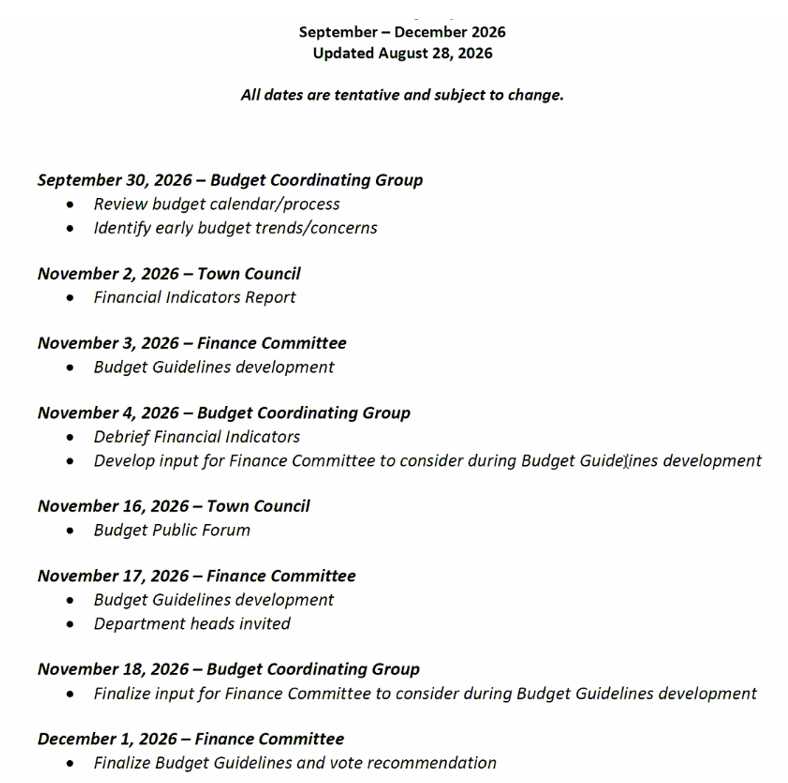
Mangano presented a proposed fall calendar designed to bring operating needs into the discussion before the Finance Committee drafts final budget guidelines. The Finance Committee would still recommend those guidelines, and the Town Council would still adopt them. The BCG’s expanded role would be to supply earlier feedback.
Next up on the docket will be the important Financial Indicators Report presentation to the Town Council on November 2. It will provide a clearer picture of Amherst’s financial health and the expected tax revenue for the coming year.