
Attendees at Listening Session Agree: Build Mixed Housing on the Hampshire College Campus
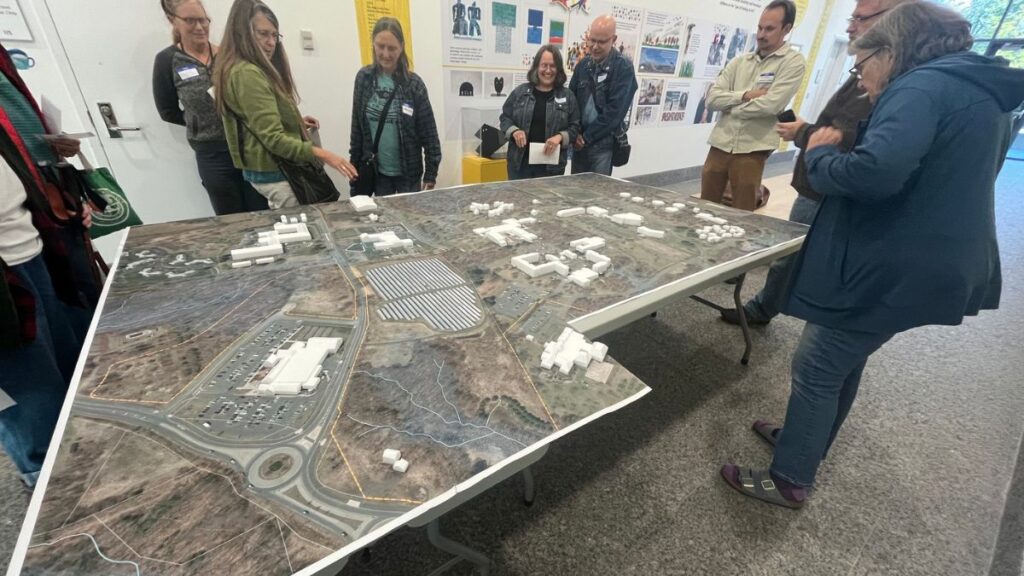
Hampshire College rezoning listening session, Sept. 22, 2026. Photo: Maura Keene
Report on the Listening Session at the Eric Carle Museum, September 22, 2026
Close to 100 people gathered at the Eric Carle Museum on September 22 to hear a presentation from Peter Flinker of Dodson and Flinker Landscape Architecture and Design and to participate in small-group discussions about rezoning the Hampshire College campus to permit uses other than educational at the site. Residents and the town agreed on what they wanted and what the town needed, but Flinker made it clear that the Hampshire College Trustees decide who will own the land. However, by rezoning the parcels, Amherst can determine what uses are possible at the site. The Hampshire College Zoning Study aims to make a wider range of development possible. Educational activities would still be allowed, even after rezoning.
Amherst was awarded a MassDevelopment grant to study rezoning, and there have been several occasions for public input. Consultants are hoping to develop recommendations by the end of 2026, when the college will close for good.
As it stands now, the core of the campus is zoned Educational. The outer areas are either low-density residential (R-LD) or outlying residential (R-O). Much of the rest is floodplain conservation in the watershed areas of the Muddy Brook and Plum Brook, which drain north into the Fort River. Amherst’s Zoning Bylaw prohibits apartments and mixed-use buildings in R-LD and R-O zones and requires a minimum of 2,000 square feet per dwelling unit, with 40% of the land left as open space. Hotels and motels are also not allowed in these zones. Flinker said the preliminary campus study indicated that the existing infrastructure would support denser development. However, this study will not evaluate the condition of the existing buildings. He said that he hopes the town will receive an additional grant for that purpose.
The suggestions from the listening groups mirrored the priorities the Town Council expressed at its August 31 workshop. These included prioritizing housing construction, generating new revenue for the town, conserving the campus’ wetlands and farmlands, and using the campus’ existing infrastructure effectively, especially the multi-sports facility, tennis courts, and daycare center. As for housing, most councilors wanted a diversity of housing types, with an emphasis on affordable and workforce housing. The councilors spoke of an opportunity to create a vibrant and diverse community with village center amenities.
Many working groups emphasized the desire for multi-generational housing, especially for moderate-income residents. As at Hampshire College now, they envisioned services and businesses on the central campus with housing in the surrounding area. There was resistance to building apartment buildings more than four or five stories tall, but Flinker pointed out that densifying housing would leave more land undeveloped.
Several groups spoke of preserving the spirit on which Hampshire College was founded, with its innovative, progressive approach to education. Murals, sculptures, and artifacts should be preserved, along with several original buildings designed by Hugh Stubbins (who also designed the Southwest Quadrangle at UMass), such as the Cole Science Center and the Johnson Library. The groups also wanted eco-friendly buildings and design guidelines for the site.
A high priority was keeping the site open to the public and ensuring all residents could use the walking paths and enjoy the views of the Holyoke Range from behind the Red Barn. Many also wanted residents to use facilities such as the swimming pool, athletic fields, and indoor tennis courts, and to reopen the childcare center. In addition to protecting the wetlands, many wanted to keep an organic farm on the site.
Other suggestions were a business or educational incubator, an adult education center, a vocational high school, an events center that would bring people to the area, and assisted living. Many felt the development should bring revenue to Amherst and integrate into the Pioneer Valley as a whole, since it sits at the crossroads of several towns.
There was universal agreement that the site should not have a data center, big-box store, large-lot individual homes, or a gated community.
With the likelihood of adding more residents to South Amherst, Maria Kopicki stressed the importance of finally building the South Amherst Fire Station, which has been discussed for more than 50 years. She said EMS and fire vehicles already take too long to reach the area. Flinker said that his group has not considered putting a fire station on the Hampshire College site, but it might be useful to consider where it might go.
Of the nearly 800 acres on campus, only an estimated 230 acres are suitable for development; the rest is largely wetlands and sensitive habitat. The college trustees have received an offer from Kestrel Land Trust and the Trustees of the Reservation to purchase the land that cannot be developed to keep it in conservation. Flinker did not know the details of that offer.
A second public session focused on design is scheduled for 5:30 p.m. on Thursday, September 24, also at the Eric Carle Museum.
It would be too bad to not provide as much housing as possible for young families and otherwise. A letter was drafted dated 8/6/25 from the Planning Department to the Amherst Town Council with subject: Housing Production Plan Adoption. It explicitly makes a connection around the severe decline of “middle middle housing” (duplexes, triplexes, and starter homes) with an acute buildable land shortage “artificial scarcity”, and restrictive zoning laws.
What is this obsession with making apartment buildings no more than 5 stories? You do know that means we have to cut down MORE forest, right?
It means we don’t have high enough ladder trucks to put out fires For one very good reason. Nor water pressure for what equipment we do have.
Why do Amherst taxpayers have to provide housing for our neighboring towns whose taxpayers don’t want the school and infrastructure expenses?
When will we decide Amherst will be built out? That we can’t afford any more growth ?
Or am I just an old curmudgeon? Too much of our permanent population has already left town.