At +2.75%, Finance Committee Asks if Equal Is Still Fair
Amherst’s Finance Committee spent nearly two hours on Nov. 3 digesting the town’s preliminary FY28 budget forecast, and a fight is already taking shape: should next year’s budget guidelines keep giving every department’s operating budget the same percentage increase? With the forecast built on a 2.75% across-the-board increase and a gap of about $170,000, several members said they are no longer sure equal is fair. The virtual meeting was recorded and is available on YouTube.
Town Council members Cathy Schoen (chair), Lynn Griesemer, Sam MacLeod and Anna Devlin-Gauthier and non-voting resident members Cathleen Mitchell and Jeffrey Robert took part. Councilor Jill Brevik and resident member Joe Jayne were absent. Finance Director Sean Mangano presented the numbers, and Town Manager Paul Bockelman joined the discussion. No members of the public spoke.
A Tight Forecast
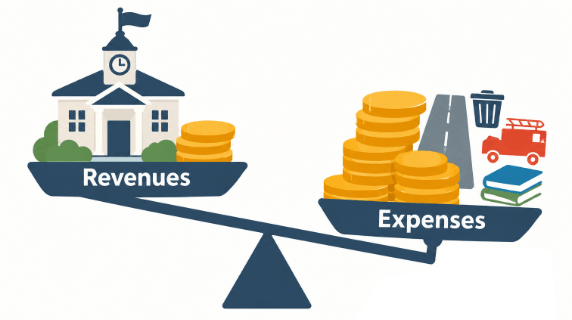
Mangano said the preliminary forecast assumes a 2.75% increase for operating budgets. Three added firefighter positions are broken out separately because the ambulance fund pays for them. The remaining gap between expected revenue and expenses is about $170,000, is “very manageable” at this point in the year, he said.
Griesemer was not reassured. “In my eight years on the council, this is the lowest percentage increase we’ve seen,” she said. “To me, this signals so little wiggle room that it’s terrifying, to be honest.” She added that she believes “we haven’t seen the bottom of the pit” for federal cuts and their effect on the state budget. Mangano replied that FY22 came in around 2%, and promised to provide a ten-year history of operating increases.
Costs Outrunning the Cap
Mangano has no official health insurance number yet, but the plan administrator says medical trend inflation is tracking near 11%, a national figure not based on Amherst’s own claims. Cost-of-living adjustments in the town’s dozen-plus union contracts mostly run 2% to 3%, plus steps that vary by contract. “If nothing changes with staffing, we’re going to blow right past 2.75,” Schoen said.
Mangano said the town has negotiated many step increases down from 5% to 3% while lengthening the pay ladders, and that collective bargaining remains a central strategy.
Interest Income, Free Cash and Reserves
Investment income was $3 million in FY26, the Finance Director said, against an average near $200,000 from 2009 to 2022. The forecast raises the budgeted amount from $500,000 to $700,000, an increase he described as intentionally modest: “We don’t want a $2 million surprise” if rates fall. Certified free cash is $12.4 million, of which about $3.7 million came from FY26 operations and roughly $2.5 million of that from investment income. The town plans to bring free cash back to its 5% target, with roads and capital stabilization as priorities.
Mangano was reluctant to tap general stabilization funds, which he said exist for sudden revenue losses like the 2008–09 housing crisis. “There hasn’t been a cut in state aid,” he said. New growth is pegged at $650,000 and relies on one large project.
Ambulance Fund, Library and Capital
Mitchell and Robert probed the ambulance fund. Mangano explained that the plan uses all expected revenue, requires fee increases, and counts on about $700,000 in voluntary UMass payments; the fund’s balance could cover one year without them. Robert warned the planned addition of three firefighters would be “relatively sticky” if revenue falls short. Mangano agreed that any revenue shock would force the town to revisit operating expenses.
MacLeod brought up a clause in the Town-Jones Library Memorandum of Agreement stating that the Town will cover principal and interest “during construction.” He asked when the library project’s “during construction” period ends, since the town is carrying interest on a $13.8 million short-term loan. Mangano answered that the town understands it carries costs until the final state library grant payment or one year after occupancy. Town Manager Bockelman pointed out that the library’s payment deadline could be relaxed if approved by the Town Council. Robert asked what might happen if the library’s depleted endowment might not be sufficient to meet operating expenses. Schoen called the library’s budget squeeze acute and “not just a little problem.” The discussion was left for a future agenda item.
Mangano showed that the five-year capital plan, built on 10.5% of the tax levy, already has a deficit: the roughly $5.7 million “new projects” line likely needs to shrink by $1.2 to $1.3 million, and DPW debt arrives in FY29. Mitchell asked for a look-back at actual capital spending, which Mangano said he could add. Bockelman cautioned the committee not to duplicate Joint Capital Planning Committee work.
The Core Disagreement: Equal Percentages
The chair framed three guideline decisions: whether 2.75% applies equally, whether capital stays at 10.5%, and whether to add $50,000 to retiree health benefits (OPEB) after flat funding. Members split mainly on the first.
Devlin-Gauthier said she is “not convinced of equal percentage increases.” “We are close enough to that bone that we should start having the conversation,” she said, worrying the committee is “prioritizing fear of lowered morale above our budgetary interests.” She also asked whether the Budget Coordinating Group had offered any guidance on equal versus unequal increases. No one had heard anything yet. Devlin-Gauthier noted that Bockelman, not the committee, divides the municipal increase among departments.
Robert argued that “a one-size-fits-all truly fits none.” Schools’ COLAs are about 3% and the town’s 2%, he said, so 2.75% underfunds schools “by a quarter percent” before insurance. “It’s this difference between fairness and equity,” he said.
Mitchell said equal percentages “just on principle” prevent talk about “essentials, obligations, legally mandated services.” She noted the forecast is already unequal because of the firefighters, and that schools lack a funding mechanism for needs like a new English-learner teacher at Crocker Farm.
Griesemer admitted to being the contrarian. She worried that bargaining results would drive allocations, saying the wiggle room “is next to zero,” and she cannot imagine avoiding unfilled positions or layoffs. Departments, she said, already balance budgets with vacancy savings, and Amherst loses police, firefighters and DPW workers to better-paying employers because “Amherst doesn’t pay as well.” “I’m not sold on dividing the pie differently,” she said.
MacLeod favored equal increases as a morale and teamwork matter, explaining “collaboration is, I’d say, a strong suit of our town.” At the same time he separated that from “true cuts,” asking whether the town has reached the bone. Schoen reminded members that “if it’s not equal, something has to be less.”
Schoen also asked whether any programs deserve a harder look. She pointed to CRESS, whose payroll and benefits now total “a little less than a million dollars” and which has not had a full evaluation. A discussion of the budget needs of police, DPW and the fire department will be on the Finance Committee’s Nov. 17 meeting agenda.
Bockelman appeared to view unequal budget increases as shaping up to potentially favor the schools at the expense of municipal departments. There are “significant ramifications,” he warned, “that will have ripple effects relationwise.” He acknowledged that “telling people no” is part of his job and that unbalanced increases deserve serious consideration, but he is worried about “unintended consequences in terms of behavior.”
At no point in the meeting was the option to reduce the library operating budget increase raised.
The committee aims to finalize guidelines, including a decision on whether to recommend equal increases across the library, elementary school, regional school and municipal operating budgets, by December 1.