Fortunately Magazine: Exploring the Intersection of Art, Culture, and Economic Democracy
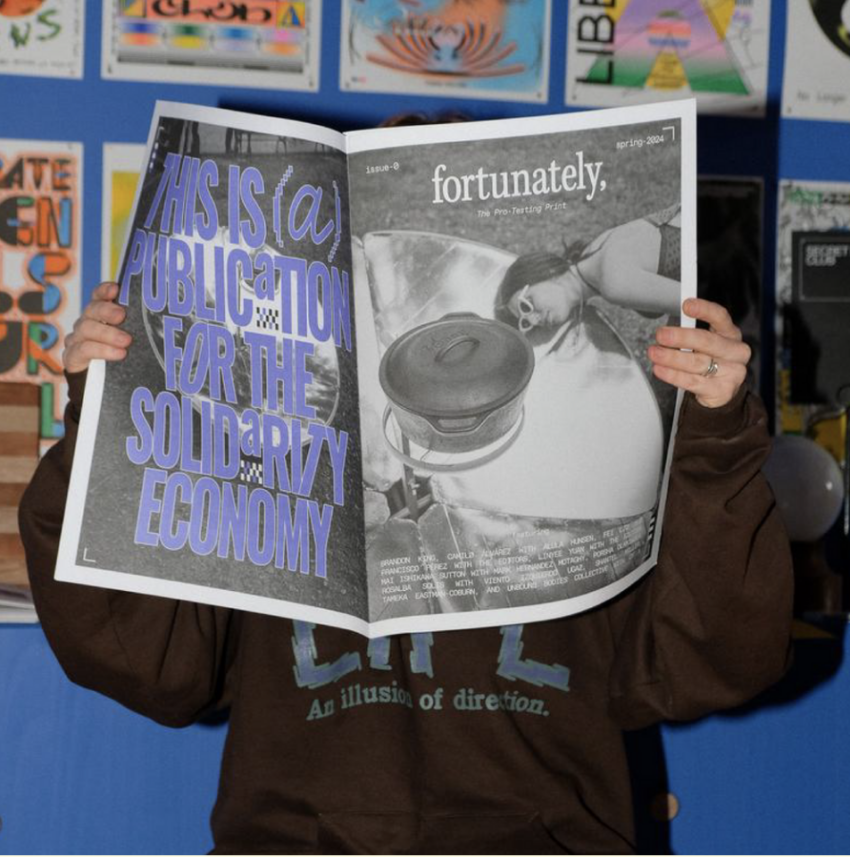
Photo: Fortunately Magazine
by Chloe Spurr and Rowan Faris
Becoming Human and A Better World Is Possible
We resume our series “Becoming Human”, in partnership with our series “A Better World is Possible”at a time when global fascism is ascendant, and as we feel the impacts of burgeoning authoritarianism and pervasive inequality in our daily lives. As we struggle to fend off these malevolent trends, it helps to remember they aren’t inevitable, resistance isn’t futile, that we can build something better, and that inspiring alternatives surround us. The profiles presented in this series illustrate some of these alternatives, showing that a better world is indeed possible. Over ten weeks, we’ll run a weekly profile of a hopeful endeavor that offers a counter-example to current trends. Members of the Building Solidarity Economies Assemblage (BSE) at UMass Amherst author these profiles. Read previous articles in the series here.
The following profile is based on interviews with Mark Hernandez Motaghy and Alula Hunsen.
When asked to think of lifestyle magazines, one’s first thought might be about celebrities, new clothes, or vacation ideas. However, Fortunately Magazine asks, “What would a lifestyle magazine look like in a post-capitalist world?” As a publication that “explores the intersections of art, culture, and economic democracy,” Fortunately focuses on highlighting solidarity economy efforts growing throughout the state and enriching worlds beyond capitalism. Their approach to lifestyle coverage is backward- and forward-looking; Alula Hunsen, co-editor-in-chief, says, “The future is not a foregone conclusion. It is based on lineage and practice and what systems and structures we’re able to produce amongst ourselves. It is something we are active participants in.”
Fortunately is produced by Ujima Press at the Boston Ujima Project, a democratic, member-run organization building a cooperative business, arts, and investment ecosystem, with additional publishing support from Art.coop. Ujima itself was initially developed with the fiscal sponsorship of the Center for Economic Democracy, a central organizing institution of solidarity economy movements in Massachusetts.
The magazine began to take shape in 2021 after Cierra Michele Peters, Creative Director, and Mark Hernandez-Motaghy, Co-Editor-in-Chief, were introduced through their mutual friend, Caroline Woolard. “Cierra and I met at a park in Brooklyn, and we just chatted for about three hours,” recalls Mark. With Cierra’s invitation to collaborate on a publication, they began a six-month-long research project. They began interviewing writers and publishers who have done this work before, including LinYee Yuan, founder of MOLD, Isabel Flower, editor of Deem Journal, and Lauren Hudson from the Cooperative Economics Alliance of New York City (CEANYC). From these interviews came advice telling them that “Part of the formula is naïveté. Just go for it.” along with guidance on how to be clear about the scope of the magazine (Boston-local versus broader, international coverage).
What began as an internal joke of publishing a “sexy magazine about the solidarity economy” soon became a serious inquiry into lifestyle journalism. As Mark puts it: “What would it mean to a lifestyle magazine seriously, not solely as an aesthetic object but as a way of knowing where lived, embodied experience and critical analysis complement one another?? What’s the everyday, mundane realities of running a co-op? I frequently borrow the phrase “boring but riveting” from Thick Press. It’s necessary to work through the messy realities of cooperation, naming tensions and missteps, and consider them as lessons in how to practice solidarity”
Since then, the magazine has grown into an effort to not only document the work of the solidarity economy but to activate it. “That can look and feel so many different ways,” say the editors. “It doesn’t just have to be in any one register. How can we think about music, dance, food, visual culture, all of these things working together to expand what we even consider solidarity economy work?” From interviews on art stewardship to cocktail recipes, courtesy of Small Format, a third space by and for queer folks based in Providence, Fortunately focuses on making clear that the solidarity economy is more than a political theory; it’s a movement of cultural practices rooted in joy, community, and creativity.
So far, Fortunately has released two issues: Issue 0: The Pro-Testing Print and Issue 1: Un-Making, both available on their website. As for what the future entails, Fortunately is dedicated to publishing more issues centered on the intersection of art and the solidarity economy. That said, rather than imagining the magazine as a permanent institution, the editors intentionally designed it around the five sectors of the solidarity economy. “Nothing needs to grow forever, and the idea that it must is a kind of capitalist logic,” Mark explains, detailing their mindset. “Let’s see what we can do with what we have, and then we’ll do it the best we can.” Currently, Fortunately is working on Issue 2: Fair, exploring forms of communal exchange during unprecedented times.
To learn more from Fortunately, follow them on Instagram (@fortunatelymag) or subscribe to the magazine here.
Chloe Spurr & Rowan Faris are members of the Building Solidary Assemblage (BSE) at UMass Amherst
Each edition of Becoming Human features an article, reflection, interview, poetry, or other types of expression that engage with a creative community or municipal effort. These will include original features that discuss a local initiative and also stories about efforts in other parts of the world that we might learn from. The growing narratives, relations, and power from which other worlds are being assembled, maybe, can help reorient our hope and desire—and resignation—away from the death drive of white supremacist, heteronormative, capitalist modernity, and towards an open, uncharted horizon of radical egalitarianism and towards the reality that other worlds are in the making or already here. For the full introduction to Becoming Human that appeared in its inaugural column, look here. For a listing of previous columns, look here.
Acknowledgments: This column is in dialogue and solidarity with numerous collaborators and comrades including Vin Lyon-Callo, Meredith Degyansky, Penn Loh, Stephen Healy, students in Anthropology 340 – Other Economies are Possible, Anthropology 341 Building Solidarity Economies, Anthropology 597CC Community, Commons, Communism, and the pluriverse of world-making and world-defending efforts, movements, and projects in Massachusetts and around the world.
A Better World Is Possible” is an occasional Indy feature that offers snapshots of creative undertakings, community experiments, innovative municipal projects, and excursions of the imagination that suggest possible interventions for the sundry challenges we face in our communities and as a species. Have you seen creative approaches to community problems, or examples of what other communities do to make life better for their residents, that you think we should be talking about? Send your observations/suggestions to amherstindy@gmail.com. See previous posts here.