
Hampshire College Coalition Seeks to Raise $10M in Two Weeks to Forestall Sale of Campus
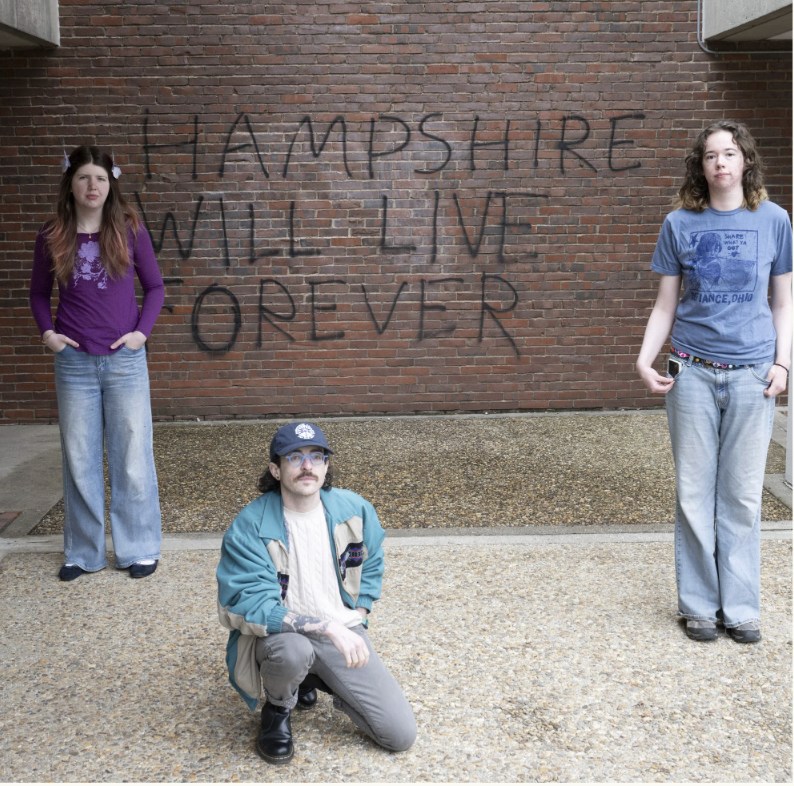
Photo: Hampshire Next
A new coalition of Hampshire College alumni, students, parents, staff, and faculty calling themselves Hampshire Next, has organized to forestall the impending sale of the campus.
The college announced on April 14 that it would close permanently at the end of the year, and Hampshire President Jennifer Chrisler announced April 28 that the campus would be put up for expedited sale to retire its debt.
Hampshire Next aims to raise emergency funding “to create a community-directed path forward — a way to keep the mission alive, preserve the land, and chart a sustainable path worthy of our history of radical reinvention and innovative education.” The coalition proposes raising $10 million in pledges before the next meeting of Hampshire’s Board of Trustees on May 16 to demonstrate that a viable path exists to retire the debt while keeping the campus dedicated to the college’s original mission in a new incarnation.
Hampshire carries approximately $21 million in bond debt coming due in September. Hampshire Next believes the board will likely approve the public sale of land and assets — assessed at $9,715,400 — at its May 16 meeting if a viable alternative is not presented. The coalition has called on the Hampshire community to carry the college’s vision forward, saying the campaign offers “a way to keep the mission alive, preserve the land, and chart a sustainable path worthy of our history of radical reinvention and innovative education.”

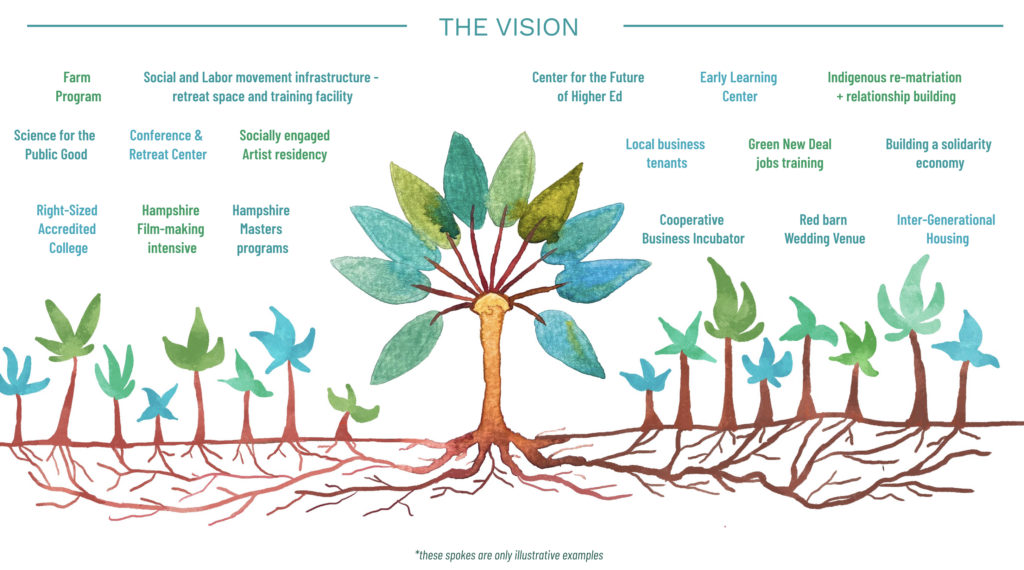
The Hampshire Next Vision
Hampshire Next offers a vision for what would follow successful retirement of the debt. Rather than a return to Hampshire College as it was, the coalition envisions a new endeavor grounded in Hampshire’s original mission, describing it as “new shoots off the Hampshire tree take root on Hampshire land.” That vision includes:
- Hampshire Community governing the use of land and facilities, guided by mission, values, and a commitment to building alternative educational models that meet cultural, national, economic, and environmental needs.
- Aligned partners, alumni, nonprofits, and a wider network bringing initial programming, with staff retained or rehired where possible, and a long-term goal of restoring formal educational programming as part of a diverse set of programs and revenue streams that build economic resilience while advancing the mission.
- A collective decision-making body of alumni, staff, former faculty, and community partners to protect and reflect Hampshire’s values — equitable representation and a commitment to collective liberation.
The Strategy
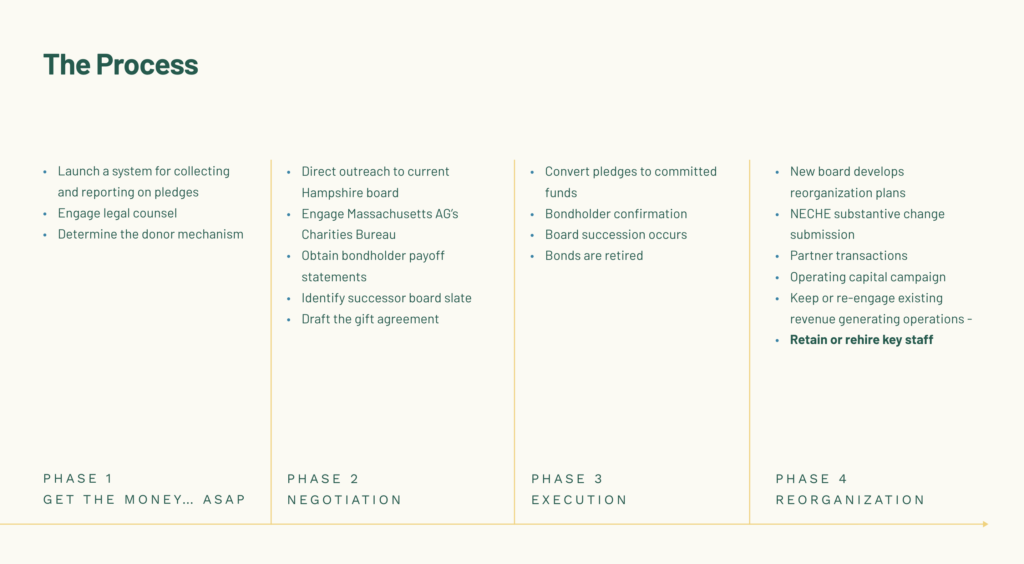
The coalition’s strategy includes:
- Raising $21 million or more in pledges from the Hampshire community, partners, and institutions.
- Using pledges to fund a restricted gift that resolves Hampshire’s debt, accessible only with enforceable, structured commitments from the board.
- Avoiding bond default and a land sale, with control of the organization and campus transitioning to the community debt-free.
- Forming and nurturing a community-driven, inclusively governed, and economically sustainable model that reimagines the best of Hampshire College as a new experiment.
More information on Hampshire’s financial status and the vision and strategy of Hampshire Next can be found here and here. Pledges to the campaign can be made here.
I just sent the following email to whoever are the people behind HampshireNext, at email addresses press@hampshirenext.org and hello@hampshirenext.org:
Through zoning, the Amherst Town Council has control over how the land is used. The current Educational Zoning District will have to be changed, which requires a vote by the Town Council that should occur only after a thorough planning process. The Town Council will not be under any obligation to rezone the entire campus for any particular purpose. The Council could require that significant parts of the campus be used for different specified purposes.
In Durand v. IDC Bellingham, LLC, 440 Mass. 45 (2003), the Supreme Judicial Court held that acceptance of value in return for a zoning change is legal. Earlier in Sylvania Electric Products, Inc. v. City of Newton, 344 Mass. 328 (1962), the Court held it was proper to rezone land in return for imposition of use restrictions. In this case whoever ends up owning the campus could offer to donate land to the Hitchcock Center as part of the consideration for a zoning change. This is called “contract zoning,” the validity of which has been upheld by Massachusetts courts.
The Amherst Town Council can play a crucial role in preserving the Hampshire College campus for public purposes that benefit the entire community, which will not impose on the Town the added financial burden that will result from for-profit residential development.
This effort would be significantly more credible with names attached.