
Massachusetts Receives National “Black Hole Award” for Government Secrecy
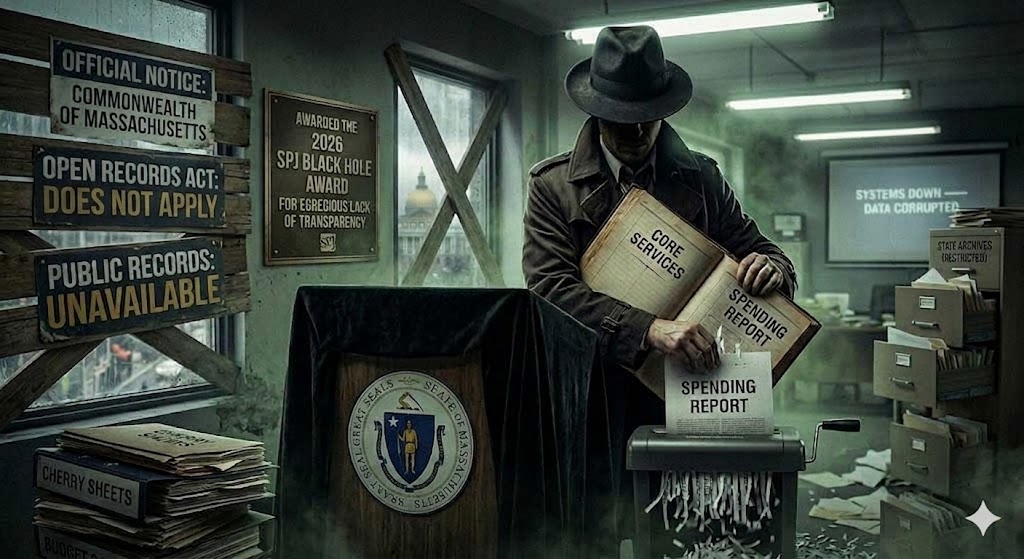
Photo: Google Nano Banana
Massachusetts has been named the 2026 recipient of the Black Hole Award, a national designation issued annually by the Society of Professional Journalists (SPJ) to spotlight the most secretive government entities in the United States. The award is intended to call out public institutions that “thwart the free flow of information,” and this year SPJ concluded that no state does so more comprehensively than Massachusetts.
The SPJ has singled out the Commonwealth for its annual “dishonor” reserved for the government body that most egregiously undermines the public’s right to know. For Amherst residents who depend on information from Beacon Hill to understand decisions on schools, housing, and climate, the award is more than symbolic—it is a warning flare.
The core issue is structural: Massachusetts is the only state in the nation where the governor’s office, the legislature, and the judiciary all claim to be exempt from the state public records law. In practice, that shields the most powerful corners of state government from the basic transparency rules that apply elsewhere in the country.
SPJ further cites “broad exemptions, weak enforcement mechanisms, and persistent delays” that limit access even to records that are legally public. Requesters—journalists, advocacy groups, and ordinary residents—routinely face long delays, silence, or fee estimates so high that many give up or never file in the first place. Compelling agencies to comply often requires costly, time‑consuming litigation that is out of reach for most individuals.
Observes SPJ President and nine-time Edward R. Murrow award-winner Chris R. Vaccaro, “The public should not have to fight, wait, or pay exorbitant costs to understand how their government operates…Transparency delayed or denied is accountability denied.”
Massachusetts joins a rogue’s gallery of government obstructionists who have earned the Black Hole designation including the Utah State Legislature (2025), Louisiana Attorney General Jeff Landry (2021), and the Trump Administration (2018).
Massachusetts Sunshine Laws represent something of a double-standard. Amherst, like all Massachusetts municipalities, is fully subject to the state’s public‑records law. Local boards, committees, and departments must respond to requests, justify redactions, and comply with deadlines. Amherst’s Town Council, School Committee, and municipal departments operate under these rules.
The state, however, does not.
This failure to protect the public’s right to insight into how the state sausage is made is under attack on multiple fronts.
State Auditor Diana DiZoglio has made transparency on Beacon Hill her signature issue, pushing to audit the Legislature’s finances and operations and arguing that “people want change. They want transparency and they want accountability from their elected leaders.” In 2024 she successfully championed a ballot measure clarifying her authority to audit the Legislature, which passed with an overwhelming statewide majority, only to see legislative leaders refuse to fully comply.
DiZoglio and allied advocates are now backing a new ballot question for this November that would pull the Legislature and governor’s office squarely under the state public records law, aligning their obligations more closely with the rules that already govern Amherst’s own boards and committees. The proposal, framed as “An Act to Increase Access to Public Records,” would end the blanket exemptions that currently allow top state officials to operate behind closed doors and would give residents, journalists, and local officials direct legal rights to see how Beacon Hill makes decisions that shape funding and policy in communities like Amherst.

We had State Auditor Diana DiZoglio on The Enviro Show in September 2024 (podcast: before that first ballot initiative. Good to learn she’s still at it. Given what’s coming at us from DC one might hope for better from Beacon Hill?