
Opinion: What Are You Doing Here? The Question Behind Belonging
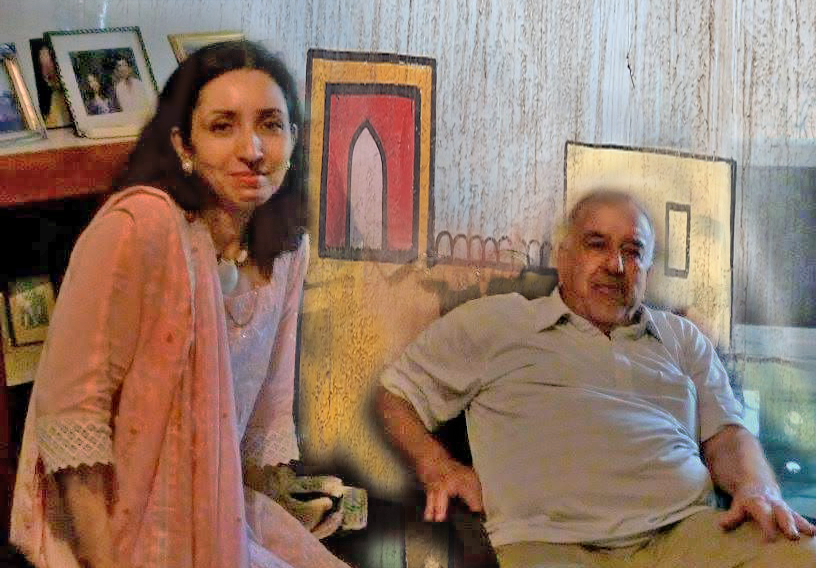
Rizwana Khan with her father, Humayun Zaman Khan, in 2015 in Pakistan.
Social Injustice Goes Global
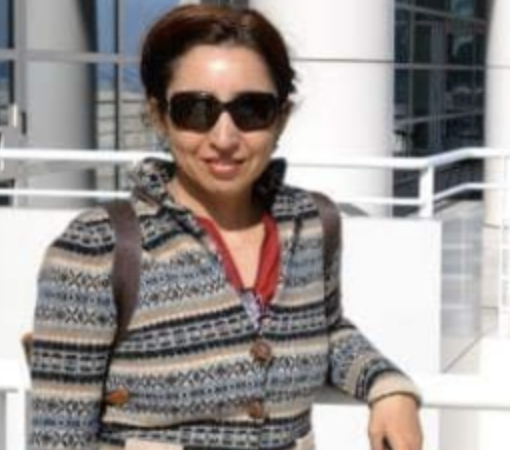
She was a psychologist, which in Amherst means she had achieved a certain sanctioned level of emotional vocabulary and outdoor furniture.
Blond, blue-eyed, cardigan energy that says “community” like it’s both a value system and a lifestyle brand. The brunch table around her was doing its usual choreography: curated humility, mutual validation, and the gentle performance of being the kind of people who read things like The Atlantic without announcing it.
I was there too, participating in what I can only describe as “soft belonging.” Smiling at the right intervals. Saying things like “that’s so interesting” with just enough curiosity to not seem like I was trying to win anything.
My writing blog and contributions to The Amherst Indy came up. Someone called it “insightful” — a containment without having to rearrange the room.
Then she turned to me.
Not a dramatic shift in tension, but just a smooth conversational pivot, like she was asking about tea preferences or parking.
“What are you doing here?”
It landed gently. That’s what made it good.
She did not appear hostile. If anything, she seemed curious, even polite. It was the kind of question that could pass unnoticed in a room accustomed to ease.
But I heard something else in it.
Not what brings you here today?
But why are you in this room at all?
In spaces like these — quietly affluent, culturally fluent, and socially self-assured — belonging is assumed. And when it is disrupted, even slightly, it often takes the form of a question.
No one else reacted. The table continued its soft clinking and polite laughter, as if language hadn’t briefly slipped its leash.
I did what you do in these situations: I smiled, because smiling is the most efficient way to keep a social system from acknowledging its own malfunction.
But internally, the question started doing what questions like that always do.
Not what are you doing here?
But:
Who let you in?
How long are you staying?
Are we supposed to adjust anything because of your presence, or can we continue as usual?
The irony, of course, is that I live here. Not in a metaphorical “we are all citizens of the world” way. In the very literal, bureaucratically verified, trash-day-and-town-meeting way.
But that wasn’t the question.
The question was about narrative placement.
And in that sense, I understood her confusion. I am not always cast in the version of this town where everyone’s mental furniture is already arranged.
So I offered one of my approved answers — the kind that passes through institutional air filters:
“I live here.”
“I’m involved in community work.”
“I write.”
All correct and useless. Because what she was really asking for wasn’t information. It was reassurance that the story she is used to inhabiting was still intact.
That brunch tables remain coherent.
That people like me appear in the margins, not the seating chart.
I could have explained more. I could have given her the full archive: migration, reinvention, translation, and the decades of becoming legible in rooms that weren’t designed with my grammar in mind.
But that would require a level of sincerity the moment didn’t deserve. So I stayed in the only register available. Polite, composed, and slightly smiling. The way you behave when you’ve learned that some questions are not invitations to answer — but signals to notice the structure of the room you’re in.
My presence in that room was not unusual. I have, by most formal standards, every right to be there.
And yet the question lingered because it revealed how fragile belonging can be when it is not equally distributed.
Women, in particular, are encouraged to ask what they want, who they want to become, and how they will define themselves.
Many women do begin there, but many others begin somewhere else entirely. And I was one of them.
In many Eastern and immigrant households, identity is shaped less by individual desire than by relational responsibility. From an early age, girls are taught to observe, to anticipate, to care for others’ needs before their own are fully formed. They learn that value is often measured not by self-expression, but by endurance: what they carry, what they absorb, what they make possible for others.
Daughters become extensions of family continuity. Wives become managers of stability. Mothers become architects of futures they will not fully inhabit themselves.
None of this is spoken as restriction, but as love, duty, or necessity. Which is precisely what makes it difficult to name as constraint.
When I was younger, I did not think of this as absence but as responsibility. Only later did I recognize how often responsibility becomes a substitute for permission.
So, when someone asks, “What are you doing here?” the question is not only social but existential. It asks how a life shaped by obligation, migration, and accumulated labor arrives in a space designed around ease.
The truthful answer is not simple.
I am here after raising children and after years of supporting other people’s ambitions while deferring many of my own.
I am here after immigration, cultural translation, financial uncertainty, and long periods of unpaid emotional and institutional labor.
I am here after building homes, relationships, and communities that often recorded my presence but not my authorship.
This is not unique but, in fact, ordinary for many women whose work has historically been rendered invisible precisely because it sustains everything around it.
What interests me now is not only the experience of invisibility, but the structure that produces it: who is expected to explain themselves and who is not; who is assumed to belong and who must continually justify their presence.
Over time, I have also become wary of how suffering is narrated in public discourse. There is a tendency, particularly in polarized conversations about gender, to reduce lived experience into totalizing claims — either universal harm or universal blame.
Neither frame is sufficient.
I understand the anger many women express when they name patterns of harm, exploitation, or emotional neglect. That anger is often precise. It points to real histories and ongoing inequities.
But I also find myself asking a different question — not to diminish that anger, but to ask what follows it.
What is built after naming what is broken? What forms of relation, responsibility, or repair become possible once recognition has been achieved?
Because diagnosis, on its own, does not create a livable future.
At some point, the question becomes not only what we are reacting to, but what we are moving toward.
In my own life, this has become less about assigning blame and more about understanding formation: how men and women are shaped differently by expectation, how emotional labor is distributed, how silence is taught, and how care is often extracted rather than shared.
One of the quiet asymmetries I have come to notice is this: girls are often socialized to track emotion — both their own and others’ — with extraordinary precision. They learn to read rooms, anticipate moods, and maintain relational balance as a form of competence.
Boys, by contrast, are more often given permission to disconnect from that labor entirely or to outsource it to others.
Neither outcome is natural. Both are taught, and both come with costs.
This is why moments like the brunch question stay with me. Not because of their individual intent, but because they reveal how easily social systems categorize people before they speak for themselves.
I am here, now, in a different relationship to those systems than I once was.
Not fully outside them. Not untouched by them, but no longer willing to understand my life solely through them.
I am here because I am still becoming.
Not as a slogan of resilience, but as a fact of lived experience: that identity is not only inherited or assigned but reclaimed.
And perhaps that is the answer I would give now, if asked again:
I am here because I did not only survive what shaped me.
I am here because I am still learning how to belong to myself.
And brunch continued, as it always does in Amherst: uninterrupted by the quiet realization that belonging is often just repetition performed convincingly enough to feel like fact.
Rizwana Khan is a writer, educator, and human rights advocate in Amherst.