
Opinion: Whither the Hampshire College Campus?
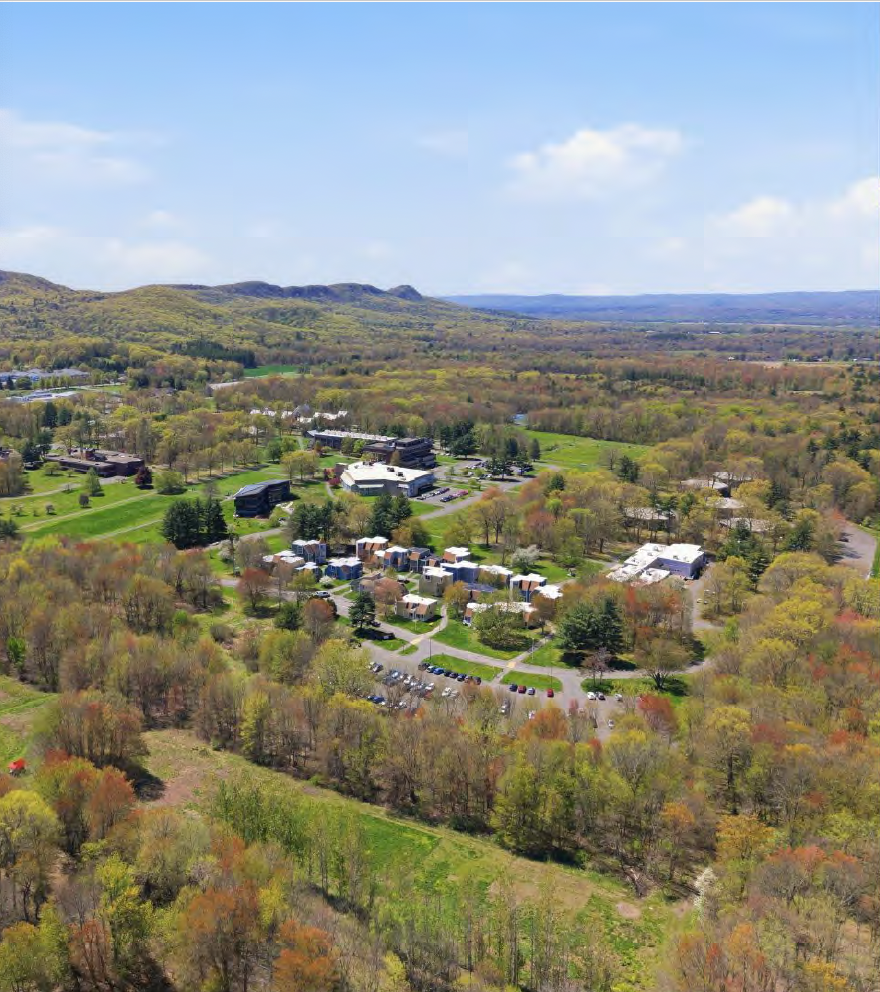
Aerial view of Hampshire College core campus. Photo: hampshire.edu

Sadly, many people involved appear to have given up on reincarnating Hampshire College as an innovative educational institution. Even though the college is not quite dead yet, the land vultures are circling, eager to carve up the 800 acre campus.
Town officials, backed by funding from the state with real estate developers in the background, are working on the mechanics of rezoning, mapping wetlands, evaluating condition of college buildings, all to provide a basis for residential development of college land. The only vision is facilitating real estate projects that will maximize profit for developers, with the profit-motive masked by liberal rhetoric about meeting a need for affordable housing. Public input will be just for show. The fix is in.
Anyone familiar with real estate development knows that residential development of Hampshire College land will be a money loser for the town, not withstanding simplistic rhetoric calling for “putting Hampshire College land on the tax rolls.” Commercial and industrial development generate positive property tax revenue. Residential development only increases the burden on essential municipal services that in Amherst are chronically underfunded and understaffed.
Such development will only exacerbate Amherst’s dire financial straits that include inadequate public school funding, streets in poor condition, dangerously inadequate fire department staffing with a century-old central fire station in need of replacement, the need for a new Department of Public Works building, and an ongoing very expensive public library reconstruction.
How will the Town of Amherst pay for the infrastructure needed for potentially hundreds of new units of housing on Hampshire College land? How will the town provide a public water supply adequate for firefighting? Will a new elementary school be required for many new families with children? Who will fund improved public transportation for affordable housing occupants who may not have reliable cars?
Michael Pill is a former resident of Amherst, and a current resident of Shutesbury. His law practice is based in Northampton.
I agree. As much as Amherst needs affordable housing, the need for light industrial and commercial development, along with the more robust tax base that such development would bring, is even greater. Over the 25 years that I lived in Amherst, I have seen repeated instances of NIMBY-ism that have thwarted the kind of development that would add to the town’s tax base.
I believe that the Hampshire College campus should be transformed into a sustainable technology incubator. As such, the campus would focus on the development and – crucially, the commercialization – of sustainable energy, manufacturing, and other technologies. The campus would provide training and apprenticeship opportunities for young people who come to learn real-world skills. Trainees and apprentices would be paid as they acquire the complex skills needed to build and manufacture the technologies needed to replace he fossil fuel-dependent, extractive, and environmentally destructive economy we currently have.
The Hampshire campus could remain within the Five College Consortium. Existing companies and new startups would benefit from the abundance of eager and well-educated students and researchers at the four other campuses. As for-profit enterprises. those companies that choose to site their operations on the Hampshire campus would contribute to a stronger tax base in Amherst to address the many financial challenges faced by the town, including “inadequate public school funding, streets in poor condition, dangerously inadequate fire department staffing with a century-old central fire station in need of replacement, the need for a new Department of Public Works building, and an ongoing very expensive public library reconstruction.”
Hear, hear, Michael Pill!
What effective legal mechanisms can put the brakes on this runaway residential-real-estate-development freight train?
And how does one explain why it that it seems — ironically?!?! — the engineer running this runaway train is a Hampshire College alumnus?
I had hoped that the combined efforts of The Trustees or Reservation, the Kestrel Land Trust, the endowments of the remaining four colleges, and even our CPAC (to which I recently applied for a position, but seem to have been passed over, unless the Town Council rejects the Manager’s recommended appointments later this month), could at least retire the short-term debt in order to stave off a “fire-sale” of Hampshire College assets.
It may be a trope to suggest “follow the money” — is anybody trying to do that before “the fix is in”?
Hampshire Next, Hampshirenext.org, a group of alumni and stakeholders have joined together to purchase the core campus. Our strategy includes individual pledges, lead donors, organizational partners, and possible development.
The four year institutional model is under stress throughout the country. We propose an educational ecosystem, hosting a wide variety of programming that accounts for existing resources— the Early Learning Center, makerspace, Crown gym’s neighborhood programming, as well as an array of other possibilities including : combined liberal arts and trades program, regenerative agriculture, indigenous land stewardship, micro college focused on a specific subject area, music production training for inner city kids, co-dwell, multigenerational housing, and much more.
These are all possibilities that reflect organizations with whom we have been in discussion.
We’re looking to ensure Hampshire remains a place for experimentation, participant, directed learning, and stays true to its original mission—albeit not as a four-year institution at this time. That’s something that can be considered in the future.
I serve on the transitional board and I invite you to check out our website, volunteer, make a pledge if you feel so inclined, attend our weekly zoom meeting, Wednesdays at 7:30 PM
Check out the website to learn more
Hampshirenext.org
I pledged a thousand dollars to HampshireNext because I support their efforts. Hopefully Stephan Cohen will transmit the following observations to the people running that organization, who will accept what follows in the spirit of constructive criticism in which it is intended. Sadly Hampshire Next appears to have abandoned any real hope of continuing Hampshire College as an innovative educational institution. Instead they are focusing on reuse of campus land. The problem is that the HampshireNext people working on this are literally scattered all over the nation and other countries. None of them has a sufficient understanding of the legal framework regulating land development in Massachusetts. They are long on beautiful visions and woefully short on knowledge and expertise necessary to accomplish their goal. For funding their pledges have topped out at about $2 million, nowhere near enough to gain control of the campus land in the face of more than $20 million in mortgage debt. The only way forward is an organized coalition that includes HampshireNext and: (1) Kestrel Trust and the Trustees of Reservations who between them can come up with millions of dollars; (2) Hitchcock Center for the Environment which is at risk of losing the trail network essential to its environmental education mission; (3) Jerome Segal who has a vision with a practical plan for implementation that would reincarnate Hampshire College as an innovative educational institution with fully qualified professors who teach rather than publish, where young folks learn practical skills to make a living along with a traditional liberal arts education, and costs are minimized by student work crews who help unionized full time people operate dining halls and maintain buildings and grounds. One motto for such an institution could be “If you think you are too good to clean the toilets in your dorm, you are not good enough for Hampshire College.” Segal has retained the Springfield, Massachusetts law firm of Egan, Flanagan and Cohen which has the practical expertise to implement his plan. No one group can transform and preserve Hampshire College. In the words of the folk song sung by Pete Seeger “Step by step the longest march can be won, can be won. Many stones can form an arch, singly none, singly none. And by union what we will, can be accomplished still. Drops of water turn the mill, singly none, singly none.”
Thanks so much for responding to my comment and many thanks for your pledge to Hampshire Next.
We haven’t disregarded, or even given up on, the idea of Hampshire as a four-year institution. That may come in the future. I know many folks, including many participating in Hampshire Next, who remain attached to that vision in some form.
Our immediate focus, however, is on creating an educational commons. Comparable examples might be Black Mountain College back in the day or the Creative Campus at Goddard (https://www.thecreativecampus.org/). A few of us have also been exploring micro-colleges as part of the Hampshire educational commons/ecosystem. Check out this link: https://thoreaucollege.org/microcollege-movement/
People within HN have had many discussions about partnering with an organization seeking to preserve the conservation land. Speaking personally, not as a Hampshire Next representative, I think it’s a great idea and one that I see as foremost on many HN participants’ minds.
We’re keen on developing a sustainable model that has room for the continuation of existing programs, such as the Early Learning Center, to name just one. We have also been in discussion with a wide range of organizations interested in Hampshire Next and the possibility of extending their educational programs to the Hampshire campus.
This approach bypasses many of the increasing headwinds facing four-year colleges across the country, whether the demographic cliff or the challenge of navigating increasingly stringent federal grant regulations.
Very importantly, when Hampshire did not accept an entering class, aside from early decision students, in 2019, and even though alumni and others raised $55 million to turn the tide, the college had already taken an immense hit. I imagine many prospective students and parents were left wondering whether Hampshire was still the right choice, given a future that seemed increasingly uncertain.
And here we are today. This time, however, the announcement was closure—full stop. That creates an even more difficult situation, one that would understandably give any prospective applicant pause about Hampshire’s long-term viability unless there were an extraordinary infusion of funding on the scale of Warren Buffett’s support for Grinnell College.
Thus, our focus on a thriving ecosystem of interdisciplinary programs with cross-fertilization between them. That’s not to say we have all the answers. We’re working on it, just as you are.