
Inadequate Erosion Control at Amethyst Brook Elementary School Site
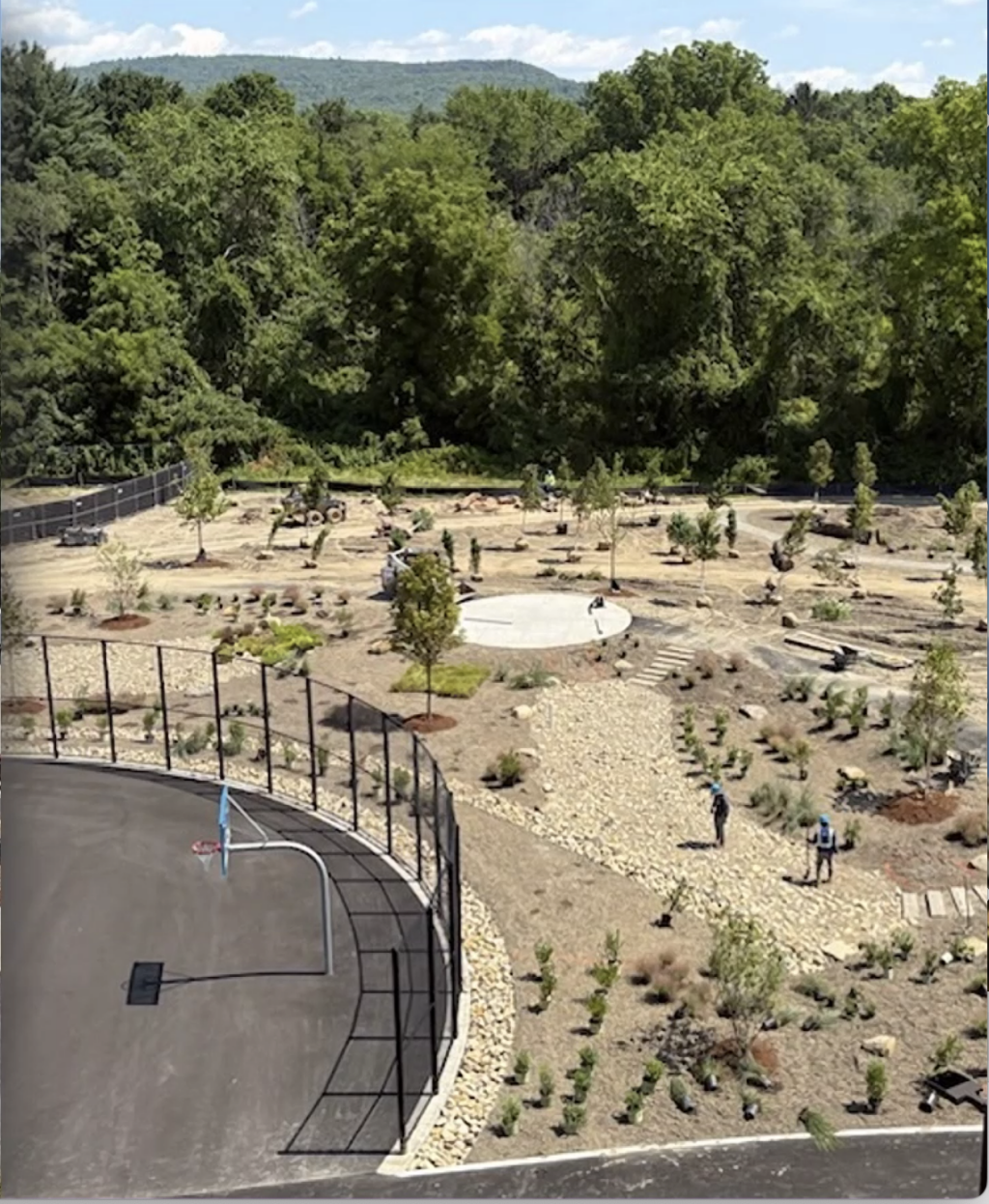
Newly planted garden, Amhethyst Brook Elementary School. Photo: amherstma.gov
Report on the Meeting of the Amherst Conservation Commission, August 12, 2025
This meeting was held over Zoom and was recorded.
Present
Commissioners: Andrey Guidera (Chair), Bruce Stedman, Carol McNeary, Rachel Loeffler, Jason Dorney, and Sarah Matthews.
Staff: Erin Jacque (Conservation Agent) and Dave Ziomek (Assistant Town Manager)
Erosion Control Violations at Amethyst Brook Elementary Site
The Conservation Commission issued an enforcement order to the CTA Construction Managers, the company building the new Amethyst Brook Elementary School, for repeated failure to adhere to erosion control measures. Conservation Agent Erin Jacque said that she has observed sediment going beyond the erosion controls and turbid water entering the river on numerous occasions, despite her request for more BMP (Best Management Practice) measures.
Jacque said she had been reluctant to delay work at the site with the school set to open in a few weeks: “I want that site solarstable immediately, but I’m not happy with the monitoring because I think there has been monitoring going on that hasn’t caught [the sediment], and yet I go out and I catch it. I’m not super-impressed with the response from the contractor.”
She asked the contractor to install a check dam with some erosion control blankets, and the response was a single line of straw waddle. She received no response to her follow-up concerns. “I know they’re hustling out there. It’s a huge site,” she said. She is especially concerned with the site stabilization when phase 2 of the project begins this fall. Phase 2 involves demolishing the old school and constructing the new playing fields.
Jacque did observe efforts to establish vegetation on the site and complete the stormwater systems, which include basins to capture stormwater. However, the excavation is worsening sediment seepage. She was still concerned that her messaging about erosion control methods was not getting through to the contractors.
Commission member Jason Dorney noted that without stabilizing the watershed upstream, the rain gardens will fill with silt and will need to be re-excavated to return to their original depth. “Those things should be in only after the upstream areas were stabilized,” he said. “Are we making sure that the school, the taxpayers, the DPW have the engineer of record go out and sign off saying that it was installed properly? It doesn’t sound like there’s a whole lot of confidence that that’s actually happening, and we’re going to be on the hook to fix this two years from now.”
Rachel Loeffler suggested that for the rain gardens to function, the contractor may need to excavate two feet down and put in a stone layer so infiltration can still work and the rain garden doesn’t just become a mud basin that needs to be dug out again with the next rainstorm.
The commission unanimously decided to issue an enforcement order to the contractor to put the required erosion controls in place, and that commission members would inspect the site again on August 24.
Change of Transformer Containment Materials at Hickory Ridge
Members of the commission admonished PureSky Energy for replacing the concrete-encased metal tubs in the containment system for the two transformer pads at the solar and battery energy storage system (BESS) project at Hickory Ridge with a PVC geomembrane. The commission was not informed of the material change before installation last fall and learned of it only after a member of the public alerted it. The commission required PureSky to send the town the specifications for the new system in case there is an issue with it in the future. It will continue the matter at its September 9 meeting.
Neil Brewster of PureSky said that the “small change” in the containment system was necessitated by supply chain problems for the approved system and the need to finish the project in a timely fashion. He said that the new system has the same sensor that will self-seal if a hydrocarbon leak is detected, protecting soil and groundwater.
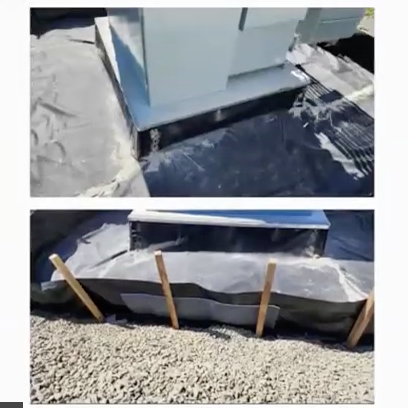
He stated that the manufacturer was on site to ensure that the system was installed properly and that PureSky has a letter from the manufacturer that the system meets standards. It will be inspected every five years and has a 25-year lifespan, the same term as PureSky’s lease for the site.
Commission Chair Andrey Guidera emphasized that PureSky had violated the terms of its permit. “How do we trust that you’re going to do things within the parameters that we set as we move forward?” he asked.
Brewster replied, “What we did here [was based on the] understanding that the end goal was to protect the environment around where the solar field would be. What we did was provide a system during construction by pivoting to a comparable piece. Everything else has been followed to the letter. This is the absolute last piece. There will be no other surprises.”
Rachel Loeffler pointed out that the containment systems for the BESS and the transformer pads are now different. She wanted to be sure that the town has clear information on which system is in place. Jacques asked that PureSky also notify the Department of Environmental Protection and Massachusetts Wildlife of the change prior to the September 9 meeting.
Town to Collaborate with Friends of Lake Warner on Mill River Watershed
Brian Pearson of the Friends of Lake Warner told the commission that the friends have received a $500,000 grant over five years to help rid the lake of water chestnuts and invasive species, as well has reducing phosphorus. He said a primary source of phosphorus pollution is Tan Brook in Amherst.
The Mill River watershed includes 20,000 acres in Amherst, Leverett, and Shutesbury. Assistant Town Manager Dave Ziomek suggested meeting with Pearson in September to discuss possible collaboration. UMass has also agreed to participate in the effort to reduce pollution sources in the watershed.
Public Hearing on Land Use and Management Plan to Take Place in the Fall
A few areas in the draft Conservation Land-Use Policy and Regulations still need clarification before a public hearing is scheduled. The commission briefly went through those points.
The staff is still evaluating the conservation areas being considered to expand the number of sites where hunting is allowed. These sites will be discussed on September 9.
Emergency Repairs to Storm Drain Allowed at University Drive CDH Facility
The strong storm on July 29 caused flooding on the ground floor of the outpatient medical facility at 170 University Drive, necessitating temporary closure of part of the building. MassGeneral Brigham applied for and was granted emergency permission to reconstruct a storm drain to prevent future flooding. The Conservation Commission unanimously approved this work.
New Vacancy on Conservation Commission
Tina Smith has resigned from the commission. Those interested in filling that vacancy should submit a Community Activity Form to the Town Manager.
Funds for Puffer’s Pond
Ziomek reported that the Friends of Puffer’s Pond submitted a check for more than $9,000 from funds raised at the annual Puffer’s Pond breakfast. The money is used to defray the cost of staff, porta-potties, and water testing at the pond. He noted that these costs are not included in the general town budget.