
Letter | Proposed Historic District Consistent with Town’s Master Plan
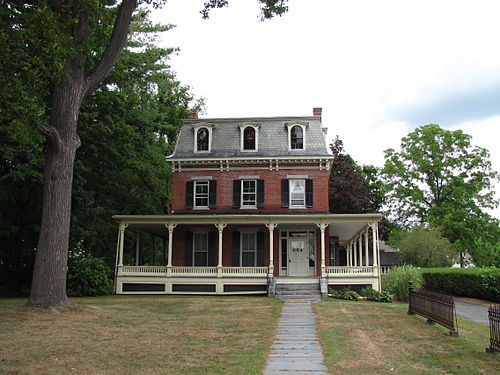
Ithamar Conkey-Stevens House (1840) on the North Side of Main Street opposite Shumwy Street and part of the Amherst East Village National Historic District. One of 22 properties proposed for inclusion in the East Amherst Historic District. Photo: Wikipedia
The following letter was sent to the Amherst Planning Board on August 17, 2026.
I am writing to ask you to support the proposed East Amherst Local Historic District. Local Historic Districts (LHD) have successfully worked in Amherst and other cities and towns as a key strategy to maintain historic properties as they are used, reused, and change over time. LHDs do not stop development; they shape it in ways that both preserve our history and promote economic development. Residents are much more likely to support change, development, and densification when it preserves the look and fabric of their town and neighborhoods. Tourists and visitors visit communities that are unique and have historic buildings, as shown by the many visitors to New England cities and towns that have protected their historic buildings and neighborhoods. In Amherst, we are lucky to have both a strong economy and many historic buildings, some built in the 1700s, and an old village center. These buildings and the village center are beautiful and still in use. Buildings such as the Emily Dickinson house, Austin Dickinson’s home, the Strong House, many buildings at Amherst College and UMass draw thousands of visitors and are part of the strength, beauty and history of Amherst.
The East Amherst Village Center has some of the earliest European settler housing in the area, historic businesses, and an historic church. The buildings date back to the days when the church parsons were paid by town taxes and only male property owners could vote in Town Meeting. Historic East Amherst buildings are all still in use, although the uses have changed over time. They are in zoning districts that allow greater density and size. The East Amherst Local Historic District will guide these changes in use and density, not stop them. Increases in building size, additions, and density will be harmonious.The LHD will also remove incentives to tear down buildings and replace them with cheap, boxy buildings, since any new construction must also fit in. We can see how this has worked well in our other local historic districts.
I think it is important to note that the East Amherst Local Historic District directly implements the Amherst Master Plan and the Amherst Historic Preservation plan. These plans were enthusiastically adopted by the Planning Board, and it is, frankly, the Planning Board’s job to implement these plans. So I hope that you continue to build on the hard work of past boards and throw your enthusiastic support behind the East Amherst Historic District.
Janet McGowan
Janet McGowan is a resident of Amherst’s District 5 and a former member of the Planning Board.
Chapter 6, Natural and Cultural Resources, Amherst Master Plan
2023 Amherst Preservation Plan
Excerpts from Chapter 6 of the Amherst Master Plan:
OBJECTIVE NC.1 – Promote the preservation, appreciation, and
sustainable use of our historical and cultural resources for residents
and visitors.Historic and cultural resources foster a connection to the Amherst
community, generate a sense of pride among its residents, and attract visitors to
the Town. Appropriate protection and celebration of these resources will ensure
that the community’s heritage and unique character are preserved and passed on
to future generations. Implementation of the 2005 Amherst Preservation Plan and
the following strategies will preserve important community character for
Amherst’s future while acting as a crucial form of local economic development
NC.1.B [Strategy] Increase historic preservation protections in Amherst’s
zoning regulations, in order to encourage preservation, restoration,
and rehabilitation of historic and archeological resources.
A special historic overlay district is one example of a measure that could
provide specific development and design regulations above and beyond
regular zoning in order to protect areas of historic and architectural
significance in the Amherst community. Such measures could allow certain
land uses by right or offer incentives if the proposed use met minimum
historic standards. An overlay district or other measures could be applied to
existing National Historic Register districts, areas that have been proposed to
receive National Historic Register designation, and other historic resources
indicated by the Amherst Preservation Plan or deemed significant by the
Amherst Historical Commission.
NC.1.C [Strategy] Establish new local historic districts to provide enhanced
protections for our most significant concentrations of historic
resources…..The Town should develop separate local historic districts
that contain regulatory language capable of protecting historic resources in
ways that zoning cannot.