
Library Project’s Failure to Repay Town Discussed at Finance Committee
Photo: AI generated image c/o Nano Banana & Depositphotos.com
This meeting was held over Zoom and was recorded.
Money Coming To the Town
Town Finance Director Sean Mangano updated the Finance Committee on the financials of the Jones Library building project at its September 15 meeting. Since his last report in March 2026, the Massachusetts Board of Library Commissioners (MBLC) has paid the town installments totaling an additional $6.4 million. The final installment of $2.4 million is not expected until sometime after the project is complete (Mangano could not provide a specific date).
According to the Memorandum of Agreement (MOA) developed between the Town Manager and the Jones Library Trustees, the library must pay its full share of the total project cost ($13,822,518) to the town “simultaneously with the final payment made to the town by the MBLC”. If the MBLC payment is delayed for some reason, the library must pay its share one year from the date on which a certificate of occupancy is issued for the project. The Jones Library Building Committee (JLBC) learned this week that the expected “substantial completion date” has been pushed out by two months, with staff move-in now projected for May 1, 2027.
Money Borrowed By the Town
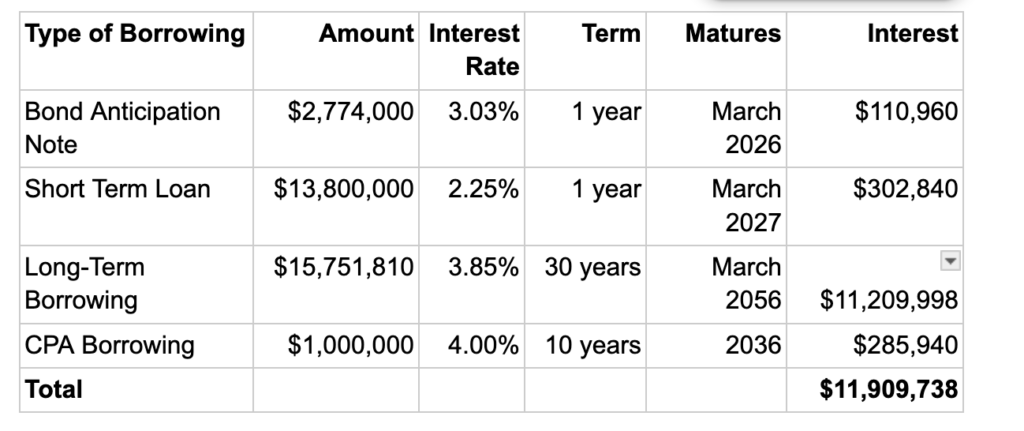
In 2023, when the Town Council authorized borrowing to pay the $46.1 million total project cost, it was presented with a cash flow analysis that estimated the total amount of interest to be paid by the town at $8.7 million, the majority of which ($7.9 million) would be the interest on a 20-year loan for the town’s $15.8 million commitment. However, last year the town instead took out a 30-year loan for that amount so the yearly debt service would be lower, but it also resulted in a large increase (more than $3 million) in the total interest the town must pay, now over $11 million.
The table below summarizes the borrowing to date:
Should the Town Borrow More Money?
Importantly, the $13.8 million short-term loan taken out last year to cover construction costs (while waiting for the MBLC and the library to pay their shares of the project) comes due in March 2027. The Jones Library Trustees have recently admitted that there will be a sizable fundraising shortfall, with $8.4 million still due to the town. That outstanding debt represents the bulk of the $13.8 million borrowed last March. At this week’s Finance Committee meeting, Mangano said that this loan would need to be refinanced. The big question that no one asked at the meeting is “Who should take out that next loan?” My answer is: “The Jones Library Trustees”.
While the MOA gives the library until the MBLC makes its final payment to pay its debt to the town, it contains another stipulation that must be honored, namely:
“During construction, the town will be paying for the principal and interest on short-term loans/BANS necessary for construction and a long-term loan”.
This is why, while the library is under construction, the town is shelling out hundreds of thousands of dollars in interest on loans that cover not only the town’s share of the project, but also the Library’s responsibility. However, as noted above, construction is projected to be substantially complete by March 2027. Under the MOA, the end of construction would also mark the end of the town’s obligation to pay interest on any short-term loans needed from that point forward. The library could/should take out other loans to cover its share of the project, or, failing that, commit (in a legally binding way) to at least pay all interest on any additional borrowing the town takes on.
What Did the Finance Committee Accomplish?
Insofar as the Finance Committee meeting agenda referred to this item as “Update on Jones Library Project Financing and costs to the Town”, it partially accomplished its goal, albeit not spelling out the interest paid to date and impacts going forward. Jones Library Trustee and Treasurer Nat Larson was obligated to attend and made the now familiar, dubious statements about the library’s desire and intention to raise money and maybe take out a loan or liquidate half of its endowment to pay its debt to the town. There was talk of the impact on their contributions to the library’s operating budget and the sentiment that “We’re all in this together.”
What wasn’t provided was proof that the library has been pre-approved by a lender or a list of high-likelihood grants or donations to cover over $8 million of debt. When Councilor Lynn Griesemer asked “Have you looked at what a loan might look like?”, Larson’s answer was “Not in any detail”. When Councilor Jill Brevik asked how they plan to secure the money owed to the town, Larson said they were “planning to ramp up fundraising” with “more personnel and more efforts”. When resident Finance Committee member Cathleen Mitchell asked for an estimate of how much they anticipate paying the town by March 2027, when the short-term loan expires, Larson responded that he “has not seen that yet from the Capital Campaign”. When Councilor Cathy Schoen prompted that “the more you turn over now, the less the town has to incur debt”, he confessed that “We don’t have that much control over the pledges.”
Why Does All of This Matter?
Resident Finance Committee member Jeffrey Robert got to the heart of the matter by asking, “When the town incurs borrowing costs, does that money come out of the general fund?” Mangano responded that it comes out of the capital allocation, which is part of the general fund that is predominantly funded from property tax revenues. Debt service is the first thing paid out of the capital allocation, and that money could otherwise be spent on operating or capital needs in town. Robert suggested that Larson please pass that information along to the Capital Campaign. In the meantime, the town will have less money to spend on roads, sidewalks, maintenance of other buildings, and operations such as school employee salaries.
Image: Nano Banana and Depositphotos.com
There are MGL rules and best practices that Amherst refuses to follow. Every one of the Trustees should be present and accountable for the cost of incurring debt. Instead they punt, anticipating a winning streak? Insanity. Just another rigged game with OUR tax dollars.
So the Town’s supposed $15.8 million contribution to the library project is in reality closer to $29 million. Because of this project and the terrible agreement the Town Manager and Town Council made with the library trustees, there is and will be a million dollars less every year for the next 30 years to spend on other town priorities. Isn’t it past time for those in power to seek legal remedies to force the Trustees to pay what they owe? Per the Cash Flow (attachment B of the document linked above), the Trustees committed to paying the Town $11.5 million by January 2026, and the balance by the end of July. I can’t imagine a bank would be as lenient as our Town leaders are being if we were $8.4 million in arrears.
Well, the Jones Library trustees were right — the building project will not cost the town “a penny more.” It will cost us 1.2 billion pennies more… and counting.
The Town Council must begin planning how to scale back library operations so that critical town services do not continue to suffer from underfunding.