
Councilors Seek More Funding from UMass; ADU & LDH Bylaws Advance to Subcommittees
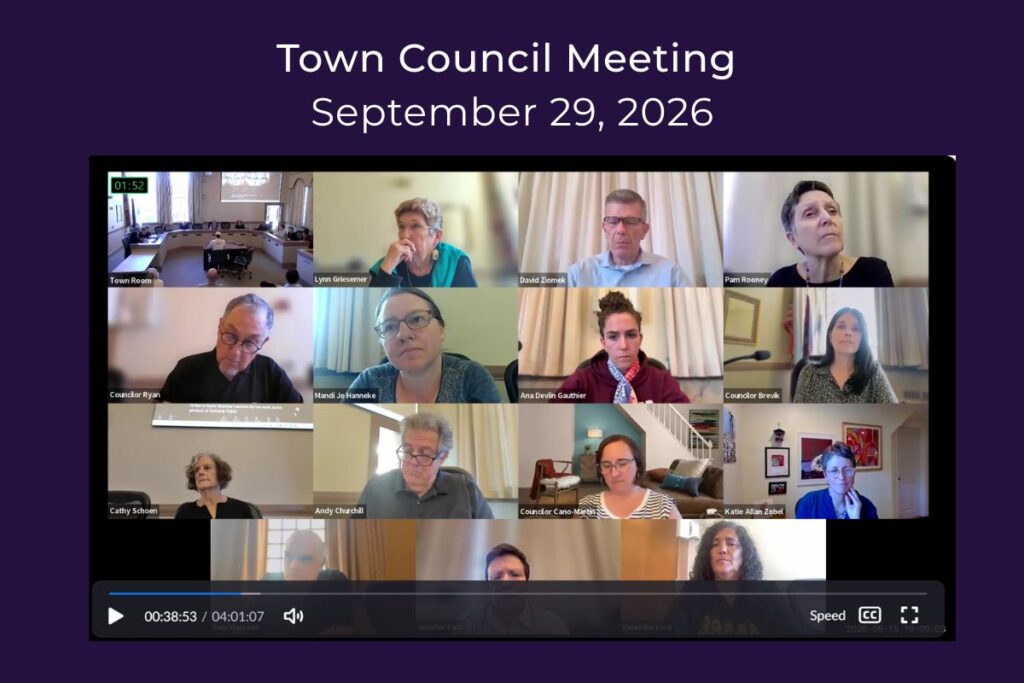
Image credit Screenshot of Town Council Meeting 9.29.26
Report on the Meeting of the Town Council, September 28, 2026
By Maria Kopicki
This was a hybrid meeting held in the Town Room of Town Hall and was recorded.
Present
Councilors: Mandi Jo Hanneke (President, at large), Jill Brevik (District 1), Amber Cano-Martin and Lynn Griesemer (District 2), Hala Lord and George Ryan (District 3), Pam Rooney and Jennifer Taub (District 4), Ana Devlin Gauthier and Sam MacLeod (District 5), and Andy Churchill and Ellisha Walker (at large). Cathy Schoen (District 1) was absent.
Staff: Paul Bockelman (Town Manager), Jeff Bagg (Director of Planning & Economic Development), Walker Powell (Town Planner), and Athena O’Keeffe (Clerk of the Council).
Strategic Partnership Agreement with UMass to be Renegotiated
Council President Hanneke asked councilors to offer their priorities as Town Manager Paul Bockelman will begin negotiations soon on the Strategic Partnership Agreement (SPA) with UMass, which will expire at the end of this Fiscal Year (June 30, 2027). The current SPA was created in June 2023 and can be found here. Common themes emerged around the desire for UMass to increase their financial support of the town, especially with respect to the roads and education. Councilor Brevik advocated for the University to contribute $1 million for primary and secondary education. Many councilors pointed out that vehicular traffic generated by UMass has a significant impact on the conditions of the town’s roads. Councilor MacLeod said, “You can’t have 25,000 people and cars and not impact the roads.”
There was also general agreement that it was not acceptable that the current public-private partnerships (P3s) are not generating any tax revenue for the town. Hanneke suggested that the town should be more involved in these P3 arrangements and/or that a community benefit agreement be required before P3s start operating. She also wanted any commercial activities on the UMass campus to produce tax revenue for the town. Councilor Cano-Martin called for more communication to the public about Payments in Lieu of Taxes (PILOT) and suggested that the town council be represented in these discussions, at least as observers.
Several councilors recommended that UMass contribute to funding for public safety, particularly the CRESS program. Cano-Martin also made the point that pedestrian safety is an issue for both year-round town residents and UMass students, particularly along East Pleasant Street where there is no sidewalk.
Bockelman thanked the council for their input and reported that negotiations will begin in November.
ADU Bylaw Amendment Referred to Planning Board & Community Resources Committee
Prompted by the controversy surrounding the implementation of a recent zoning bylaw on Accessory Dwelling Units (ADUs), including appeals to the Zoning Board of Appeals and Land Court and now the subject of two lawsuits, the town’s planning staff has proposed amendments to the town’s ADU bylaw intended to provide clearer guidance for future applications, particularly regarding gross floor area, floors, and definitions of spaces such as attics. Director of Planning & Economic Development Jeff Bagg made a presentation and said that they are planning a joint meeting of the Planning Board and the Community Resources Committee (CRC) on October 22. Any amendment to the bylaw would require approval by two-thirds of the Town Council.
Some issues were raised by councilors that had not previously been discussed publicly. One was about the lack of notification to abutters prior to construction of these ADUs. Bagg clarified that the state had established minimal criteria that did not include a requirement to notify neighbors and said that if the town wanted to add that, it would require a separate amendment to the town’s bylaw. Councilor Taub mentioned that the state is accepting suggestions on-line and that it seems that many municipalities are having difficulties with the new law.
The vote was unanimous to refer this issue to the Planning Board and the CRC.
East Amherst Local Historic District Creation Referred to CRC & Governance, Organization & Legislation Committee
Town Planner Walker Powell presented the latest information on the creation of an East Amherst Local Historic District (EALHD) comprised of 23 parcels around the intersection of Main Street and North/South East Streets. Although this area is part of the East Village National Register Historic District, it is not currently recognized as a local historic district, which would require a review and approval of substantial changes to the exterior of the buildings that are visible to the front street. Elizabeth Sharpe, Amherst LHD Commissioner and Co-Executive Director of Historic Northampton, provided context to the proposed LHD. She noted that this area was one of the first villages in Amherst, dating back to the early 1700s with connections to the Revolutionary War era, including Shay’s Rebellion. She also pointed out that, although the motivation of the EALHD is to protect that history, many of the buildings that are included are multi-family homes, ADUs, and rentals.
Councilor Ryan asked whether the EALHD would limit increased densification in the area or the affordable housing project planned for the old South East Street School. Walker explained that there would be no impact on either as the school property project is grandfathered in and the increased density being pursued is south of these properties, at the intersection of College Street and South East Street. Hanneke questioned whether some of the properties are pre- or post-Civil War era and pointed out that the parcels are not contiguous and that the East Town Common parcel does not have any structures on it. Taub clarified that the LHD designation would not prohibit necessary changes to the East Amherst Town Common and that it was included because of its historical significance. In response to concerns that this designation would create prohibitive costs and a time-consuming approval process for owners, the presenters and Taub explained that regular maintenance is not reviewed, guidelines have been updated and streamlined, alternative materials are not strictly prohibited, and Community Preservation Act funding is available. Councilor Devlin-Gauthier, however, described LHDs as “unfunded mandates” and said that without offering financial support to owners, “how is it not an undue burden?” Taub responded by saying that there is a hardship exemption.
The council voted 11 in favor, 1 opposed (Hanneke), and 1 absent (Schoen) to refer the EALHD Bylaw to the CRC and the Governance, Organization, and Legislation (GOL).
Councilor Griesemer Added to Budget Coordinating Group
Hanneke reported that Councilors Griesemer and Schoen had requested that additional councilors serve on the Budget Coordinating Group (BCG). They argued that currently there are only two councilors on this committee (Hanneke and Cano-Martin), neither of whom are on the Finance Committee. Taub nominated Griesemer to serve and the vote was unanimous to add her with a term to expire at the end of January 2027.
No Discussion of Jones Library Project Financing Implications
With Finance Committee Chair Schoen absent, Griesemer stepped in to field a question about the Finance Committee’s report on financing for the Jones Library project. Taub asked why there was a large discrepancy between what the town reported as having been raised by the library to date and what the library has reported, and asked for clarification about the schedule of repayment to the town of the library’s share of the project cost. Griesemer replied that the library trustees’ figures include outstanding pledges in its fundraising totals and confirmed that the library still owes the town $8.4 million which is due no later than when the Massachusetts Board of Library Commissioners (MBLC) makes its final payment to the town (expected by the end of June 2027).
Not discussed was the question of how further borrowing will be managed when a short-term loan taken out by the town to cover the amounts still not received from the Library and MBLC comes due in March 2027. The Finance Committee report calls attention to a clause in the Memorandum of Understanding (MOU) between the Town and the Library Trustees that only requires the town to pay principal and interest on short-term loans during construction, which is expected to be substantially complete around the same time the current short-term loan matures (March 2027).
Hanneke Concerned About DPW Building Project Budget Creep
Hanneke asked Councilor Rooney to report on the work of the Department of Public Works (DPW) Building Committee, expressing concern that this project, which is still in the early design stage, may already be over budget. Rooney confirmed that construction costs were estimated at $600 to 800 per square foot but did not state how the 53,000 square foot building would be built within the $35 million total project budget. In answer to a question from Griesemer about whether the project will include consolidation of all DPW locations, Rooney explained that satellite departments such as water, sewer, and trees & grounds are not part of the project and will not be located in the new facility.
Consent Agenda
The following items were included on the consent agenda and passed without discussion:
- Authorization of the November 3, 2026 State Election Warrant
- Referral of Proposed Amendment to the Bylaw Review Committee Charge
- Beyond the Charter Recommendations to the Town Manager for Budget Documents
- Approval of Town Manager Appointments to the Community Preservation Act Committee: Marc Barrette and Mary Klaes
The next meeting of the Town Council will be held on October 5, 2026.