
Planning Board and CRC Propose Fixes to ADU Bylaw, Discuss Possible Data Center Ban
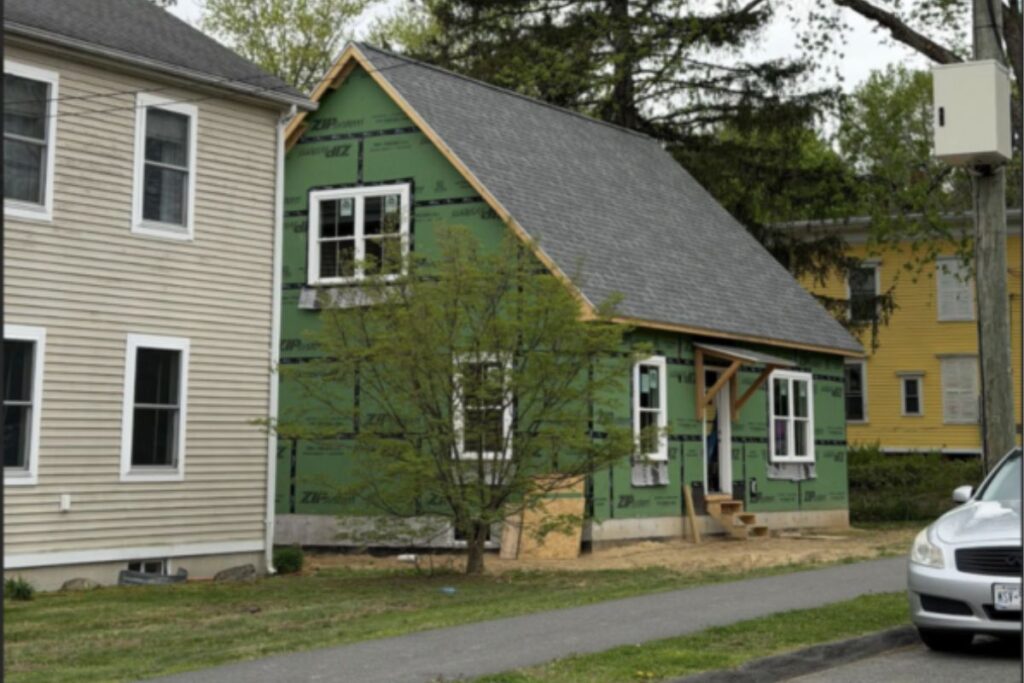
ADU under construction at 79 Taylor St., with four bedrooms and two baths and two floors of finished space. Photo: amherstma.gov
Report on the joint meeting of the Planning Board and the Community Resources Committee, Oct. 22, 2026
This meeting was held over Zoom and was recorded.
Present
Planning Board: Doug Marshall (chair), Bruce Coldham, Roy Johnson, Jesse Mager, Jerah Smith, and Angus McLeod. Absent: Fred Hartwell.
Community Resources Committee: Town Councilors Pam Rooney (chair, District 4), Andy Churchill, Mandi Jo Hanneke, and Ellisha Walker (at large), and Jennifer Taub (District 4).
Staff: Jeff Bagg (director of planning and economic development), Rob Morra (building commissioner), Walker Powell (planner), and Pam Field Sadler (assistant).
Amendments Proposed to Limit Size of Protected-Use ADUs
The Planning Board and the Town Council’s Community Resources Committee (CRC) held a joint public hearing on amending the Zoning Bylaw’s provisions on accessory dwelling units (ADUs). The goal is to clarify which units qualify for the expedited permitting and eased requirements given to protected-use ADUs.
Several ADUs with up to 1,200 square feet of living space have received permits as protected-use ADUs, which the bylaw limits to 900 square feet. In those permits, the second floor was classified as an attic, which the bylaw does not count toward gross floor area (GFA). When an abutter challenged the permit for one unit, the Zoning Board of Appeals overturned it, and the developer sued in Land Court.
The state law is meant to encourage small units by easing permitting requirements. To keep builders from circumventing that intent, planning staff recommended several changes to the Zoning Bylaw’s ADU provisions, especially how GFA is calculated.
State law does exclude attics, crawl spaces, garages, and porches from GFA, but Amherst’s Zoning Bylaw does not define “attic.” Building Commissioner Rob Morra has designated the second floors of several ADUs as attics because they were too small (less than one-third of the area of the floor below) to qualify as half-stories.
The proposed changes would clarify the meaning of GFA (Section 5.0112), clarify the definition of a half-story (Sections 6.181 and 6.182), and define an attic (Article 12) as “any space above the ceiling of a story or half-story, or any space behind a wall in the eaves of a roof that does not have the required ceiling height and room dimensions in accordance with the Massachusetts Building Code to be utilized as Habitable Space.”
Planning and Economic Development Director Jeff Bagg said any protected-use ADU application filed after the public hearing noticed on Oct. 6 must comply with the proposed amendments until the changes are adopted or rejected. He said the state Executive Office of Housing and Livable Communities is also planning changes to the ADU law, but the Planning Department did not think the town could wait for them. He said the town needs to clarify the rules for protected-use ADUs as soon as possible to guide staff in evaluating applications.
Amherst has granted at least 40 ADU permits since the new bylaw was adopted. At least 12 of those are for two-story ADUs with a finished second floor classified as an attic.
Planning Board Chair Doug Marshall raised a concern about excluding enclosed porches from GFA, because an enclosed porch could later be converted into a bedroom. Morra said that in a single-family home, the porch must have the required insulation, windows, heating, electrical outlets, and foundation to count as living space. In an ADU, however, the conversion could push the structure over the 900-square-foot maximum. The group generally agreed that enclosed porches with a compliant ceiling height should count toward GFA, even though state law currently excludes them.
Morra said, “I think we’ve learned through this that the state regulation has its flaws, and we need to make some decisions locally and stand behind them. We need to write the bylaw that works best for us and be willing to stand behind it, recognizing that some things might conflict with the state regulation. Last time around, we decided we weren’t going to be creating anything in conflict with the state regulation, and that got us here.”
Many hypotheticals were raised, mainly by Councilor Mandi Jo Hanneke, about storing items in attics in single-family homes and above garages. Bagg said the Planning Department wanted to focus on ADU problems rather than rewrite major sections of the Zoning Bylaw. He said a builder was unlikely to incur the expense of building a staircase to an unfinished attic in an ADU. He also cautioned that the town should stay within the scope of the noticed public hearing, because broadening it significantly would require a new public hearing.
There was no public comment. The hearing was continued to Nov. 12 at 6:30 p.m. Bagg said the Planning Department will review the comments from this meeting and recommend changes to the bylaw proposal for the November meeting.
Hearing on Data Center Ban Continued to Nov. 12
Nine town councilors sponsored a proposal to ban data centers in Amherst. Councilor Lynn Griesemer presented it. She said it was based on bylaws adopted by other Massachusetts towns and had been reviewed by the town attorney. Because the Zoning Bylaw does not address data centers, the town would need a zoning amendment to ban them.
The proposal would prohibit any data center larger than 1 megawatt by amending Section 3.3 and Article 12 (definitions) of the Zoning Bylaw.
Hanneke raised concerns, saying, “My overarching question for the sponsors is [that] we hear a lot about data centers and AI, particularly some bad things data centers can do in towns. But we also all use data centers, and so where are the data centers that power our Gmail, our Microsoft cloud storage supposed to go if every town says no to them? It seems partly that this is a not-in-my-backyard — let me use it, but don’t let me have it.”
Councilor Andy Churchill, one of the sponsors, noted that the town doesn’t allow power plants but residents still use electricity. He added that the town has pressing space needs, such as housing, and should prioritize those uses over data centers.
Planning Board member Angus McLeod said the Professional Research Park districts permit light industry and manufacturing and might be a suitable location for a small data center, approved by special permit, that would generate tax revenue for the town. He said the Center on Global Energy Policy at Columbia University has issued guidelines for regulating data centers, including requiring them to recycle gray water and generate their own renewable energy.
Marshall said he found the proposal’s definition of a data center confusing. He said the real concern is huge buildings that use large amounts of electricity and water and make a lot of noise.
Hanneke was concerned that the ban could interfere with AI research at UMass and Amherst College, but Bagg said those institutions would be exempt from town zoning because they are in educational districts.
No one at the meeting was sure how large a 1-megawatt data center would be. Bagg said town staff lacks the expertise or capacity to develop regulations at this time. He suggested the town adopt a 12- to 18-month moratorium on data centers to allow further study, which would close the public hearing. He added that the state is developing new data center regulations.
If the town does not amend the bylaw, Bagg said, data centers would be allowed by special permit in certain districts under the bylaw’s “data processing” use.
During public comment, recent Hampshire College graduate Zain Salim said, “Data centers aren’t necessary for AI to function. There are lots of open-source large language models that you can run on your personal devices that work almost as well as the mainstream large language models. The real reason why big tech companies are building so many data centers is not to power AI per se, but it’s because their business model is collecting and selling people’s personal data for profit, and that requires that they prevent users from running their AI models and [also] to store the massive amounts of data that they collect on their users.”
This hearing was also continued to Nov. 12.
Planning Board Hears Case for Question 7 on Starter Homes
Andrew Mikula of the Yes on 7 coalition gave a presentation on the benefits of Question 7 on the November ballot. The measure would allow single-family homes on 5,000-square-foot lots with at least 50 feet of frontage and access to municipal water and sewer. He said, like the ADU law, the measure would encourage building smaller, less expensive homes for first-time buyers and seniors. It would also help small-business owners who struggle to attract employees, he said.
He said the initiative allows cities and towns to “reasonably regulate certain aspects, including height, distance from neighboring buildings, open space, parking requirements, and whether they can be rented out on a short-term basis.”
Mikula said Gov. Maura Healey, Lt. Gov. Kim Driscoll, Attorney General Andrea Campbell, and many state legislators, members of Congress, and mayors support the measure. Chambers of commerce, business groups, news organizations, and the Amherst Democratic Town Committee have also endorsed it.
The Massachusetts Municipal Association opposes the measure, was invited to present at the meeting, but did not respond.
Planning Board member Jesse Mager said he thought the measure would make Amherst’s housing situation worse because anything built would end up as rentals for college students. Mikula said he appreciates the town’s challenges, but most houses now being built in Amherst are out of reach for most residents. He said he has heard from residents who are interested in setting aside part of their lots for an additional house.
Marshall doubted the measure would lower house prices, since land is only a small part of building costs. Mikula said that in Houston, housing prices fell 40% after the minimum lot size was reduced from 5,000 to 1,400 square feet. He said he was unsure how that figure would apply to the Massachusetts proposal.