Stone Soup Cafe: Building Solidarity and Cultivating a Beloved Community
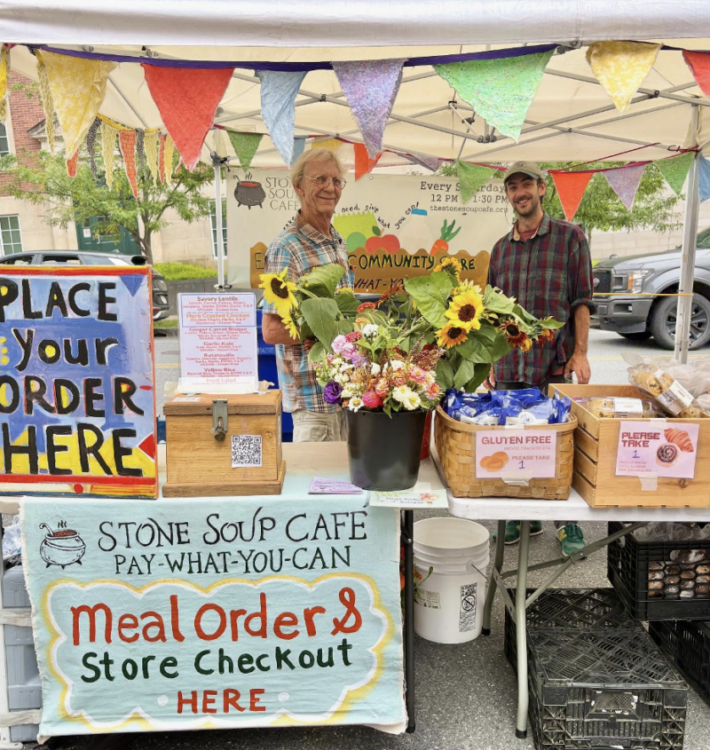
Stone Soup Cafe, Greenfield, MA. Photo: Chloe Spurr and Rowan Faris
By Chloe Spurr and Rowan Faris
With this article, we mark the resumption of our “Becoming Human” series, in partnership with our “A Better World is Possible” series.
We resume at a time when global fascism is ascendant, and as we feel the impacts of burgeoning authoritarianism and pervasive inequality in our daily lives. As we struggle to fend off these malevolent trends, it helps to remember they aren’t inevitable, resistance isn’t futile, that we can build something better, and that inspiring alternatives surround us. The profiles the series presents illustrate these alternatives, showing that a better world is possible. Over the next ten weeks, we’ll run a weekly profile of a hopeful endeavor that offers a counter-example to current trends. These profiles are authored by members of the Building Solidarity Economies Assemblage (BSE) at UMass Amherst.
Behind a red door on Hope Street in Greenfield operates a pay-what-you-can cafe where dignity, care, and community are at the center of every meal. Stone Soup Cafe, once known as Let All Eat Cafe, grew out of a relationship between American Zen Buddhist master Bernie Glassman and award-winning actor Jeff Bridges, who wanted to provide a weekly community meal in Montague. As community interest grew, Glassman dreamed of moving to a larger, more centrally located space, and All Souls Church stepped in to fill the need. In 2010, the Let All Eat Cafe began serving its weekly meal in Greenfield and a year later, was renamed to Stone Soup Cafe through a sociocratic process led by community members.
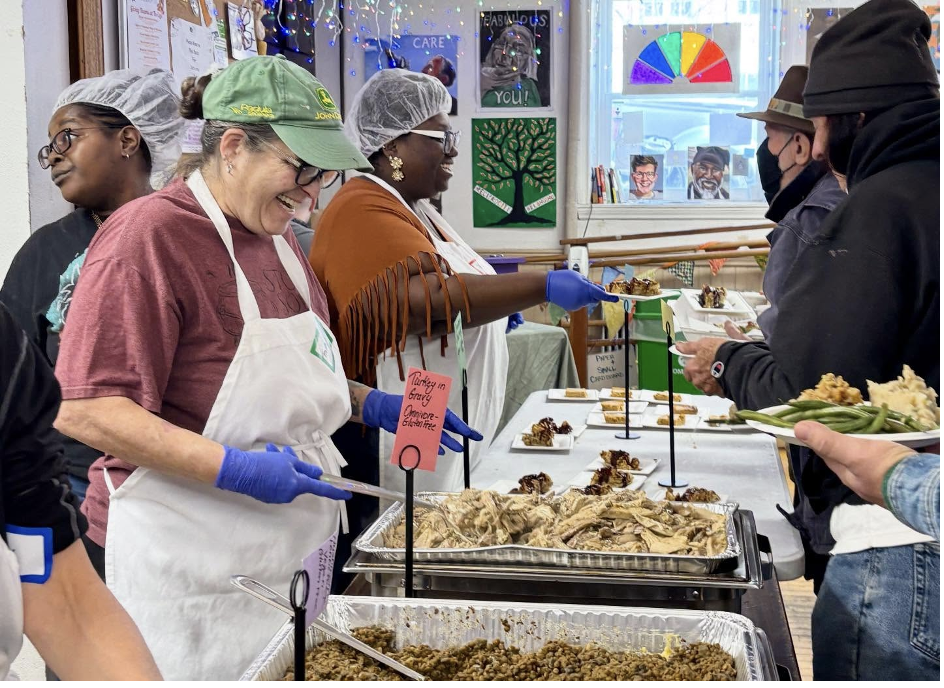
When Stone Soup first opened in 2010, a dollar was placed on every placemat, and people could either take it for themselves or leave it for the next person. Through this practice, people could choose for themselves with dignity, without feeling shame about their decision. Emerging from this initial choice came the pay-what-you-can model, which provides a way for people to take what they need and give what they can; everyone is welcome to eat together, regardless of means. Ten years after that first choice, and around the same time the cafe became a non-profit organization, Stone Soup began to identify itself within the mutual aid framework and started asking questions about its role in society as a whole. These questions led to events focused on political education and community conversation that bridge the gap between the cafe and the outside world. Today, Stone Soup offers Saturday meals, catering, baked goods at Farmers’ Markets, seasonal soup CSAs, monthly soup nights, and a community store that work together to meet community needs, fight injustice, and generate the resources needed to sustain the cafe.
By “building an infrastructure to meet our most basic needs” while initiating community conversations through their Solidarity Workshop series, featuring local organizations such as Redistro and Easthampton Tenants Union, Stone Soup is part of a growing solidarity economy in Massachusetts. Outside of the cafe, Stone Soup is strengthening relationships with local farms and gleaning organizations, such as Rachel’s Table and Just Roots Farm, to create a local food economy and provide organic meals.
Beyond expanding the solidarity economy, Stone Soup is contributing to a larger shift in how people think about and meet their needs. The cafe’s pay-what-you-can model shows people alternative ways to organize themselves and meet their needs outside the traditional market. By removing the hierarchy between volunteer and community member, or giver and taker, Stone Soup is reminding people that the food they provide is for everyone, not just a certain population. While our dominant capitalist system separates people, Stone Soup builds solidarity among community members and ensures everyone has a seat at the shared table.
Looking ahead, Stone Soup hopes to increase revenue through catering and soup CSAs while continuing to host more community events. In the long term, the cafe plans to buy the building where Green Fields Market now resides and turn it into a full-time restaurant and store where people can sit with their families and shop with a cart. To get involved with Stone Soup, visit their website to learn more about weekly volunteer shifts or check their Instagram (@stonesoupgreenfield) for upcoming community events!
Chloe Spurr & Rowan Faris are members of the Building Solidary Assemblage (BSE) at UMass Amherst
Each edition of Becoming Human will feature an article, reflection, interview, poetry, or other types of expression that engage with a creative community or municipal effort. These will include original features that discuss a local initiative and also stories about efforts in other parts of the world that we might learn from. The growing narratives, relations, and power from which other worlds are being assembled, maybe, can help reorient our hope and desire—and resignation—away from the death drive of white supremacist, heteronormative, capitalist modernity, and towards an open, uncharted horizon of radical egalitarianism and towards the reality that other worlds are in the making or already here. For the full introduction to Becoming Human that appeared in its inaugural column, look here. For a listing a previous columns, look here.
Acknowledgments: This column is in dialogue and solidarity with numerous collaborators and comrades including Vin Lyon-Callo, Meredith Degyansky, Penn Loh, Stephen Healy, students in Anthropology 340 – Other Economies are Possible, Anthropology 341 Building Solidarity Economies, Anthropology 597CC Community, Commons, Communism, and the pluriverse of world-making and world-defending efforts, movements, and projects in Massachusetts and around the world.
A Better World Is Possible” is an occasional Indy feature that offers snapshots of creative undertakings, community experiments, innovative municipal projects, and excursions of the imagination that suggest possible interventions for the sundry challenges we face in our communities and as a species. Have you seen creative approaches to community problems, or examples of what other communities do to make life better for their residents, that you think we should be talking about? Send your observations/suggestions to amherstindy@gmail.com. See previous posts here.