School Committee Discusses FY27 Budget Draft and Possible Time Change for School Day Start
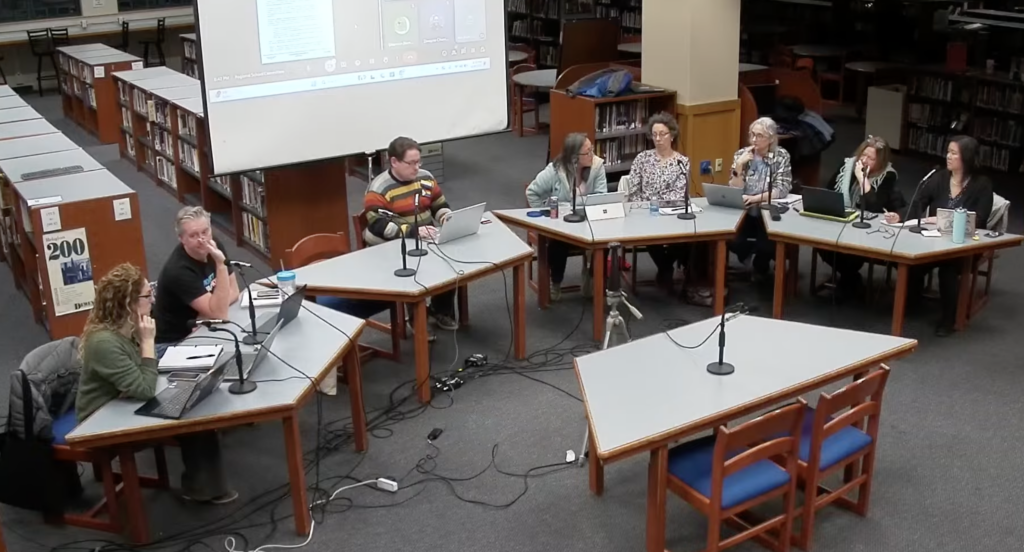
Meeting of the Amherst-Pelham Regional School Committee on December 9, 2025. (L-R) Sarahbess Kenney (Chair). William Sherr, Tim Shores, Anna Heard, Sarah Marshall, Deb Leonard, Bridget Hynes, Jennifer Shiao. Photo: Screen Shot/Amherst Media
Report on the Meeting of Amherst-Pelham Regional School Committee, December 9, 2025
This meeting was held in the library of the Amherst Regional High School and simulcast over Amherst Media Channel 15, and was recorded.
Present
Regional School Committee: Sarabess Kenney (Chair, Pelham), Anna Heard (Shutesbury), Bridget Hynes (Amherst), Deb Leonard (Amherst), Sarah Marshall (Amherst), Jennifer Shiao (Amherst), William Sherr (Pelham), Tim Shores (Leverett)
Staff: E. Xiomara Herman (Dr. Xi, Superintendent of Schools), Shannon Bernacchia (Director of Finance, Amherst Public Schools), Samantha Camera (Interim Assistant Principal at Amherst-Pelham Regional High School, representative of the Teaching and Learning Committee), Talib Sadiq (Interim Principal at ARHS)
Public Comment Supports LGBTQIA+ Families
The library chairs were packed with parents and community members ready to share their distress about Delinda Dykes’ reinstatement as a guidance counselor at the Regional Middle School (past reporting by theIndy) and to demand guarantees for the safety of gay and trans students. After about 50 community members and parents stood in silent protest outside the building entrance and lining the halls leading to the library, they placed their signs on seats facing the Amherst Media camera before the meeting began. Some of the signs stated, “Gay Agenda: accountability, transparency, equity” and “Yup, gay and so is our agenda” and “Gay agenda: protects kids.”
Eight parents and community members addressed the reinstatement of Delinda Dykes and the impact this will have on the students and the Middle School. Most of them shared their personal stories and asked the committee to take on a watchdog role to ensure that bullying does not start again. Some parents asked that their requests for their students to have “no contact” with Dykes be respected and upheld.
The LGBTQIA+ Caucus of Amherst said they were reclaiming statements made by Dykes, and replacing negative connotations around the phrase “gay agenda” with positive ones. Organizer Ali Wicks-Lim called for students, staff, faculty, and parents to paint their fingernails in support of queer students at the middle school in response to a report that Dykes had removed nail polish from the fingers of a male staff member in 2023 because, she had said, it was gender-inappropriate and sent the “wrong message” to students.
“This is a difficult time for queer and trans students,and it’s going to take all of us to protect them,” said Wicks-Lim, representing the caucus. “Language is important. Tonight, we’re reclaiming some of the language Dykes weaponized.”.
In an open letter to Dykes, Emily Pfeiffer, a parent of a former Amherst Regional Middle School (ARMS) student said, “If in your role as a counselor you want to avoid harming children, there’s only one thing for you to do. Resign. Find work somewhere else…Let these kids begin to heal and get through these challenges years of their lives without adding to the injury.”
Molly Johnson, an Amherst resident, shared her personal experience with bullying and the lifelong impact it has had. “My husband and I live here, we pay taxes here, we shop here, we want to buy a house here in a good school district and raise a family, but why would I do that where my future kids could be subjected to the same environment of fear that I had?” she asked..
Town Councilor-elect Amber Cano-Martin (District 2) a parent of two children in the school district, shared her experience as a parent as well as the understanding she has gained from talking with other parents in the community. She said parents are paying attention and residents deeply care about this issue.“We need the School Committee to be paying attention constantly to what is happening in the schools. Listen to teachers, listen to parents, and listen to the kids themselves, and take every possible step to document what is going on in those schools and what this individual is doing,” she said.
New Courses
While no formal votes were taken, the committee enthusiastically supported two new courses proposed for ARHS — Make a Play! and Music Theory 2 — as well as the Policy IKFE Competency Determination Proposal.
Changing School Day Start and End Times
With the support from Superintendent E. Xiomara Herman (Dr. Xi) the Office of Teaching and Learning (OTL) presented their requests to change the start and end times of the high school day from 9 a.m. to 8:30 a.m. and 3:30 p.m. to 3:00 p.m. (presentation). This presentation was meant to introduce the proposal and no votes were taken.
Samantha Camera, representative of the Amherst Regional Public Schools (ARPS) Office of Teaching and Learning (OTL), which provides curriculum and instruction support for grades K–12, as well as professional development for all staff in the school district, shared their proposal that is designed to introduce some flexible time into the daily schedule following the termination of Flex Block for this academic year. That change was enacted in order to ensure that the district meets minimal instructional hour requirements of the Massachusetts Department of Elementary and Secondary Education (DESE).
Read more: Students Praise ‘Flex Block’ as Chance to Study, Vibe, and Chill at Day’s End (The Graphic)
Camera explained that the loss of the Flex Block, which allowed students to go to one of their teachers for 40 minutes at the end of the school day for extra help, has led to reduced after-school opportunities for students to meet with teachers.
She said the loss of Flex Block has cut available afterschool time from 40 minutes to 10 minutes creating a conflict between instructional needs and extra curricular activities. Enrollment for clubs has decreased there is diminished time for student and teacher interactions and for relationship-building. Camera also said that during Flex Block, the library was open 130 minutes before and after school, but now it has been reduced to 25 minutes.
Preserving the extended block, the OTL argued, would mean that students could get extra help or participate in school clubs between 3 and 3:40 p.m. prior to the start of sports at 3:45 p.m.
Dr. Xi assured the committee that the proposed change aligns with state regulations, teacher contract requirements, and sports schedules, and will provide more time for individual instruction plans (IEPs) and 504 plans, as well as parent meetings, without loss of instructional time.
The proposal was met with skepticism from the committee.
Jennifer Shiao, Tim Shores, William Sherr, and Sarah Marshall requested to see more perspectives from students, teachers, parents, and from middle school staff and students who will also be affected by a time change.
Also, Shores and Sherr were “not convinced” that the American Academy of Pediatrics (APA) policy statement on start times supports the change, given that 8:30 a.m. is the earliest time it recommends for high school to start.
According to Shore, “It’s not just about the timing, it’s about the direction of change…. There’s just no research on the impacts on students and teachers on the shift in the other [earlier] direction, so that’s why I say I think we’re on thin ice.” Emphaszing that most schools are emphasizing a move to later start times, in response to pediatric recommendations, he said “I don’t think we can look at that [APA] policy brief and say we are aligned with that recommendation,” he added.
Anna Heard focused on the cost of transportation and how the new hours would impact it. She pointed out the current struggle to get buses to the school on time.“We need to figure out the transportation portion of this before we settle on this as a good idea because the way I see it this is going to blow up the transportation budget,” Heard said.
FY27 Draft Budget
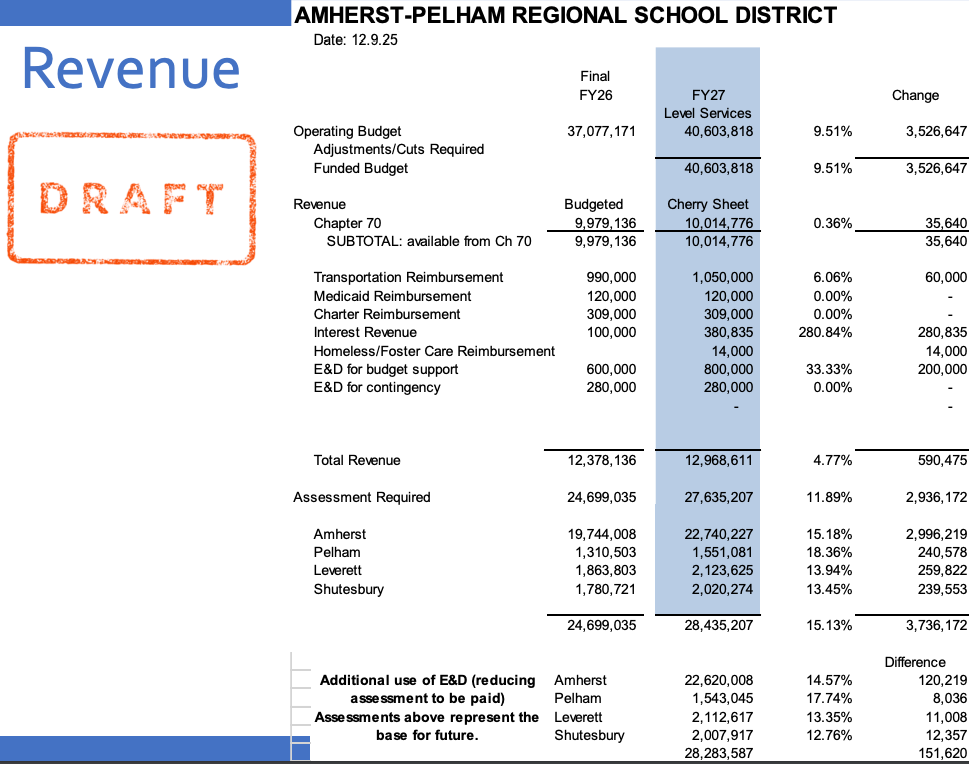
The preliminary proposed budget numbers suggest the FY27 budget will be $40,603,818, which represents an increase of 9.5% from FY26.
Usually presented in late January or February, Shannon Bernacchia (Director of Finance, Amherst Public Schools) shared preliminary numbers for the 2027 fiscal year capital budget and operating budget with the committee.
Chair Sarahbess Kenney reminded the committee that the budget will need three of the district’s four towns to pass it and that each town’s percentage contribution is fixed, so the committee cannot request any of the towns to pay more than their established share.. “It is our job to direct the superintendent to propose a budget back to us that meets certain funding expectations or hopes and educational goals,” Kenney said.
The next meeting on the budget will be January 5, with a Four Towns meeting on January 10. There will be a formal public hearing in February,
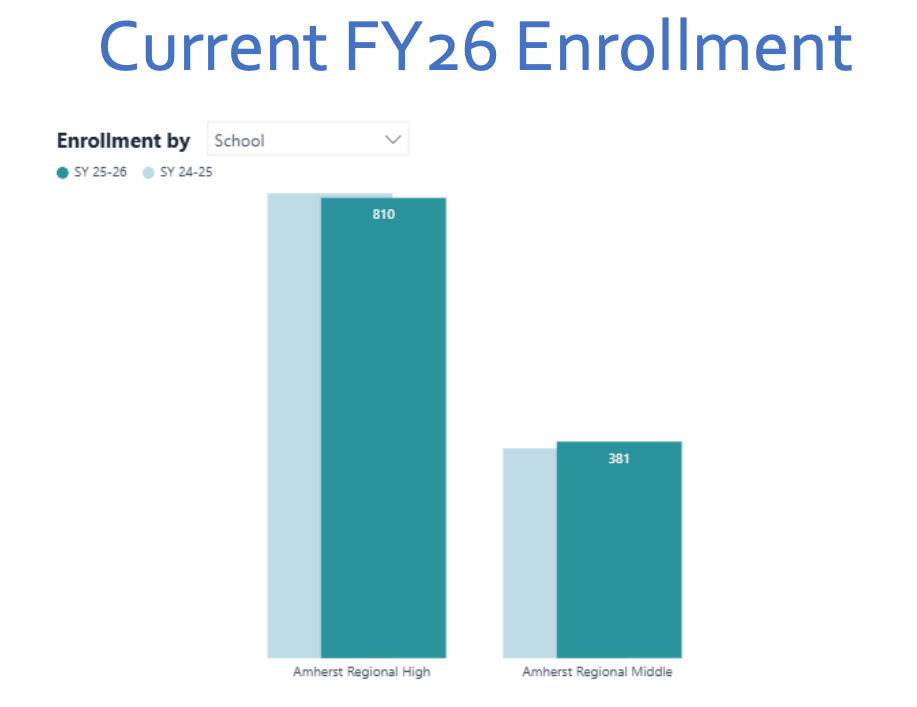
For this budget presentation, Bernacchia led the committee through graphs and numbers focusing on enrollment, revenue, a draft of the operating budget, capital requests, and revolving funds.
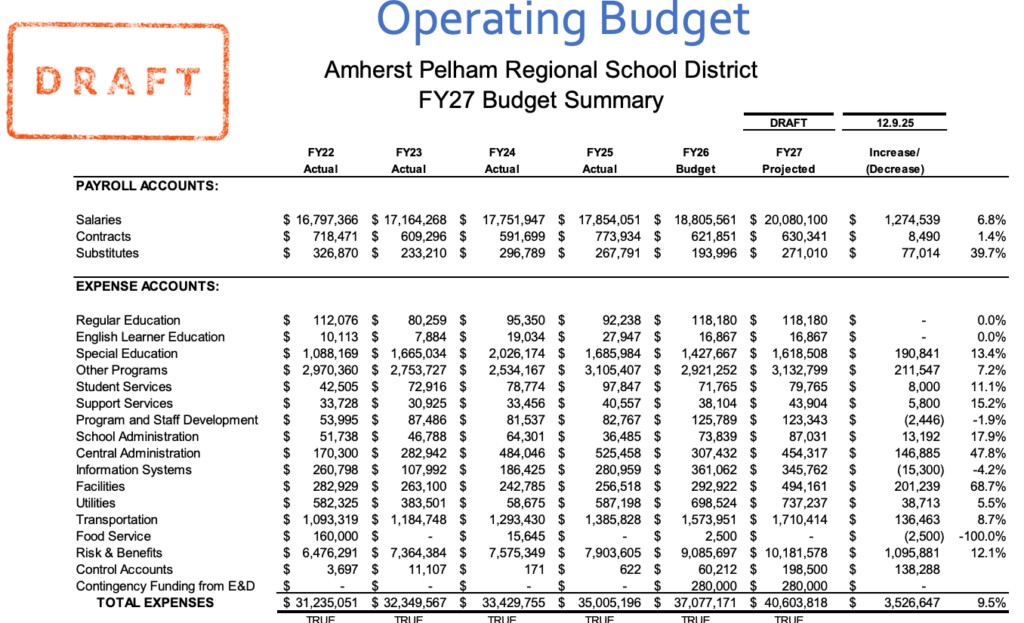
The greatest increase in expenditures comes from the Central Administration which is projected to receive a 47.8% increase, largely in response to legal fees and human resources, according to Bernacchia.
While Dr. Xi and Bernacchia reported on a range of expectations that had been raised by the committee, members nonetheless felt uncomfortable with the lack of details and insufficient time allotted to make comments and ask constructive questions. The committee will submit their questions and concerns for consideration by the superintendent’s team by December 16 in preparation for the meeting on January 5.
Below are some of the important graphs provided by Bernacchia
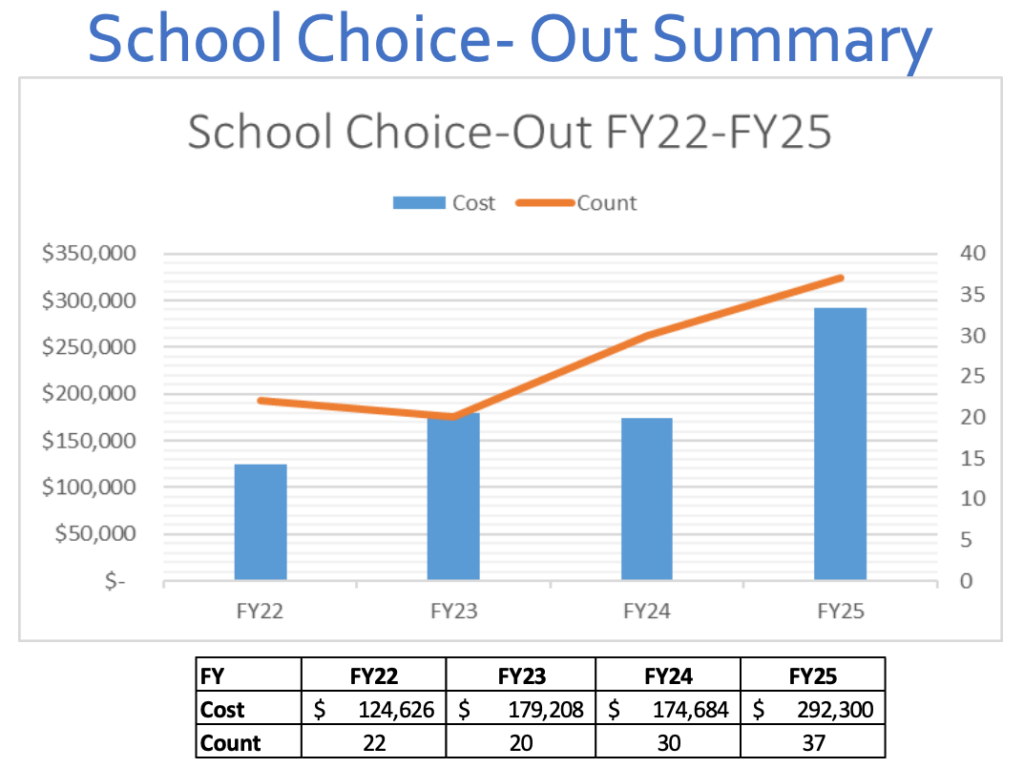
The graph below illustrates the cost of students opting out of the Amherst-Pelham district through school choice.
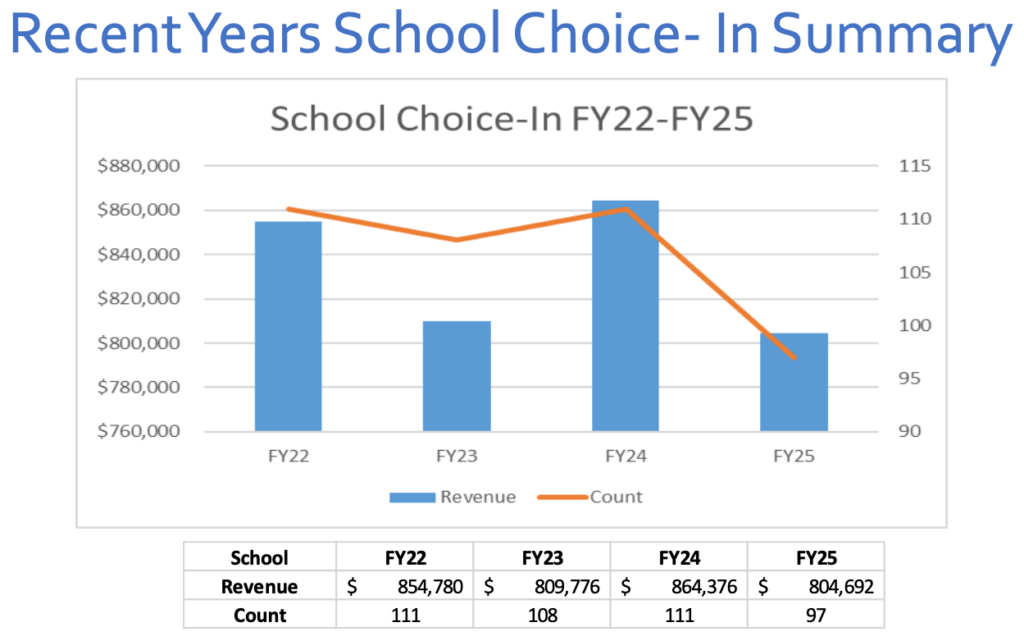
The graph below demonstrates the revenue generated from students opting into the Amherst-Pelham Regional School District through school choice.
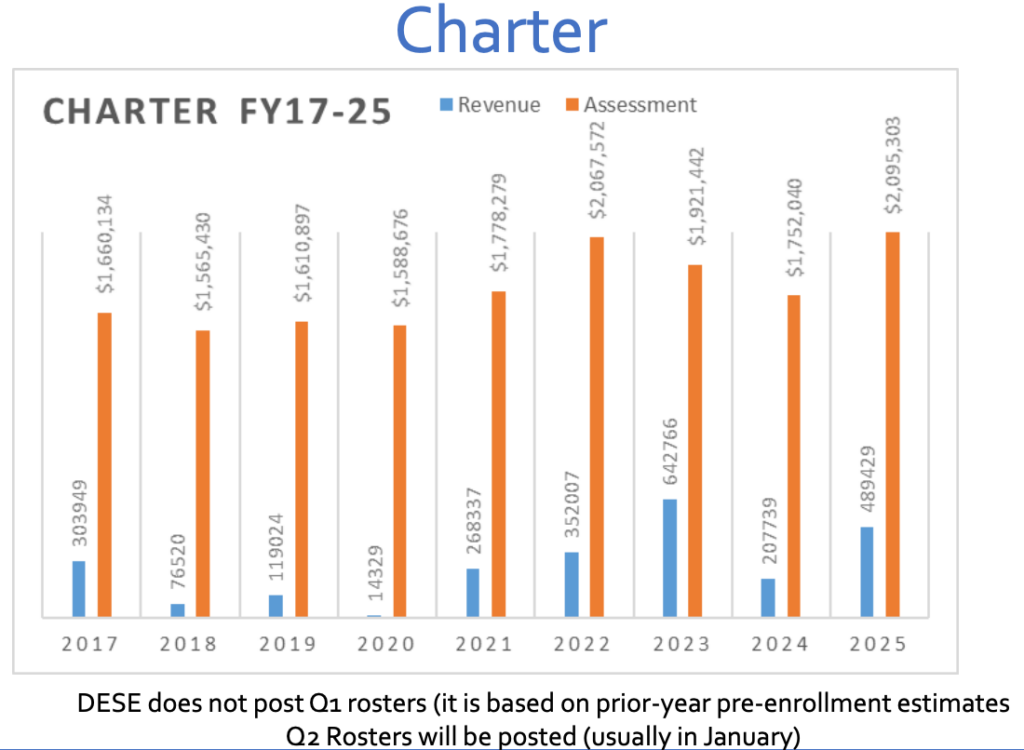
The graph below illustrates the revenue in blue and cost in orange for students attending charter schools in past fiscal years.
The graph below illustrates the anticipated operating budget based on past information and shows the increased percentage for each account. Central Administration and Facilities are the highest increases since last year.
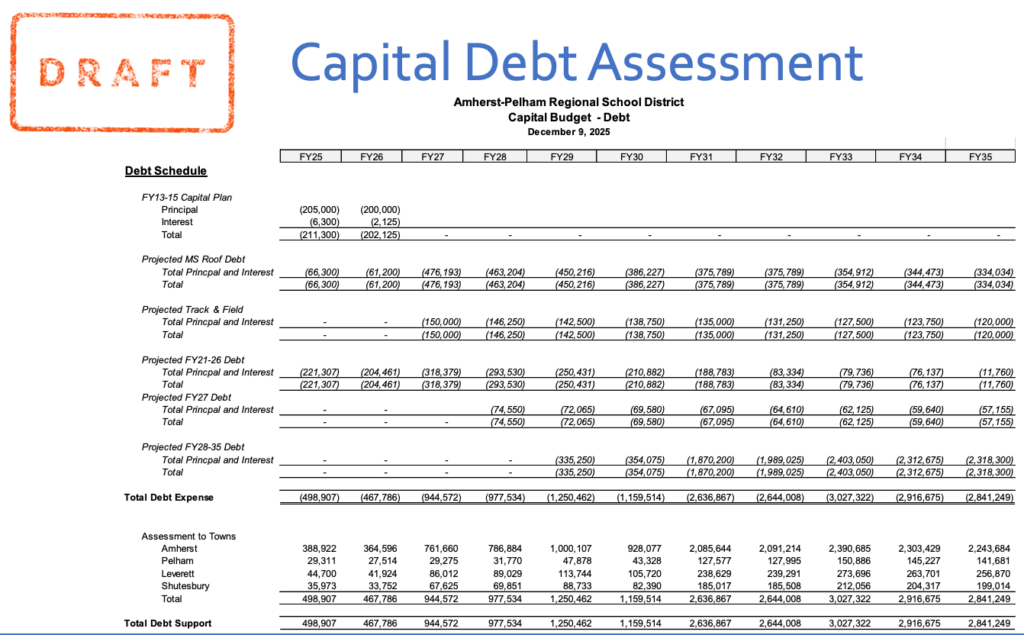
The graph below shows the expected capital debt, based on past years, and anticipates costs for maintenance of the new middle school roof and track.
The graph below shows state aid through the anticipated Chapter 70 formula funding for FY27, as well as transportation reimbursement and a new contribution in homeless/foster care reimbursement.