
Council Rejects Additional CPA Funding for Jones Library Project
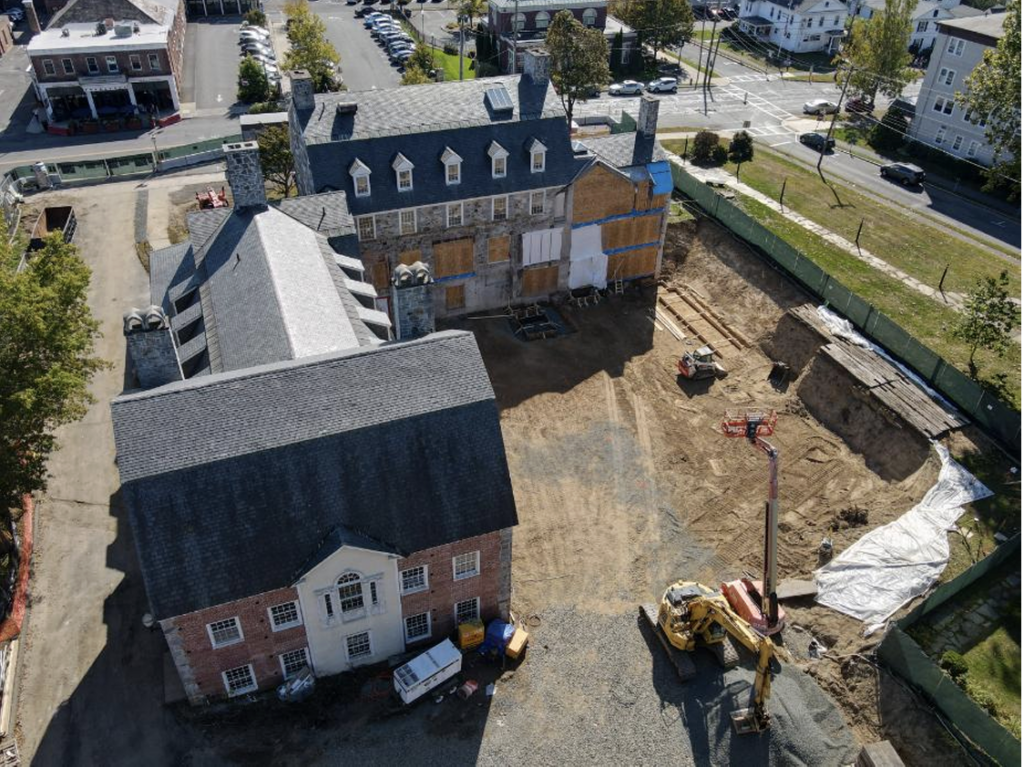
Aerial view of Jones Library following demolition of the 1993 addition. Photo: amherstma.gov
Report on the Meeting of the Amherst Town Council, April 27, 2026, Part 1
This was a hybrid meeting held in Town Hall. It was recorded.
Present
Mandi Jo Hanneke (President, at large), Jill Brevik and Cathy Schoen (District 1), Amber Cano-Martin and Lynn Griesemer (District 2), Hala Lord and George Ryan (District 3), Pam Rooney and Jennifer Taub (District 4), Ana Devlin Gauthier and Sam MacLeod (District 5), and Andy Churchill and Ellisha Walker (at large).
Staff: Paul Bockelman (Town Manager) and Athena O’Keeffe (Clerk of Council)
Highlights
- Town Rejects $330,000 CPA Allocation for Jones Library Expansion
- Clean Energy Bylaw Referred to Planning Board and Community Resources Committee
- Councilors Request Clarification on Town’s Policy on Interaction with Federal Immigration Officers
- Still No DPW Worker on DPW Building Committee
- Council Passes Resolution Honoring Amherst Media’s 50th Anniversary
- Public Comment in Support of Elementary School Budget
Council Rejects Additional CPA Funding for Jones Expansion Project
After several debates at council and Finance Committee meetings about whether the Jones Library’s request for $330,000 in Community Preservation Act (CPA) funds for preservation of historic Philippine mahogany woodwork was eligible for the funds, the council voted 4-7-2 against the allocation. Mandi Jo Hanneke, George Ryan, Andy Churchill, and Sam MacLeod voted for the funding, and Lynn Griesemer and Ana Devlin Gauthier abstained. The library had previously received $1 million in CPA funds for Special Collections in 2021.
The major issue in this new request was that the work to be covered was already included in a signed construction contract with Fontaine Brothers and the money to pay for that work had already been borrowed by the town. The original request of $1.3 million was decreased to $477,000 in order to eliminate work on ineligible windows and then decreased again to $330,000, because some of the preservation work had already been completed, and therefore was not eligible for FY27 CPA funding. “Supplanting” (see also here) projects funded by other means is not allowable under CPA guidelines.
In evaluating the situation, the Finance Committee received conflicting information. The Town Attorney K-P Law felt that the request was not supplanting, but an attorney for the Amherst Historic Preservation Coalition, Anderson-Kreiger, disagreed. Stuart Saginor, the Director of the state CPA Coalition, thought the request fell into a “gray area in terms of the spirit of the law, and he did not like it”, and Ken Woodland, Attorney for the Municipal Law Division of the Department of Revenue, also felt it fell into a gray area. The town’s auditor Tanya Campbell, however, agreed with K-P Law.
The decision to not support the funding was clearly difficult for some councilors who noted their support for the renovation and expansion project. Hala Lord said, “I support the library project itself. I’m excited that Amherst will have a beautiful and expanded public space that can serve residents across generations.” She said her “concerns are grounded in governance, process, and trust. This council previously stated that we would not permit additional taxpayer funds to this project.” She vowed to do what she could to help raise funds to complete the project.
Devlin Gauthier and Griesemer also announced their strong support for the library project, but abstained because they were worried about the legal ramifications of allotting more CPA funds to the Jones expansion. Devlin Gauthier said she understood the need for the library’s capital campaign to have to “scrap for every dollar” and did not fault them for seeking additional CPA funds. But she voiced her concerns: “Where I am stuck is if these were truly additional funds, I would have zero qualms supporting it. My challenge is that the items are in an existing contract that has been signed, and a project that will happen regardless. I’m struggling because I do see where the argument for supplanting is strong here.”
Griesemer said, “This, unfortunately, has brought out all of the controversy that has existed around this project from even before this council was first seated. This project has been in court. It’s cost the town an enormous amount of dollars to defend it in court. And we won. My biggest concern about this vote is that if we vote yes, we’ll end up in court yet again, and it’ll cost the town even more money.”’
[Editor’s note: Two of Griesemer’s assertions are factually incorrect. The town went to court in June of 2021 to defend itself in a voting rights suit brought against the town for inappropriately disqualifying signatures on a petition (see also here) to force a referendum on the Jones expansion borrowing under the voter veto provision of the Town Charter. The town did not win that suit but eventually consented to hold the referendum, which resulted in the dismissal of the suit. The town spent seven months and unaccounted legal fees fighting a referendum that they ended up holding anyway. That time, and those dollars, would not have been lost if the town had simply held the referendum in June 2021 as provided for in and mandated by the Town Charter.]
Cathy Schoen gave three reasons why she opposed the library receiving more funds from CPA. She firmly believed that CPA funds are tax dollars, since more than 80% come from a 3% surcharge on property taxes, and the council had assured that public that the cost to the taxpayers of the library project would be no more than the $15.8 million voted in the Memorandum Of Agreement with the town. Schoen thought that the previously awarded $1 million in CPA funds should have reduced the town’s obligation to $14.8 million.
Secondly, she said that, according to the town’s guidelines, CPA funds are meant to be supplemental in order to increase available resources, not to supplant work already underway. She said many of the letters that councilors received from residents appeared to believe that the funds would add to the scope of the project “that we were buying something more,” not paying for work already funded.
Lastly, she maintained that when the vote on whether to rescind funding for the project in April of 2025, “the trustees assured us that they intended to raise the funds to finance their share. They listed foundation, state, and federal sources. They never listed CPA. If they had, I would have voted to rescind.”
Churchill and MacLeod based their vote to award the CPA funds primarily to respect the work of the CPA Committee. MacLeod acknowledged that CPA funds are taxpayer money. Churchill added that the extra funds would help protect the library’s endowment which has been pledged as collateral against a fundraising shortfall.
The strongest expression of support came from Ryan. He stated, “What I do know is that [the renovated library] will be a transformative project. What I do know is a town jewel will be given another hundred years of life. It’ll be enjoyed by countless people, most of whom we will never know. And they will be profoundly grateful for what we’ve done. The Jones Capital Campaign has raised over $9 million to date. No project in the history of this town has ever come close to that figure. Yet it still has to raise another $6.8 million. Whatever it cannot raise in the intervening year and a half will come out of the endowment.” He pointed out that the project lost $1 million in NEH funds when the Trump administration rescinded almost all NEH grants. He maintained that he would not vote for more borrowing for the project, but felt the CPA funds should be given to ease the burden on the library’s fundraising campaign and endowment.
In public comment, Maria Kopicki stated, “The Jones CPA application is rife with problems, and the process that brought it forward failed to adequately address concerns about supplanting and the historic preservation requirements for CPA. It was also far from impartial, with several members of committees who failed to recuse themselves from discussion and decisions, despite their active participation in the very capital campaign that brought the application. Each time this project has come to the town to bail it out, you reassured us, your constituents, that the MOU’s protect us against further impact. It’s time for you to show us that those were not empty promises.”
The other CPA projects, as well as the borrowing authorization for $1.5 million for the War Memorial bath house, were approved unanimously on the consent agenda. Lord recused herself from voting on the CPA projects because she is on the board of the Goodwin Church, which is one of the applicants.
Clean Energy Bylaw Referred to Planning Board and Community Resources Committee
Sustainability Director Stephanie Ciccarello described the four-year process that led to the development of the draft Clean Energy Bylaw that will govern the establishment of ground mounted solar installations and battery energy storage systems (BESS).
Ciccarello said that in August 2025, the state revised its laws in order to expedite the approval and construction of large solar projects, and the town’s bylaw needed to be brought into agreement with the state regulations. She highlighted the fact that the state requires a proposed project to receive a consolidated permit from all relevant boards and entities within 12 months of filing an application. The state does allow for a 90-day pre-application period to resolve major concerns and provide documentation.
All solar projects larger than 25 megawatts and BESS over 100 megawatts are automatically reviewed by the state. The new regulations go into effect in October 2026.
According to the town’s bylaws, the proposed new bylaw must be referred to the Community Resources Committee (CRC) and the Planning Board. Those two entities will hold a joint public hearing on May 20. The measure will then go to KP Law and the Governance, Organization, and Legislation Committee for review before it returns to the Town Council for two readings and finally a vote.
MacLeod worried about the effect of the new regulations on individual homeowners wanting to install solar panels on their roof. Council President Hanneke said that rooftop solar was considered an accessory use and could be approved by the existing permitting application.
Schoen noted that, ironically, “The state, in its interest to speed up the process has produced one of the most regulatory heavy things that I have ever seen.”
Brevik and Cano-Martin Request Session with Town Manager to Clarify Town’s Response to Possible Actions of Federal Immigration Officers
Councilors Jill Brevik and Amber Cano-Martin asked that Town Manager Paul Bockelman appear before the council at the May 18 meeting to clarify the interaction between town staff and federal immigration agents. They said that they have received many questions from residents about what would happen in different instances. They hoped Police Chief Gabriel Ting would also come to answer concerns not clear in Bockelman’s March 3 executive order.
Brevik’s memo states that the request is “intended to provide an opportunity for town leadership to answer a series of questions and clarify both the Town’s policy and guidance on interactions with ICE agents as well as proactive steps that are being taken to prevent ICE from harming Amherst residents.” She suggested that members of the council, the Community Safety and Social Justice Committee, and the Human Rights Commission submit their questions and questions from residents to the Town Manager by May 4, so he can answer them on the 18th.
Devlin Gauthier pointed out that the presentation that Bockelman and Ting did at Applewood in March dealt with many issues around possible federal agent activity in town, but she thought it would still be helpful for them to speak to the council. According to Bockelman, the Applewood presentation was not recorded.
Bockelman said that he believes that Chief Ting will be interested in attending.
Still No DPW Worker on DPW Building Committee
Despite the vote of the Town Council recommending that a DPW employee be included on the DPW Building committee, Bockelman remained noncommittal. In response to Ryan asking if a DPW employee had been appointed yet, Bockelman said, “I’m still considering it. I haven’t made a decision yet.”
Cano-Martin asked that the DPW Building Committee meetings be hybrid, so more people could attend. As of now, they are only held in person and are not recorded. Bockelman replied that the decision is up to the committee chair. He recommended that Cano-Martin send a request to the committee chair Christine Gray-Mullen.
Council Passes Resolution to Honor Amherst Media’s 50th Anniversary
The council unanimously passed a resolution “honoring Amherst Media on the occasion of its 50th anniversary and recognizing its distinguished service to the community of Amherst.” Amherst Media was founded in 1976 and is the longest-running community media organization in the United States.
The resolution concludes, “NOW, THEREFORE, BE IT RESOLVED that the Amherst Town Council expresses its deepest gratitude and highest commendation to Amherst Media for fifty years of exceptional service to our community, and celebrates this golden anniversary as a testament to what can be achieved when a community invests in its own voice.”
Amherst Media is celebrating its 50 years in existence with a gala at the UMass Campus Center on Saturday, May 2. Representative Jim McGovern and radio personality Monte Belmonte will be there, as well as entertainment and presentations on the history and vision for the future of Amherst Media. Tickets are available on the Amherst Media website.
Public Comment in Support of the Elementary School Budget and Cooperation Between UMass Student Government and the Town
Several educators urged the Town Council to accept the elementary school budget passed by the school committee, which restores the positions of specials teachers, intensivists, and some special education staff. This budget is $360,000 over the 3.8% increase recommended by the Town Manager for all town departments.
Educators Laura Yvonne Steinman, Chris Spinozzi, and Peter Nolan spoke of the harm that would come to students who need more individual attention if positions were cut because of a budget shortfall. Nolan read a statement signed by eight special education teachers at Wildwood and Fort River schools.
Six UMass undergraduate students active in the Student Government Association expressed the hope that the town and SGA could work together in confronting concerns that both have, especially regarding the shortage of housing. Charlotte Reeve spoke against the limitation of no more than four leases per unit, which increases housing costs and, she maintained, did not deter noise and decrease trash as intended. Others also spoke of collaborating on sustainable initiatives and supporting local businesses. The students are now finishing the academic year, but maybe the collaborative approach they spoke of can begin in the fall.
Editor’s note: this is in response to public comment by Charlotte Reeve at the very end of the article.
Limiting rentals to four unrelated people is not just about noise or trash; it’s also one of the few levers left to keep Amherst from tipping further into being a seasonal dormitory town. Families already can’t compete with a house that can pull in four or more students at 1,200 dollars each. In a market like that, the “rational” owner maximizes beds and cars, not neighborhood stability. We already have private dorms downtown and whole areas regularly called “student slums,” even by the Planning Board. Meanwhile, year‑round population is steadily declining, which undermines schools, civic life, and the basic sense that Amherst is a community rather than a campus edge. A modest cap on unrelated renters is an imperfect but reasonable tool to preserve some balance while we figure out more comprehensive housing and zoning reforms.
First, the Town Council (and the CPAC) should consider reallocating that $330K, plus a major share of the next years’ (plural) CPA fund allocations, to secure Hampshire College open space with conservation easements and APRs in cooperation with the Commonwealth (DCR and DAR), the Town of Hadley, with land-preservation organizations like the Kestrel Land Trust, and with the debt-holders; potential community housing infrastructure on the Hampshire campus can also be protected by analogous means.
Second, and without delay, the Town Council (through the Town Manager) should exercise its authority under MGL Chapter 79.
https://malegislature.gov/Laws/GeneralLaws/PartI/TitleXIII/Chapter79
In addition to all the reasons Ira Bryck notes for maintaining the town’s bylaw that limits occupancy to no more than four unrelated individuals in a single dwelling unit, increasing occupancy is unlikely to reduce the per resident monthly rent. Landlords leasing to students charge per person, and are unlikely to rent a house or apartment to six students at the same total monthly rate as they would when renting that same unit to four students. Increasing occupancy limits will yield a greater return on investment for property owners, but is unlikely to lower monthly rents for individual tenants in the unit.
Our bylaws require one lease for all of the persons living in a unit. Leasing by the bedroom defines a rooming/boarding house which is regulated by a different much more stringent section of the zoning bylaw, requiring among other regulations, an owner occupant.
So why are there six students living in the house next to me? As told to me by the tenants themselves and evident by the six cars parked there. Then you add the one or two boyfriends/girlfriends that show up for the night, you’ve got seven/eight cars most nights. This has been brought up numerous times through town complaint forms but nothing is consistently done about it.
To clarify in response to Hilda Greenbaum — yes, landlords issue one lease per dwelling unit, but they base the total monthly rent on the number of occupants. If a landlord who currently rents a house to four students at $4,000 a month is permitted to rent that same house to six or eight students, the total cost of the monthly rent is unlikely to remain $4,000.
It also seems likely that a house with 6 people will create more trash and noise than a house with 4 people. I’d love to read the study someone referenced that says that’s not so.
There is no “Invisible Hand” that is wisely regulating the balance in Amherst. Not to mention no government body. But still, the only tools and levers a town has to regulate anything are regulations.
Here is a partial list of places that have a max of 3 or 4 unrelated people:
3 Unrelated Person Limit:
Belle Terre, NY; Jackson, WY; St. Louis, MO; Boulder, CO; Norman, OK; Gainesville, FL; Columbia, MO (R-1 zones); Pittsburgh, PA; Salt Lake City, UT; Loveland, CO; Longmont, CO; Milwaukee, WI; Fargo, ND; Philadelphia, PA; Chicago, IL (all unrelated); Fort Collins, CO; Aurora, CO; Littleton, CO (U+2)
4 Unrelated Person Limit:
Chapel Hill, NC; Las Vegas, NV; Grand Rapids, MI; Baltimore, MD; Cambridge, MA; Fairfax County, VA; Columbia, MO (non-R-1 zones); Madison, WI (certain rental zones); Arlington, VA; Brighton, CO; Denver, CO
in New Orleans, 5 or more unrelated residents living together would be in a rooming house, that require special licenses, square footage minimums (often 60-80 square feet per rooming unit), annual inspections (examining structural conditions, exits, electrical, HVAC, plumbing, ventilation, smoke alarms, pest control, and over-occupancy, with criminal penalties)
So that limitation is a widely used method to control overcrowding all over the US.
There are lots of generalizations above about both property owners and tenants. One person can be a total slob and four nursing students can be studying or working most of the time so rarely home. One family was so dirty we had to strip the apartment to the studs to evict the cockroaches which were never in that building. Five honors pre-med guys want a quiet place to study etc.
Check references, but don’t depend on the most recent one who may want to get rid of a bad Apple. But don’t generalize! That’s discrimination.
Regarding the issue of the council’s vote against CPA funding request for the Jones …
Oh my, a window of common sense and, dare I say, one allowing in the spirit of the law.
Was that because a council member was protecting the town against additional legal costs, as if using more tax dollars for the Jones Folly would not cost “the town”? Apparently, residents who filed the previous lawsuit referenced were willing to accept their own legal costs to defend their rights.
Thank you for pointing out yet another inaccurate statement by Ms Griesemer.
As I recall, as a listed plaintiff, the aforementioned lawsuit concerned the process used to verify the signatures of voters on a petition, which disqualified many, not the reason for the petition.
“This project has been in court. It’s cost the town an enormous amount of dollars to defend it in court. And we won”.
So, a member of the town council sees themself as a member of the town, not to be confused with the resident taxpayers who had a serious disagreement with what the town did in their name.
Sadly, those who speak on behalf of the town or a “win” for it do not always represent what is in its best interest or fairness for all of its residents. Think the presidential election of 2024…just saying.