
Opinion: The Merry Maple and Dickinson’s Ghost
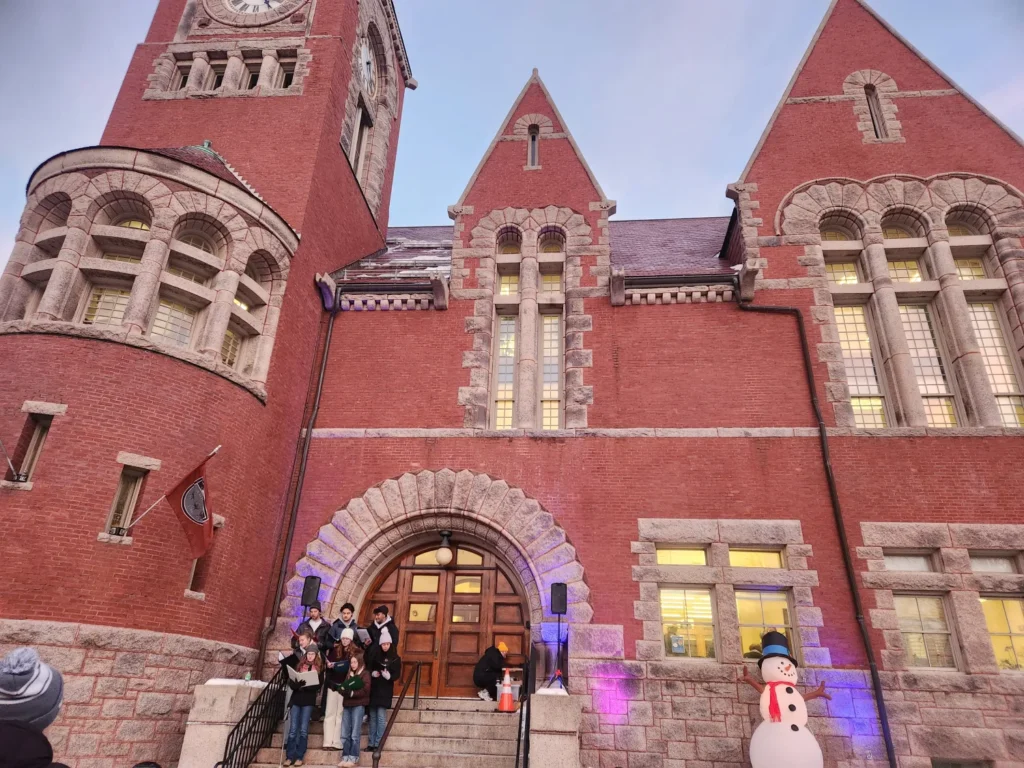
Carol singers and the steps of Town Hall for the lighting of the Merry Maple, December 5, 2025. Photo: Rizwana Khan
Social Injustice Goes Global

Amherst restores your faith in community—just enough to make you forget the zoning fights, the parking wars, and that one guy who always complains about taxes. But we show up, freeze a little, and clap for lights on a tree, and for a moment the whole place feels stitched together. That’s the Merry Maple effect.
On a crisp Friday evening, December 5, 2025, when Amherst temperatures plunged toward sub-zero and the air carried that sharp New England bite, I joined the crowd on the North Common for the town’s annual tree-lighting ritual. The air sharpened and slowed as the whole town braced itself for winter’s longest stretch. The lights and the cider-sweet warmth of strangers pressed together offered an ambiance both quaint and defiantly timeless.
Dating back to the early 1960s, the event was born from Amherst’s realization that it needed at least one winter gathering capable of coaxing students, families, long-term locals, and reluctant introverts into the same square without anyone arguing about zoning or parking.
Outside, Amherst Town Hall, a building nearly 150 years old, glowed under holiday lights. White granite stairs, worn by generations of boots, protests, and snowstorms, stood steady as choral singers lifted their voices, mingling with the scent of hot apple cider and freshly fried donuts drifting through the cold air.
The fire station, Amherst’s beloved brick guardian, was decked out in lights like a Norman Rockwell painting gently updated with a Pinterest account. Captain Kennedy stood near the engine bay, greeting people with the patient warmth of someone who has faced every imaginable fire.

I joked, half lightly and half out of genuine curiosity, about whether the department had finally unlocked the secret to preventing another Olympia Place situation. Captain Kennedy answered with that unmistakable diplomatic firefighter smile: kind, steady, and just evasive enough to signal that even first responders deserve one night off from carrying the town’s collective anxieties.
Next, on December 6 afternoon, I wandered through the Emily Dickinson house, restored close to how it looked when Emily Dickinson lived there until her death in 1886.
The Emily Dickinson Museum had that late-afternoon Amherst glow that makes you suddenly believe in poetry again, or at least in artisanal cider. Celebrating Dickinson’s 195th birthday with free apple cider, ginger cookies, the tiny cards printed with her verses, scattered across tables like confetti for introverts. Only in Amherst can a woman who famously avoided company still host a crowd 138 years after leaving the party.
I sipped the cider—warm, a little too sweet, but charmingly local—and imagined Dickinson in the kitchen, sneaking botanical experiments into the batter and quietly laughing at the chaos of life she mostly ignored but pressed between notebook pages like fragile flowers.
The Homestead and The Evergreens have been restored to resembling Amherst of Dickinson’s time: dark wood banisters, delicate wallpaper that looks like it would dissolve in sunlight, the faint scent of old wood polished by caretakers and volunteers with MFA degrees. Walking through, it feels like time travel curated by gentle New England preservationists.
Amherst College hovers over the town’s history, a quiet colossus founded in 1821 by the grandfather of Edward Dickinson, Emily’s father, as a modest institution aiming to educate young men in the liberal arts. born of civic ambition and private generosity grown into one of the wealthiest colleges in the world. Its endowment, a modern echo of a grandfather’s vision: to shape a town and minds and to leave a mark that would outlast even the tallest oak on the campus green. Amherst College’s influence allowed Dickinson’s family and her circle to flourish intellectually.
Upstairs, everything softened into a hush, and alone on the second floor, the distant hum of Amherst’s version of rush hour receded. The light shifted like an unfinished stanza.
I took in her writing table, small bed, and the famous window overlooking the garden that she treated like a second vocabulary. Dickinson, perched at her tiny desk, scribbling furiously, ignored a world that didn’t understand her. She pushed back against editors, mentors, and societal expectations that wanted her to be small, quiet, manageable.
The room’s acoustics made me hyper-aware that I was trespassing in a genius’s solitude. Late afternoon light slanted across the floorboards and felt like the room itself inhaled.
The bedroom had been returned to its old state, though several key pieces, the bureau and the tiny writing desk that shaped Dickinson’s work were reproductions. (The originals are at Harvard.) Dickinson’s single bed, dark wood polished to a melancholy glow, felt particularly poignant.
Snippets from her poems were scattered throughout the house. I read a few— “A chilly Peace infests the Grass” and “I dwell in Possibility”—to get into the mood.
A fantasy of a life where creativity isn’t constantly interrupted by email notifications, rent increases, and climate anxiety. Dickinson didn’t have Instagram, yet she mastered the soft-girl aesthetic before any of us existed. She wrote in secret while we post confessions into Notes apps, praying no one finds them.
A replica of one of her white dresses caught the golden light near the window, appearing almost alive. A chilly Peace infests the Grass… I dwell in Possibility…”—and felt a thrill, as if the house itself were breathing in her words and exhaling inspiration.
Autonomy and survival are inseparable from community responsibility and skills were learned not just for oneself, but for others. Meals shared, decisions debated and celebrations collective, not solitary Instagram moments. Dickinson tending her mother, sustaining her creativity, building invisible yet vital networks; this is what Atul Gawande argued for: autonomy, dignity, and meaningful presence, even at life’s end.
Dickinson in her Amherst home, writing poems, tending to her mother, claiming control over her world. Gawande in Being Mortal, now, showing us how the systems we build often rob us of our agency. And in Amherst, in our brunches, in our volunteer work, in our classrooms we can do better and care for each other, fully, responsibly, fiercely.
Emily Dickinson, pocket-sized daguerreotype in hand, nodding at this philosophy, clarifies that isolation fosters creativity and connection and gives life the invisible web: Dickinson’s poems and the legacy of Amherst College—all pointing to the same truth: humanity isn’t in independence but in interdependence.
Rizwana Khan is a writer, educator, and human rights advocate in the Town of Amherst.
Thanks, Ms Khan, for this charming and thoughtful piece.