
Federal Funding Cuts Could Hurt Massachusetts Economy for More Than a Decade
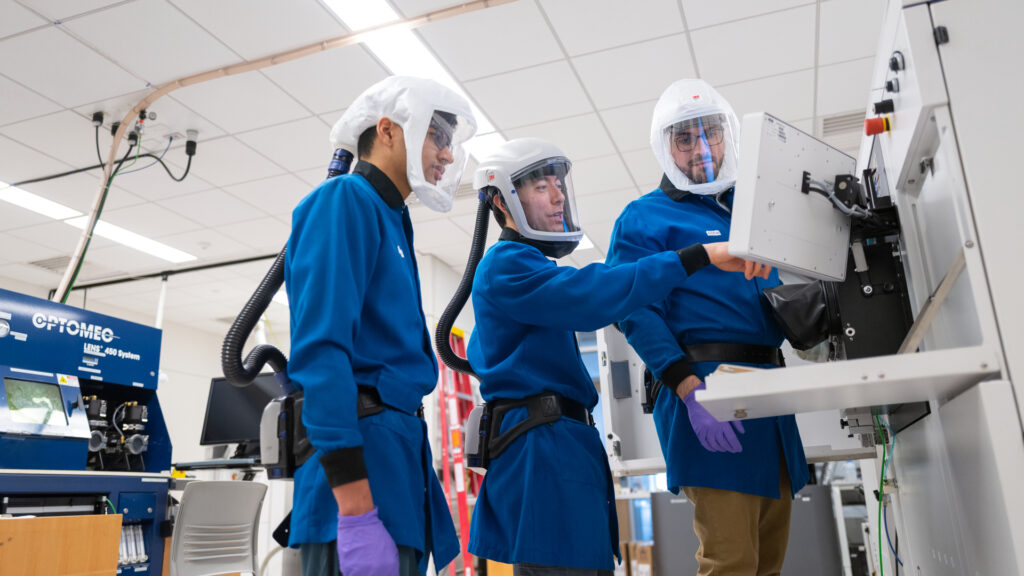
Institute for Applied Life Sciences, UMass Amherst. Photo: umass.edu
Source: UMass News and Media
A new study by the University of Massachusetts Donahue Institute provides a first-of-its-kind analysis of the commonwealth’s research & development ecosystem, which includes jobs in scientific research and development activities plus the high-tech innovation industries (e.g., life sciences, semiconductors, computer systems, etc.). This sector thrives due to cutting-edge research underway in the state, and fuels more than 376,000 direct jobs, $347 billion in total economic activity and more than $13 billion in state and local taxes.
This research underscores the symbiotic relationship between early-stage scientific research in the academic and medical fields and different elements of the innovation economy in the private sector. With that, federal funding for research and development plays a much greater impact on the state’s economy than has been widely understood and reductions in that funding could adversely impact the commonwealth’s economy for at least a decade, according to the Donahue report.
“The economic consequences of federal research funding uncertainties are real. Research is the engine of the Massachusetts economy, and any funding disruptions will not only stymy innovation but also threaten the development of the next generation of scientific and engineering talent in the state. This is a threat to our global competitiveness now and in the long term,” said Mark Melnik, director of the Economic & Public Policy Research group at UMass Amherst Donahue Institute.
The report comes as federal support for early-stage research—especially from Massachusetts universities and research hospitals—has declined due to shifting federal priorities. Historically, this funding has fueled innovation and economic growth by enabling institutions to develop and test new technologies that, once commercially viable, attract private investment to bring products to market and scale production.
Economic Impacts
The Massachusetts research and development ecosystem directly employs 376,000 workers and, when accounting for broader spin-off effects from business-to-business and consumer spending, supports:
- $347 billion in total economic activity
- Just over one million jobs statewide (28% of 2024 employment)
- $142 billion in labor income (40% of all wages in the state)
- $218 billion to gross state product (28% of the state economy)
- $8.7 billion in state taxes (equivalent to 15% of the FY2024 state budget)
- $4.6 billion in local taxes
Massachusetts Ranking Amongst Other U.S. States
- Massachusetts’ research and development ecosystem, in terms of job numbers, is a quarter of the size of California’s and just over half the size of Texas’ despite having a fraction of the population of either state.
- For every 1,000 residents in Massachusetts, 52 people are employed in the research and development ecosystem, the highest of any state.
- Federal research funding obligations in Massachusetts were valued at $10 billion in 2023, fourth nationwide for total federal R&D funding as well as for per capita federal funding obligations.
- The National Institutes of Health (NIH) accounts for over one-third of all federal R&D funding destined for Massachusetts and the state is the largest recipient of NIH funding on a per capita basis.
- Per capita, the state also received the most funding from the Small Business Innovation Research (SBIR) and Small Business Technology Transfer (STTR) awards in 2024.
- Venture capital: With nearly $16 billion in 2024, Massachusetts ranked third, behind California and New York.
- Business spending: The scale of business spending on R&D in Massachusetts is substantial ($49 billion in 2023) and reflects the industry recognizing the state as an effective location for transforming ideas into marketable products and services. Massachusetts ranks third in the country in this measure, only behind California and the state of Washington.
Foreign Researcher Mobility
- U.S. visas for international workers (J-1 and H1-B) are vulnerable to increasing restrictions by the federal government. In early 2026, visa issuances to residents of 75 different countries were paused, including for Brazil, which is the fourth largest origin for research and short-term scholars in the nation.
- In FY2025, H1-B visas in Massachusetts declined by 18 percent compared to the previous year. Massachusetts ranked 7th amongst the states in H1B approvals for new employees in FY2025.
- If saddled with further restrictions, the international talent pipeline that benefits Massachusetts will divert their talents to competing nations. Already, China, Germany, the United Kingdom, and Japan are all offering visa programs, among other incentives.
Massachusetts Competitive Issues and Threats
- Even prior to the federal research funding challenges, Massachusetts was already confronting a slowdown in both overall jobs and jobs growth within the R&D ecosystem. As shown in the report, Massachusetts is far ahead on many metrics of research and development performance, but other states are gaining ground. The states R&D ecosystem grew by 29 percent between 2014 and 2024, below the national rate, and ranking Massachusetts only 7th among its top competitor states.
- Although the value of venture capital invested in Massachusetts is high, there is concern that both California and New York, driven by investments in artificial intelligence (AI), have been pulling away from Massachusetts in the last couple of years.
- The tendency for people educated in Massachusetts to move out of state after graduation remains an issue, and data from U.S. Census Bureau shows that domestic outmigration from Massachusetts is largely driven by 25-34-year-olds. Retaining and attracting these young workers would augment the state’s competitiveness by enlarging the labor force needed to advance growth and expansion in the research and development ecosystem.
- High costs in Massachusetts, including real estate (housing, land, and commercial space) and utilities in Massachusetts (among the highest in the country), mean that firms may start up in-state, then scale up elsewhere. While several quality-of-life factors including highly regarded schools, excellent hospitals, and access to a range of recreational and cultural offerings add to the appeal of Massachusetts, the state’s high costs form a barrier.
This analysis was based on data available through public sources, including the National Science Foundation and the U.S. Department of Labor’s Bureau of Labor Statistics, and further informed by interviews with leaders in policy, industry, and academia throughout the state. The multiplier effects of the Massachusetts research and development ecosystem were calculated by using IMPLAN, a highly regarded econometric model used throughout the country.
The full report is available here.
A new study by the University of Massachusetts Donahue Institute provides a first-of-its-kind analysis of the commonwealth’s research & development ecosystem, which includes jobs in scientific research and development activities plus the high-tech innovation industries (e.g., life sciences, semiconductors, computer systems, etc.). This sector thrives due to cutting-edge research underway in the state, and fuels more than 376,000 direct jobs, $347 billion in total economic activity and more than $13 billion in state and local taxes.
This research underscores the symbiotic relationship between early-stage scientific research in the academic and medical fields and different elements of the innovation economy in the private sector. With that, federal funding for research and development plays a much greater impact on the state’s economy than has been widely understood and reductions in that funding could adversely impact the commonwealth’s economy for at least a decade, according to the Donahue report.
“The economic consequences of federal research funding uncertainties are real. Research is the engine of the Massachusetts economy, and any funding disruptions will not only stymy innovation but also threaten the development of the next generation of scientific and engineering talent in the state. This is a threat to our global competitiveness now and in the long term,” said Mark Melnik, director of the Economic & Public Policy Research group at UMass Amherst Donahue Institute.
The report comes as federal support for early-stage research—especially from Massachusetts universities and research hospitals—has declined due to shifting federal priorities. Historically, this funding has fueled innovation and economic growth by enabling institutions to develop and test new technologies that, once commercially viable, attract private investment to bring products to market and scale production.
Economic Impacts
The Massachusetts research and development ecosystem directly employs 376,000 workers and, when accounting for broader spin-off effects from business-to-business and consumer spending, supports:
- $347 billion in total economic activity
- Just over one million jobs statewide (28% of 2024 employment)
- $142 billion in labor income (40% of all wages in the state)
- $218 billion to gross state product (28% of the state economy)
- $8.7 billion in state taxes (equivalent to 15% of the FY2024 state budget)
- $4.6 billion in local taxes
Massachusetts Ranking Amongst Other U.S. States
- Massachusetts’ research and development ecosystem, in terms of job numbers, is a quarter of the size of California’s and just over half the size of Texas’ despite having a fraction of the population of either state.
- For every 1,000 residents in Massachusetts, 52 people are employed in the research and development ecosystem, the highest of any state.
- Federal research funding obligations in Massachusetts were valued at $10 billion in 2023, fourth nationwide for total federal R&D funding as well as for per capita federal funding obligations.
- The National Institutes of Health (NIH) accounts for over one-third of all federal R&D funding destined for Massachusetts and the state is the largest recipient of NIH funding on a per capita basis.
- Per capita, the state also received the most funding from the Small Business Innovation Research (SBIR) and Small Business Technology Transfer (STTR) awards in 2024.
- Venture capital: With nearly $16 billion in 2024, Massachusetts ranked third, behind California and New York.
- Business spending: The scale of business spending on R&D in Massachusetts is substantial ($49 billion in 2023) and reflects the industry recognizing the state as an effective location for transforming ideas into marketable products and services. Massachusetts ranks third in the country in this measure, only behind California and the state of Washington.
Foreign Researcher Mobility
- U.S. visas for international workers (J-1 and H1-B) are vulnerable to increasing restrictions by the federal government. In early 2026, visa issuances to residents of 75 different countries were paused, including for Brazil, which is the fourth largest origin for research and short-term scholars in the nation.
- In FY2025, H1-B visas in Massachusetts declined by 18 percent compared to the previous year. Massachusetts ranked 7th amongst the states in H1B approvals for new employees in FY2025.
- If saddled with further restrictions, the international talent pipeline that benefits Massachusetts will divert their talents to competing nations. Already, China, Germany, the United Kingdom, and Japan are all offering visa programs, among other incentives.
Massachusetts Competitive Issues and Threats
- Even prior to the federal research funding challenges, Massachusetts was already confronting a slowdown in both overall jobs and jobs growth within the R&D ecosystem. As shown in the report, Massachusetts is far ahead on many metrics of research and development performance, but other states are gaining ground. The states R&D ecosystem grew by 29 percent between 2014 and 2024, below the national rate, and ranking Massachusetts only 7th among its top competitor states.
- Although the value of venture capital invested in Massachusetts is high, there is concern that both California and New York, driven by investments in artificial intelligence (AI), have been pulling away from Massachusetts in the last couple of years.
- The tendency for people educated in Massachusetts to move out of state after graduation remains an issue, and data from U.S. Census Bureau shows that domestic outmigration from Massachusetts is largely driven by 25-34-year-olds. Retaining and attracting these young workers would augment the state’s competitiveness by enlarging the labor force needed to advance growth and expansion in the research and development ecosystem.
- High costs in Massachusetts, including real estate (housing, land, and commercial space) and utilities in Massachusetts (among the highest in the country), mean that firms may start up in-state, then scale up elsewhere. While several quality-of-life factors including highly regarded schools, excellent hospitals, and access to a range of recreational and cultural offerings add to the appeal of Massachusetts, the state’s high costs form a barrier.
This analysis was based on data available through public sources, including the National Science Foundation and the U.S. Department of Labor’s Bureau of Labor Statistics, and further informed by interviews with leaders in policy, industry, and academia throughout the state. The multiplier effects of the Massachusetts research and development ecosystem were calculated by using IMPLAN, a highly regarded econometric model used throughout the country.
The full report is available here.
Established in 1971, the UMass Donahue Institute is a public service, research, and economic development arm of the University of Massachusetts. Our mission is to foster healthy communities and support economies that alleviate poverty and promote opportunity. In collaboration with partner organizations and clients, we carry out our mission through research, education and training, capacity building, and direct services to strengthen our collective impact. For more information: www.donahue.umass.edu.
The Institute’s Economic & Public Policy Research (EPPR) group provides clients in Massachusetts, New England, and beyond with impartial analyses on economic and other policy matters. EPPR is at the front lines of action-oriented public policy research examining the social determinants of health and work, as well as broad issues of inequality, equity, community vitality, economic opportunity, and upward mobility. Featuring mixed methods research approaches including economic modeling, population projections, geospatial analysis, surveys, interviews, focus groups, and secondary data analysis, EPPR helps clients make informed decisions about strategic policy, planning, and investment priorities. Since 2003, EPPR has been the officially designated State Data Center for Massachusetts and serves as the state’s liaison to the Population Division of the U.S. Census Bureau. Additionally, EPPR produces MassBenchmarks, an economic journal that presents timely information on the performance and strategic direction of the Massachusetts economy.