
TSO Calls for Faster Action on Waste Hauler Reform
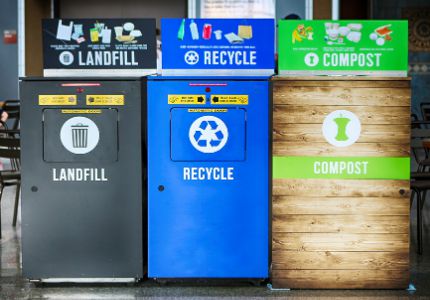
Photo: CalRecycle
The Town Services and Outreach Committee (TSO) heard a report and presentation on May 21 from Mimi Kaplan, former Amherst Waste Reduction Coordinator and current Pioneer Valley Planning Commission consultant to the town, outlining the key policy and operational decisions Amherst needs to make to transition to a town-wide curbside waste collection system. The proposed system is projected to dramatically reduce the town’s waste stream while lowering residents’ trash disposal costs. Kaplan has been charged with helping the town draft an RFP (request for proposals) to haulers by Sept. 30 to determine the costs of the change.
The proposed bylaw calls for the town to contract, through a competitive bidding process, with a solid waste hauler for services that include universal curbside pickup of compostable materials. Residents would pay a basic fee to the town for trash, recycling, and compost pickup, and would either buy official waste disposal bags or pay a fee based on the size of their trash toter (“Pay As You Throw”) to incentivize waste reduction. Residents currently contract individually with waste haulers for services and are billed directly by them. USA Waste and Recycling currently holds almost all of the contracts for homes in Amherst.
History
TSO Chair George Ryan introduced the topic by providing some history on the proposal (see also here, here, here and here for additional history). The proposal was submitted in 2021 and was first referred by the Town Council to the TSO in August 2022. In June 2024, still uncertain of what the new system would cost, the TSO moved to recommend to the council that it request the town to issue an RFP to local haulers. The council voted unanimously to request that Town Manager Paul Bockelman do so and to include eight specific elements in the RFP. When Bockelman informed the council that he would need a consultant to move forward with the request, the council voted to allocate $75,000 for that purpose. In December 2025, Bockelman contracted with the PVPC to create a “roadmap” for issuing an RFP.
Curbside Compost
A central issue noted by Kaplan was whether and how to implement curbside food waste (compost) collection. Food waste accounts for roughly one-third of household trash, and expanding composting is identified not only as a key waste-reduction strategy but also as a climate strategy in Amherst’s Climate Action and Resilience Plan. Decision points listed by Kaplan were: whether composting will be mandatory or voluntary, whether to contract with a single hauler for trash, recycling, and compost or be open to separate vendors, and whether to launch composting alongside a new system or phase it in later, potentially starting with a pilot program.
Pay As You Throw
Another major policy choice highlighted by Kaplan involves adopting a Pay-As-You-Throw (PAYT) system, which charges residents based on how much trash they generate. PAYT has proven effective in reducing waste by incentivizing recycling, composting, and reuse. Amherst already uses PAYT at its Transfer Station. Options include requiring smaller standard trash bins with overflow bags sold at a premium, offering multiple bin sizes with tiered pricing, or reducing trash pickup frequency — e.g., biweekly collection — with excess waste taken to the Transfer Station for a fee. Each model varies in how effectively it reduces waste. Collection frequency is another consideration: biweekly trash pickup could support PAYT goals, especially if composting participation is high.
Single vs. Dual Stream Recycling
A key decision is between single-stream recycling, where all recyclables are combined, and dual-stream recycling, where paper is separated from other mixed recyclables. Single-stream is easier and cheaper to collect but results in higher contamination rates, while dual-stream produces higher recycling rates and higher prices returned from end markets.
Transfer Station
The use of the Transfer Station is another major decision point in Kaplan’s report. Currently used by about 27% of Amherst households, the Transfer Station provides disposal for trash, recycling, compost, bulky items, and hard-to-recycle materials. Options include maintaining full services but adjusting fees to align with the new curbside system, closing the Transfer Station for routine household waste while keeping it open for specialty items and services such as bulky waste, and charging all households a small annual fee to support Transfer Station operations.
Costs
According to Kaplan, Bockelman prefers to fund curbside collection through a direct monthly or annual fee rather than through property taxes. This fee would cover all costs pertaining to the contracted services. Key variables include the number of participating households (approximately 5,050 eligible units), hauler pricing, disposal (tipping) fees, and administrative overhead. The town could also add a surcharge to fund Transfer Station access.
Kaplan provided comparative data showing that annual household costs for similar contracted programs in Massachusetts range widely — from about $200 to $525 per household — depending on service design and market conditions. This underscores that Amherst resident’s costs are likely to decrease substantially for trash and recycling services through a competitive bidding process, and that final costs will depend heavily on choices regarding curbside compost collection and general service levels.
Susan Waite, Amherst’s western Massachusetts Department of Environmental Protection (DEP) Waste Reduction Coordinator, spoke enthusiastically during the Q&A period, suggesting that Amherst could be a trailblazer in putting this program forward. She emphasized that everything does not have to be done at once.
Darcy Dumont, speaking on behalf of Zero Waste Amherst, the community sponsor of the original legislation, offered the group’s resources and assistance in formulating an RFP.
Councilor Amber Cano-Martin, a new sponsor of the waste hauler legislation, attended the meeting as a panelist. She suggested that the timeline for obtaining a draft RFP be moved up to June 30, rather than Sept. 30. Though Bockelman objected, Cano-Martin’s suggestion was supported by the other councilors who spoke. Kaplan agreed to try to meet the June 30 deadline for draft RFP language.
In addition to “reduce, reuse, recycle” , add re-think. Society, not just Amherst, must first of all reduce its use of disposable packaging, mass-produced throw-away goods, fast fashion, etc., especially in regard to plastics. We must reuse whatever and whenever we can, by refurbishing, repairing, etc. And of course we must recycle, but without kidding ourselves about what is truly recycle-able. And we must also rethink our public policies and personal choices.
Pay-as-you-throw and recycling food waste are steps in the right direction. But we must all lean that the individual choices we make must also be re-thought. Does it make sense to use reusable shopping bags? Of course. Does it make sense to routinely go to Wholefoods and fill those reusable bags with produce flown in from half a world away? No. Hanging on to things to reuse them makes sense. Needing to rent storage facilities to warehouse mountains of our unused stuff does not.
As a town, Amherst can make municipal decisions that help mitigate our vast waste stream. We should all back up those policies with personal choices about what and how much we really need in the first place, how stuff is made, and who profits and who loses when we spend our time and money.