
Search Begins for Temporary Space for DPW
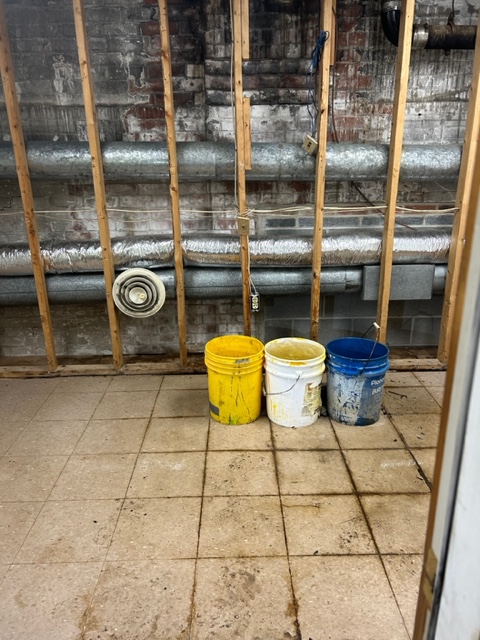
Buckets collecting dripping water at the Amherst DPW building long after an August 2023 rain. Photo: Kitty Axelson-Berry
Report on the Meeting of the Amheerst Town Council, April 6, 2026
This was a hybrid meeting held in Town Hall and was recorded.
Present
Mandi Jo Hanneke (President, at large), Jill Brevik and Cathy Schoen (District 1), Amber Cano-Martin and Lynn Griesemer (District 2), Hala Lord and George Ryan (District 3), Pam Rooney and Jennifer Taub (District 4), Ana Devlin Gauthier and Sam MacLeod (District 5), and Andy Churchill and Ellisha Walker (at large).
Staff: Paul Bockelman (Town Manager) and Athena O’Keeffe (Council Clerk)
In addition to extensive discussion regarding conditions at the DPW, the council continued its discussion of the recommendations of the Charter Review Committee and heard extensive public comments about funding for the schools and protection of residents from unlawful actions by federal immigration agents.
Council Acts to Support DPW Employees
After the March 30 Special Town Council meeting in which DPW workers presented their concerns about low wages, high turnover, and the unhealthy conditions at the main DPW building on South Pleasant Street, the Town Council voted today on several measures to improve conditions there. The DPW workers have been working without a contract since July 2025 after contract negotiations between the union and the town, which began in 2024, stalled. Contract negotiations resumed in early March, but no contract has yet been approved.
The council’s actions took several forms. Ellisha Walker’s motion, which Council President Mandi Jo Hanneke had not allowed her to make at the March 30 meeting on procedural grounds, asked for information regarding the adequacy of the town’s water and sewer rates to support, through the existing enterprise fund, system maintenance and infrastructure needs, workforce sustainability, and address recruitment and retention challenges within the Department of Public Works. She also requested information on the long-term financial stability of the enterprise funds.
Walker asked if revenue from the water and sewer enterprise funds could be used to boost the salaries of DPW workers in other divisions, but she was told by Town Manager Paul Bockelman that it could not, although many workers in other divisions belong to the same union and are governed by the same union contract. He also noted that the water and sewer funds need to support infrastructure maintenance and capital expenses of the department. A study of the wastewater treatment plant is currently underway.
Walker stressed that her motion was not seeking only a report, but also an analysis of the departments’ and of the funds’ long-term stability. She stated, “We heard about training, we heard about actually operating these facilities, and I’m wondering if changing the structure of our water and sewer fees is something that could improve that.” The motion passed unanimously.
Search Begins for Temporary Space for DPW
The inadequacy of the DPW headquarters at 586 South Pleasant Street has long been known. A 2016 study by Weston and Sampson stated that the 110-year-old former trolley barn “ has lost its functionality and its ability to expand and keep up with the growing population and infrastructure needs of the town.” A 2016 photographic study by the DPW depicted the conditions at the existing building that did not meet code and that created unhealthy conditions for those working there. Despite the passage of 10 years, workers are still in the building, coping with leaking ceilings, poor ventilation, and other toxic conditions.
With the completion of a new building several years in the future, the council wanted to ensure that temporary workspace was found as soon as possible. Amber Cano-Martin wanted the Town Manager to produce a plan for relocating DPW staff within 30 days and to actually move all staff out of the current building by October 1. Several councilors voiced concerns about the tight timeline, so the motion that passed unanimously stated that Bockelman should produce a plan to locate swing space by June 29 and to relocate all staff by October 1, 2026.
Pam Rooney, who also serves on the DPW Building Committee, felt that finding swing space was also the responsibility of that committee. She stressed the need to find adequate space, so the workers do not need to move two or three times while the new building is being constructed. Cano-Martin emphasized the importance of getting input from DPW workers about what is needed for the temporary space.
Bockelman stated that the town does not have any space ready to be occupied, and if space is rented, the council will need to appropriate funds to cover the cost. He noted that the temporary space is unlikely to be in Amherst, but access to the town’s iNet Wi Fi network is a complicating factor. He said that the four classrooms at the North Amherst School do not have restrooms and the building is not on the iNet, while the Wildwood School will not be available until September.
He added that some of the DPW employees actually spend very little time in the building, but are out in their trucks most of the day, so it will be easier to relocate them.
Superintendent of Public Works Guilford Mooring said, “We talk about this a lot, and are really excited and thankful that it’s actually becoming an issue and you’re seeing it.” He said that staff are concerned about being moved to a place that is not much better and “being stuck there”. He wanted the town to make a plan and then move the department to a location where they could stay for two years. He added that office staff interact a lot with other staff members, so it would be a problem to separate them. He also said that he didn’t think there was a building in Amherst that could be used as the vehicle maintenance facility.
As part of the plan for finding temporary space, the motion included obtaining input from the DPW staff as well as a cost estimate and funding sources for the space.
Council Votes to Add a DPW Staff Member to the Building Committee
Cano-Martin introduced another motion, to increase the size of the DPW Building Committee from seven to eight by adding a DPW employee as a voting member. She said, “I think it’s really important to have their feedback on this crucial building committee, because these are the folks that are using the facilities day in and day out, and they have so much knowledge about them.”
Cathy Schoen pointed out that raising the committee size from seven to eight would raise the number needed for a quorum from four to five, and might make it more difficult to schedule meetings. She wanted the DPW employee to be a nonvoting member. George Ryan disagreed. He stated, “Councilor Cano-Martin’s motion is the right one. The workers need to have a voice, and it should be a voice that counts.”
Rooney said that members of each DPW department need to be heard, and it is up to the committee to get their input. But she favored keeping an odd number of members on the committee.
Hanneke had a different objection. She felt, “A request to the manager like this is really telling the manager what to do. We have the ability to give him duties, but this is not a duty. This is telling him how to do his job, and I worry that that goes beyond our jurisdiction.”
Ana Devlin Gauthier asked how the DPW employee would be chosen. Mooring answered that “in situations like this, we open it up to all the employees in the building, and we ask for people who are interested, and then we sort it out. It usually works out fine.”
The vote on adding the DPW employee as a voting member to the committee passed by a vote of 8 to 5. Hala Lord, Andy Churchill, Lynn Griesemer, Jill Brevik, Devlin Gauthier, Ryan, and Cano-Martin voted yes. Hanneke, Sam MacLeod, Rooney, Schoen, and Jennifer Taub voted no.
Charter Amendments to Allow Ranked Choice Voting and Voting Rights for Lawful Non-Citizens
Two of the items in the “Beyond the Charter” section of the 2024 Charter Review Committee report, both pertaining to local elections, were referred to the town attorney to prepare for a town-wide vote at the next local election in November 2027. These are Ranked Choice Voting (RCV) and voting rights for lawful non-citizens. Both measures were filed as Home Rule petitions with the state legislature, the first in 2021 and the second in 2023, but neither has been taken up in the past three terms.
In public comment, Ranked Choice Voting (RCV) advocate Andy Anderson urged the council to incorporate RCV for local elections into the charter, as was done in Easthampton.
Other items were referred to the Town Services and Outreach Committee for further discussion. These included: a comprehensive review of resident boards and committees and their role in town governance, clarification of the application process for boards and committees, and clarification of the various ways residents can participate in the town’s governance and weigh in on government decisions.
The Finance Committee will discuss making public, greater detail in budget documents, and the council will consider amending the Town Manager’s goals by adding improvement in the ability to find information on the town website.
These actions were approved unanimously. The suggestion that the council be allowed to increase line items on the budget in addition to the budget lines for education was referred to the town attorney.
Another item suggested in the Charter Review Committee report was to create a committee explore regionalization of town services. Hanneke pointed out that the charter already gives the Town Manager the ability to explore regionalization opportunities, so that suggestion by the Charter Review Committee does not need further action.
Evan Naismith Takes Aim at The Indy for Amherst’s Budgetary Woes
Among several public comments, Evan Naismith, a resident of District 5, criticized a letter from more than 400 residents to UMass Chancellor Javier Reyes encouraging the university to build more housing for its students. Naismith said, “I want to talk about the letter to Chancellor Reyes. I want to talk about how it got written. When The Indy crowd writes letters like this, they start with a conclusion, and then they work backward. The facts they manufacture are easily disproven with a quick Google search. For example, the letter claims that UMass lags in its duty to create on-campus housing. Well, according to actual facts, UMass does not lag at all. It’s a regional leader in on-campus housing. UMass has more on-campus housing, both in sheer number and as a proportion, than UMass Lowell, URI, UVM, UNH, and the University of Maine—all big schools located in small towns.
“So, unless all regional colleges are laggards, then neither is UMass. But The Indy crowd doesn’t want you to know that. So, instead of linking to a truthful source, they just type out sentences that would support their conclusions, and hope you don’t fact-check. And when you point this out, they permanently block your account.
“There’s a reason why these Indy writers are not members of the Planning Board or the Finance Committee. They are not qualified. Their past applications have been rightfully rejected, and their proposals should be subject to extraordinary scrutiny, because these people are not acting in good faith.
“Tomorrow, I have a piece in The Amherst Current that highlights many of the glaring misrepresentations in this letter. I invite those of you who signed it to defend your work. A vibes-based housing policy is a true threat to our fiscal and progressive future. We deserve better. Please do the right thing and listen to actual evidence.”
Majority of Public Comment Supports Added Funding for Schools and Protection of Residents from ICE
The general public comment portion of this meeting began with third-grader Kieran Drumm advocating for parity among Specials (music, art, library, PE, and technology teachers) between Crocker Farm and the new Amethyst Brook Elementary Schools. He pointed out that Crocker Farm will have half the number of students as Amethyst Brook. “That means students at the new school will get less attention. That’s not right,” he said. I’m also worried about the teachers. Having one teacher for so many students will be really hard.”
Teachers Georgia Lederman, Chris Herland, Laura Yvonne Steinman, Sarah Johnson, and Kristin Reilly echoed Drumm’s pleas for more adequate funding for the schools, particularly for special education and Specials teachers, as did Vincent O’Connor.
John Bonifaz, Kathleen Traphagen, and Josna Rege spoke to the inadequacy of the Town Manager’s executive order protecting residents from the unlawful actions of federal agents, because it doesn’t mandate that police protect residents.
I am concerned that Wildwood School is even being considered as a temporary home for DPW.
Just as the town has announced the formation of a committee to determine the highest and best use for that site, to move DPW there even temporarily ignores a major rule of the universe: things don’t go as planned. Interim deans often last longer than permanent deans, and temporary headquarters can get permanented.
I understand the need to provide a safe and well functioning building for DPW. I just don’t think Wildwood School is a good fit, even so-called temporarily.
Could it possibly work to share some of those services with Hadley? there are many examples of multi-town collaboration? Here’s an AI written proposal for the town to look into that, that I am also going to send to my town councilors to consider:
Proposal
Amherst is searching for a new DPW headquarters and yard. I urge the Town to explicitly consider a shared or co‑located facility with Hadley. This could mean one joint site serving both towns, or a host‑community model where one town owns the facility and the other participates through an inter‑municipal agreement under G.L. c. 40, §4A.
Why a Shared DPW Makes Sense
Lower capital and operating costs by sharing land, buildings, equipment bays, fuel and maintenance facilities, rather than each town fully duplicating them.
More resilient operations through shared staff, backup vehicles, and coordinated response to storms and emergencies.
Alignment with state policy, which actively encourages regionalization and provides models and guidance for inter‑municipal agreements, including public works and infrastructure.
Relevant Examples
Across Massachusetts, neighboring communities already share water and sewer plants, wastewater treatment, and solid waste facilities, with costs and responsibilities defined by inter‑municipal agreements.
A multi‑community highway purchasing consortium shows how towns jointly buy road materials and sometimes share equipment to reduce costs.
Regional collaborations in public health, 911 dispatch, veterans’ services, and equipment maintenance demonstrate that shared staff, facilities, and governance structures can work smoothly over many years.
These precedents show that a joint Amherst–Hadley DPW facility would be a practical, mainstream form of regionalization, not an experiment.
Suggested Next Steps
Agenda item: Place the shared DPW concept on an upcoming Council agenda.
Initial talks: Ask the Town Manager and DPW leadership to meet with Hadley’s counterparts to gauge interest and sketch basic options (locations, host vs. joint model, rough scale).
Feasibility work: If there is interest, seek assistance from regional and state partners to conduct a focused feasibility study on costs, benefits, governance, and siting.
Thank you for considering this cost‑effective and collaborative option as Amherst plans for its future DPW needs.
Key Takeaways
A shared Amherst–Hadley DPW facility could save money, strengthen services, and follow well‑tested Massachusetts regionalization models.
Many towns already share infrastructure, equipment, and staff, proving the concept is feasible.
A short, structured process—agenda discussion, initial talks with Hadley, and a feasibility study—can clarify whether this is the right path before any commitment is made.
a few examples of such collaborations:
Examples from Massachusetts
Middleton & Danvers (MA) – Shared IT services, where Danvers provides IT support, cybersecurity guidance, and group purchasing advantages to Middleton through an inter-municipal arrangement.
Hampshire Public Health Shared Services Collaborative – A regional public health consortium including Northampton and nearby towns in Hampshire County, pooling staff and resources to expand local public health services.
Franklin–Hampshire Public Health collaborations – Multiple smaller towns in Franklin and Hampshire Counties share public health staff, inspections, and administrative capacity under formal shared-service agreements.
Essex & Manchester-by-the-Sea (MA) – Conducted a collaborative municipal services study to identify ways to jointly deliver services (e.g., public works, facilities, admin support) more cost-effectively.
Massachusetts regional dispatch & public safety – Many communities participate in regional 911 dispatch and shared emergency services, enabled and encouraged by state-level regionalization initiatives and manuals on shared services.
Highway purchasing consortium (MA) – An inter-municipal agreement involving 38 cities and towns to jointly purchase highway products and services (e.g., road salt, paving-related materials), reducing costs through bulk procurement.
Shared police training and fuel facilities (MA examples) – Neighboring towns collaborate to share police training programs, legal HR services, and shared gas fueling facilities for municipal fleets.
Regional technology and software consortia – Groups of Massachusetts municipalities jointly purchase and manage technology solutions (software, permitting systems, etc.) through interlocal agreements.
Examples from Other States / General Models
Multi-county 911 systems (e.g., Rankin, Scott & Simpson Counties, MS) – Three neighboring counties combined their 911 dispatch through one upgraded system, sharing both capital and operating costs.
Connecticut towns sharing services – Neighboring towns share animal control, building officials, tax collection, ambulance services, and multi-town regional school districts, with state legislation explicitly encouraging such arrangements.
Canadian small-town collaborations – Neighboring townships such as Scugog, Brock, and Uxbridge share services in community development and building inspection, providing backup staff when one town’s inspector is unavailable.
Evan Naismith: the following is a comment on your recent article in The Current that the Current would not publish.
https://theamherstcurrent.org/2026/04/07/an-open-challenge-get-your-facts-straight-town-councilors/
“Evan, why on earth would you NOT be pushing for the colleges to be contributing more to Amherst? UMass’s future PPPs could be structured so that they are taxable. Why do you want a windfall for those developers? Taxable PPPs are a win-win. We know they exist and can be structured to be taxable. We thought our first one would be.
And I would be careful about calling everyone in Amherst NIMBY for not wanting family neighborhoods carved into on all sides by short term rentals. That is definitely a majority opinion. Our neighborhoods are some of the most diverse you could find anywhere. My neighbors in Orchard Valley are all races, nationalities, ages, and gender orientations. And the year round residents are invested in the neighborhood’s health and future. They want folks to move in who will also be invested in Crocker Farm School and who will have kids who will play with their kids. It’s not about being anti student. It’s about being pro family neighborhood. “