
Historical Commission Imposes Demolition Delay on Phillips Street Porches
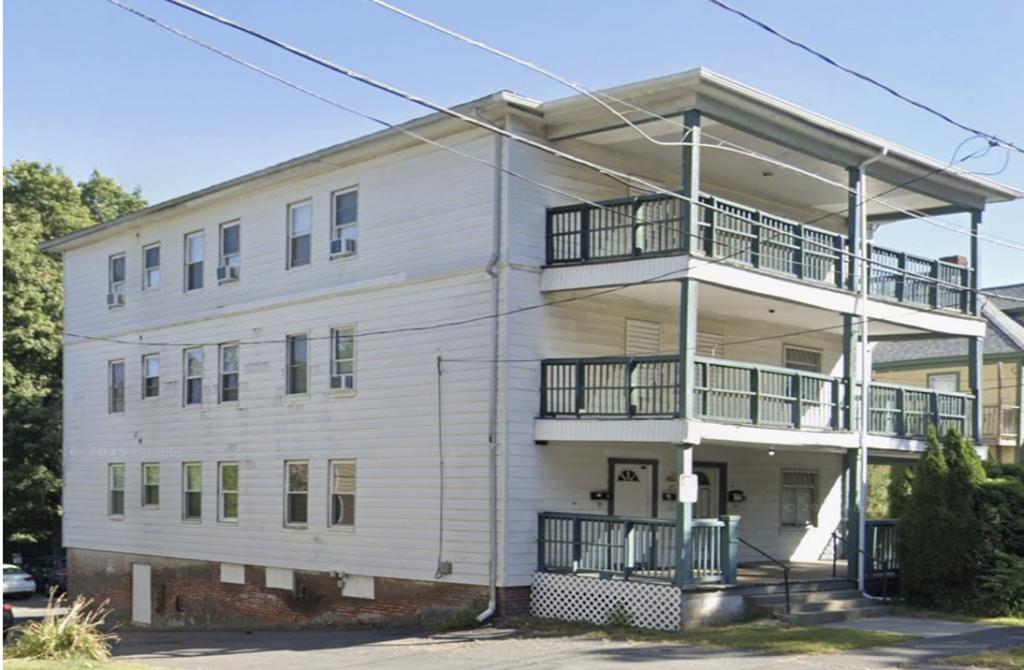
The Amherst Historical Commission has issued a one-year demolition delay for the three stories of porches at 27-29 Phillips Street. Photo: amherstma.gov
Report on the Meeting of the Amherst Historical Commission, May 12, 2026
This meeting was held over Zoom and was recorded.
Present: Robin Fordham (chair), George Baitinger, Joel Greenbaum, and Hetty Startup. Absent: Makenzie Landsittel. Staff: Walker Powell (planner).
Alex Korotich, contractor for Eagle Crest Property Management, came before the Historical Commission to request approval to remove the front and back three-story porches from the house at 27-29 Phillips St. The commission unanimously voted to impose a 12-month demolition delay on the plans, stating that the porches are integral to the design of the historic building and are clearly visible from the street.
The owner told Korotich that student residents had held a Mardi Gras-size party, and he was worried about the porches collapsing. All window and door access to the porches has been boarded up, but he said people still try to climb onto them. The plan is to replace the porches with 10-by-10-foot covered landings on the first floor in the front and rear. The owner is also concerned about liability.
An independent inspector stated that the porches were failing. They do not present an immediate risk but should be rebuilt within a few years. The town has not assessed their structural integrity.
Historical Commission Chair Robin Fordham stated that the late-19th-century three-story building is historically significant. Hetty Startup noted that front and rear porches were characteristic of the era, giving inhabitants outdoor space to relax and stay cool. Joel Greenbaum thought the building would “look funny” without the porches.
Fordham said that in a perfect world, we wouldn’t have to worry about students overloading a deck. Greenbaum noted that if the decks were rebuilt, they could handle the load of people gathering there, and 42-inch railings would increase safety. He added, “All old buildings require maintenance, and these porches have not been maintained. I would like to see them rebuilt.”
Korotich replied that even if the porches were rebuilt, insurance rates for the property would greatly increase. He said the building is strictly a student rental and that the structure has already lost much of its historical fabric — it has vinyl siding and new windows. He added that he has won awards for historical preservation on projects in Springfield, but this building retains few of its original features.
Fordham pointed out that the original clapboards probably remain under the vinyl siding, should a full restoration ever be undertaken.
George Baitinger said, “We’re here to try to preserve the integrity of buildings, even if the insurance rates go up. It is still a historic building. Maybe we need to train the students not to have parties — make it a condition on the lease.”
The vote was 4-0 to impose a 12-month demolition delay on the porches. If the owner returns to the commission with an acceptable alternative plan, the delay could be lifted sooner.
Historical Commission Hears About Proposed Downtown Design Standards
Peter Flinker’s April 14 presentation of the three-volume proposed Downtown Design Standards to the commission was interrupted by a power failure. He returned to present the proposal at this meeting.
Baitinger commented that he liked the four different zones in the downtown area that preserved its existing varied character. Flinker explained that incorporating the differing views of stakeholders who contributed to the plan was a balancing act. Some people wanted dense development throughout downtown, but those living in nearby residential areas might not welcome a four-story apartment building next door.
Commission members agreed to review the draft document and submit comments.
Survey of Mid-Century Modern Structures Expanded to Include Hampshire College
The Historical Commission was awarded $15,000 in Community Preservation Act funds in fiscal year 2026 to “hire a trained historic architect to create an inventory of structures built between 1935 and 1975, when many of Amherst’s neighborhoods were built. This project will document 20th-century buildings and sites in Amherst that have not been previously recorded, via Mass Historic Commission (MHC) Inventory Forms that will be stored in the state database.” Members agreed that the Hampshire College campus should be included in the survey, because buildings there may be threatened by the college’s closure.
Startup noted the historic significance of the Robert Crown Center, which contains the gym and swimming pool, as well as the adjacent library. Those buildings were constructed in 1972. She also pointed to some of the farm buildings and the red barn as needing to be documented in the report.
Fordham said she would consult with the Massachusetts Historical Commission regarding the best way to document the buildings on the campus — perhaps using an area form rather than an in-depth study of each building.