
Opinion: The Body Politic Keeps the Score
Photo: Denin Lawley for Unsplash
This is the fourth article in a five-part series that the LGBTQIA+ Caucus of Amherst has prepared for Pride Month, 2026. The Indy will publish one piece each week during the month of June. Look here and here and here for the first three articles in the series.
Pride creates the cultural commons where we celebrate queer joy. It’s an annual act of love and a traditional acting up in defiance. What does Pride require of us in return? What we cherish about our queer community in June requires attention to histories of queer adversity that can be painful and beautiful. In too many cases the stories of adversity are still ongoing today.
Pride is not only a celebration. It’s also a confrontation. Pride confronts our institutions with the demand for courage to live up to the values they publicly affirm. Pride demands ongoing vigilance and insistence. Pride demands queer safety and queer visibility. Safety and visibility require a community’s willingness to remember and confront the harms that have been dealt to queer people, especially in the places that were responsible for protecting us. Here in Amherst, with our schools at the center of the frame, Pride demands our willingness to remember, talk about, and recognize the harm to trans and queer children and staff who were left unprotected in the Amherst-Pelham Regional Middle School. When we demanded that the adults in our schools do everything possible to protect trans and queer kids, the adults in power failed them. The adults in power, though many are well-intentioned, continue to fail them today.
Every community tells stories about itself, and some stories are easier to hear than others. The easiest ones assure us that we are already kind, inclusive, and on the right side of history. A top job of social justice is to ask that we preserve and amplify history that interrupts our self-congratulating.
For the community served by the Amherst-Pelham Regional School District, the 2023 crisis of trans and queer students who were subject to dehumanizing hostility, insult, and stigma by educators is a community story that should not be filed away as a regrettable episode or old news. It left an indelible mark on students, caregivers, staff, leadership, committee members, and the public trust, reshaping our body politic. The fallout persists even now — and the harm continues — keeping many of us alert to new developments concerning student safety, staff accountability, and school governance.
Student reporters broke the story, publishing their investigation in the May 2023 issue of The Graphic that detailed allegations of Amherst Regional Middle School (ARMS) staff deadnaming and misgendering trans students, failing to protect queer and trans youth from bullying, and using personal biases and religious beliefs to justify mistreatment of students in a public-school setting. Their journalism forced the community to focus on what our adult-led institutions had left out of focus. We owe a debt to these bold students and to all reporters and advocates who demanded our attention to a dangerous situation. Their work was not easy nor without risk.
The tsunami of journalism that followed The Graphic made it plain that this was not a misunderstanding of tone or a small-bore conflict inflated by local politics. Regional and national outlets picked up the story, investigations were launched, staff members were placed on leave, school committee members resigned, the superintendent resigned, and lawsuits began taking shape. When the final reports of the Title IX investigation (see also here) were released in late 2023, they confirmed serious, systemic failures affecting LGBTQIA+ students and described a broader culture of fear, intimidation, and institutional breakdown.
Following the Indy’s recent news roundup, Protect Trans & Queer Kids, it is worth pausing over the sheer volume of public writing generated by the 2023 crisis. A rough count of published articles, letters, and opinion pieces about the crisis and the demand to protect trans and queer kids comes to 230,000 words in 2023 alone and nearly 300,000 words across more than 200 published pieces through 2026. That record accumulated page by page: brave student reporting, then adult advocates, local journalists, regional editors, and eventually national attention.
The scale becomes even clearer beside other school topics. Coverage of MCAS, COVID-19 response, and unrelated bullying issues barely registers next to the public record created by the 2023 ARMS crisis. The comparison shows how much sustained civic labor it took to achieve District accountability.
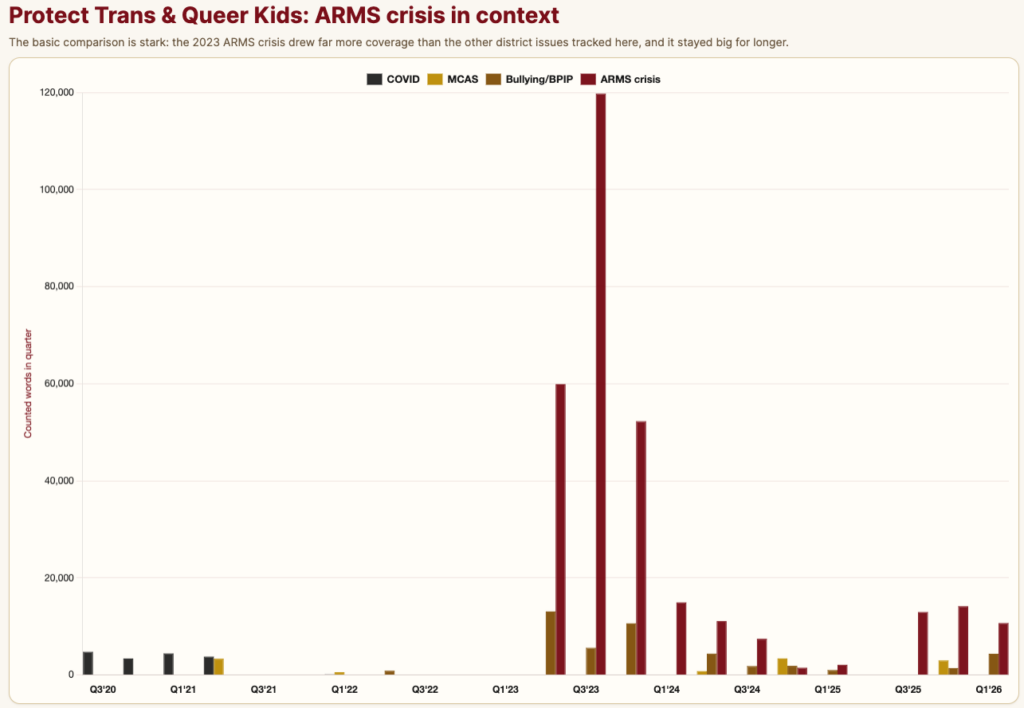
Figure 1. A quarter-by-quarter comparison of published writing about the 2023 crisis at ARMS versus three other topics this district talks about: COVID-19 response, MCAS results and accountability, and bullying issues unrelated to the 2023 crisis. Some articles in the tally span multiple topics.
Three hundred thousand words did not spill by accident. This is what it has taken, so far, to sound the alarm and demand safety and visibility for trans and queer kids in Amherst. The volume of writing and community response reflects a progressive community’s difficulty reckoning with systemic harm to trans and queer students and the complacency shown by too many of its members. Amherst is fluent in the language of equity but fell short when inequity demanded action. The body politic keeps the score. So will students, their families, friends, neighbors, and morally grown-up community members everywhere — and, shoved ever onward by their organizing, advocacy, and votes, so will history.
The crisis left deep institutional marks on the civic fabric of Amherst, and the catalogue is still growing. By late 2023, a superintendent and several school committee members had departed. As of today, the district has seen a long tail of resignations and attrition unfold. The turnover has drained our schools of institutional knowledge and continuity. The new faces who have shown up — many of them motivated by the crisis itself — have been figuring out how to restore community trust from scratch. Yet we continue to find evidence that our schools remain unsafe for queer and trans students.
A long legal afterlife keeps the 2023 crisis in the present tense. In July 2025, an arbitrator ordered the reinstatement of a guidance counselor previously dismissed in connection with the crisis, ruling that the district had failed to provide due process required for dismissal. The district sought to block the reinstatement and later appealed, but the court did not rescue it from the consequences of the prior administration’s procedural failure. As the ruling held and reinstatement drew near, community members organized new rounds of showing up for students with rainbow umbrellas outside the schools. Some middle school families and staff members — their distress renewed by news of the arbitrator’s order — filed directives that the school shall permit no contact between their children and the reinstated guidance counselor. These directives were motivated to create safety, but students and staff have observed how the guidance counselor has practiced exclusivity by providing privileges, snacks and prizes to some students in the presence of students with no-contact directives and students who simply do not feel they can safely participate.
Threats to student safety and questions of accountability and institutional trust reemerge when a community allows itself to believe a crisis has passed.
Ongoing policy implementation and enforcement is where the history of our crisis continue, today. A school district can pass strong language and still fail in practice due to delay, selective enforcement, poor documentation, inadequate supervision, staff fatigue, and legal challenges.
The district’s policy response has proceeded carefully but not without disruption. Policy ACAA, adopted by the school committees in August 2025, made explicit that identity-harming conduct, including misgendering, deadnaming, and other acts of discrimination, cannot be waved away as confusion or interpersonal conflict. A Problem Resolution System (PRS) complaint filed with the state Department of Elementary and Secondary Education triggered a months-long review of Policy JICFB, which was reaffirmed in January 2026 by school committees, committed to holding the line that bullying and harassment protections should not be withdrawn because implementation and enforcement prove contentious. Ongoing policy implementation and enforcement is where the history of our crisis continue, today. A school district can pass strong language and still fail in practice due to delay, selective enforcement, poor documentation, inadequate supervision, staff fatigue, and legal challenges.
This is why the history of our 2023 crisis and the continuing failure to make our schools safe must remain visible in our community: collective memory is a practical safeguard against the backsliding that becomes possible when people grow weary, tired of hearing about it, and ready to move on.
This is why the history of our 2023 crisis and the continuing failure to make our schools safe must remain visible in our community: collective memory is a practical safeguard against the backsliding that becomes possible when people grow weary, tired of hearing about it, and ready to move on.
If the Amherst community wants trans and queer students and everyone else to believe that Amherst has their back, then we need to figure out how to properly commemorate the crisis of 2023. We must commemorate this crisis to tell our students that their lives matter more than institutional self-protection, more than community nostalgia, and more than the comfort of adults who are ready to forget. We must commemorate this shared history by acting up for students today. The story of our schools for three years and counting has become inseparable from the ongoing fight to protect trans and queer middle school students.
A celebration of Pride without attention to the history of adversity becomes decorative and won’t protect anyone. Pride worthy of the name requires memory, accountability, and vigilance. Queer joy makes space for pain, trauma, grief, and anger. Vigilance and allyship means families and community members who keep pushing and pushing, writing, showing up with umbrellas, running for office, all committed to keep doing the work. Most of all, queer joy makes space for the children whose trust has been betrayed again and again by their middle school. Those children are perfect just as they are: powerful, brilliant young people who belong to our LGBTQ+ community.
This article is a collective effort of members of the LGBTQIA+ Caucus of Amherst.
The LGBTQIA+ Caucus of Amherst is a grassroots group formed in the fall of 2023 in response to a clear need to push for transparency, accountability, and equity from the local administration, and to mobilize greater advocacy and support for queer and trans students. The Caucus works with the community, including Amherst Regional Public Schools staff and administration to identify and meet the needs of LGBTQIA+ students. To protect its members from potential retaliation and intimidation within the community, the Caucus operates with an anonymous membership structure relying on a designated spokesperson for public communication. Caucus spokesperson Ali Wicks-Lim (they/them) can be contacted at CaucusLGBTQIA@gmail.com.