
Anti-LGBTQIA+ Bias Still a Problem at Middle School
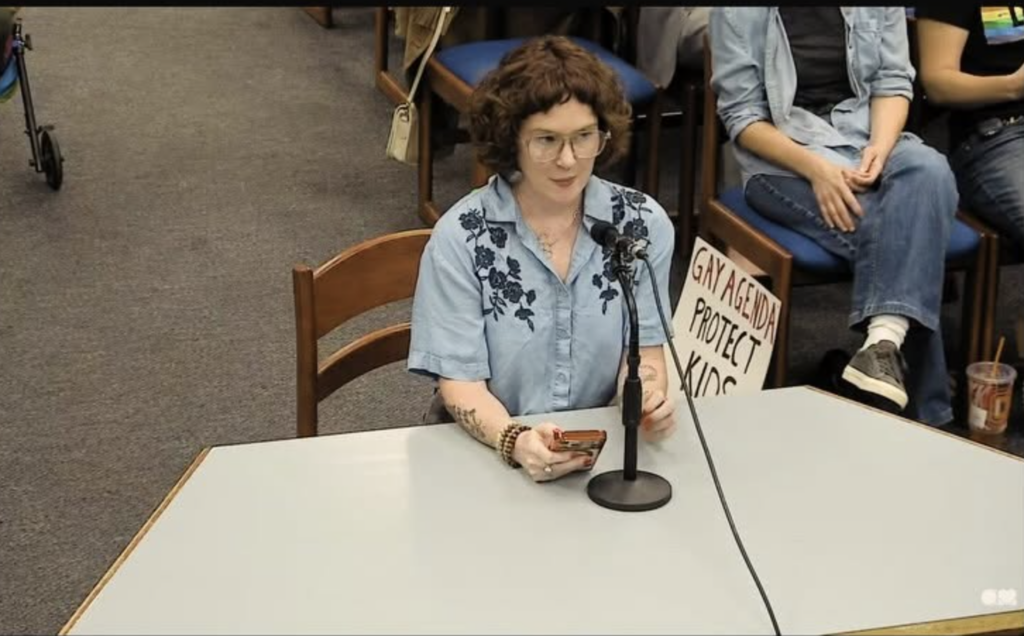
Amy Cronin DiCaprio read a statement from the LGBTQIA+ Caucus of Amherst at the Regional School Committee meeting on June 23, 2026. Photo: amherstma.gov / YouTube
Report on the Meeting of the Regional School Committee, June 23, 2026
This was a hybrid meeting held in the High School library and was recorded.
The ramifications of the court-ordered reinstatement of middle school adjustment counselor Delinda Dykes were made clear in the impassioned public comments delivered to Regional School Committee (RSC) members at the June 23 meeting. Twenty-six people spoke about the continued bullying and mistreatment of middle school students, even after a change in administration and school committee following the Title IX investigation (see also here, here, and here) in 2023 that implicated Dykes and other adjustment counselors for holding prayer meetings and espousing anti-gay views.
Although Dykes’ name was rarely mentioned during the comments, it was clear that she was the staff member who held an invitation-only end-of-year program that excluded queer students and those who were not permitted to have contact with her. She was also implicated in a harassment prevention complaint filed against LGBTQIA+ activist and volunteer Ali Wicks-Lim, who had police come to her door one night last week to serve her with a complaint for a case to be heard the following morning. The charges were quickly dismissed for failure to meet the burden of proof.
Most commenters expressed concern for the wellbeing and safety of LGBTQIA+ students. A caregiver named Ellen said her neurodivergent child was harassed by middle school students at the sixth-grade step-up day until another middle schooler intervened. She said the staff member responsible for allowing middle schoolers to serve as guides on step-up day remains in that role, despite not intervening in the bullying situation.
Another caregiver told of her queer son who offered to lead tours for sixth-graders and was taunted by other students with anti-trans slurs. No staff member intervened.
Alex Lopez focused on the lack of responsiveness of the school district. One of his children was dropped off the school bus more than a mile from home and told by the bus driver to “suck my dick.” His daughter reported that pornographic images of a friend were being circulated on Snapchat. The dominant narrative among students, he said, was not that some students were committing a serious crime, but that the problem was the person who reported it. The word “snitch” was then used by at least four staff members to describe his child, and the sexually predatory behavior continues.
Lopez continued, saying, “When I went to pick [my daughter] up and went into the office [to sign her out], Delinda Dykes looks at me and asks my 12-year-old if that’s her brother, and then continues to say, ‘Oh, it’s your dad. You have a good-looking dad.'” Lopez, who filed a complaint with the school district about his encounter with Dykes, said he has a written acknowledgment from Dykes that this occurred, but the school district has not yet responded.
The thrust of the public comments was that the middle school is not a safe place for queer students and that it is up to adults to remedy the situation. Several commenters were therapists for LGBTQIA+ youth and stressed the elevated rates of suicide attempts and other mental health issues among that population.
Nancy Sardeson, who identifies as gay, said she felt the Amherst schools used to be a partner in raising her children, but that is no longer the case. “What we do matters,” she said. “We are the grown-ups. I am angry and ashamed. Do something, please.”
In a phone message, Elizabeth Thompson said, “I insist that the Amherst Regional Public Schools address harmful staff conduct before it causes further harm to students, families, staff, or community members, and we must make it visible that the people on the front lines of this work are supported by a community that will not tolerate harm to LGBTQIA+ people.” She also spoke against the harassment prevention order filed against Wicks-Lim, which she said “has the potential to be chilling on people in our community who want to stand up for and protect queer and trans children.”
District 2 Town Councilor Amber Cano-Martin decried the unsafe situation for queer and transgender youth at the middle school and the reinstatement of a staff member who had been documented to have engaged in behavior harmful to trans and queer youth. She asked school leadership to take disciplinary action when needed. “The stakes are incredibly high,” she said. “We know that LGBTQIA+ youth have higher risks of mental health problems and/or substance abuse.”
Amy Cronin DiCaprio read a statement from the LGBTQIA+ Caucus of Amherst. Wicks-Lim then summarized: “Right now, your middle school is not a safe or healthy place for people like me of any age. Is that okay with you? And if it isn’t, what are you going to do about it? I spoke about what it means for someone like me to have been targeted in this way. The fear and anxiety about what might come next from someone who would do something like this are not lost on me.” She pleaded with school staff to address the problems.
Marc Gomes Introduced as New High School Principal
Listening on Zoom to the above 90 minutes of public comment was incoming Amherst Regional High School Principal Marc Gomes. Superintendent E. Xiomara Herman (Dr. Xi) introduced Gomes, saying he was selected through a comprehensive search that included input from students, staff, families, administrators, and community members.
“Throughout the process, he demonstrated a strong commitment to student success, educational excellence, collaborative leadership, and fostering an inclusive school environment,” she said. She praised his integrity and his ability to reflect and identify areas where he is willing to collaborate and grow.
Gomes previously held leadership roles in New York City and Montgomery Public Schools in Maryland, and most recently served as assistant principal at Van Sickle Prep Academy in Springfield. He also worked as network principal for alternative educational campuses in Jefferson County Public Schools in Colorado.
Regarding the difficult situation at the middle school presented in the public comments, Gomes said, “I’m excited to join the Amherst community. I would love the opportunity to hold conversations, listen to the community, and do the best job that I can to support all the students, staff members, and caregivers who attend the Amherst Regional Public Schools.”
RSC member Tim Shores (Leverett) urged Gomes to “pay a lot of attention to all the public comment that we heard tonight and look into the history behind it, because it’s not the first public comment section we’ve had on the matter of LGBTQIA+ students and other community members needing attention to their safety from authorities. That’s going to be important going forward.”
Gomes starts his new position July 1.
Regional School Climate Data Collection Plan Launched
Dr. Xi introduced a plan to regularly survey teachers, students, staff, administrators, parents, and alumni through a participatory research initiative to examine perceptions, attitudes, and behaviors across the district and explore the social justice climate. The goal of the project is to analyze and disseminate the data annually to promote continuous improvement in creating an environment of physical and emotional safety, build confidence in reporting concerns, and strengthen student-to-student and student-to-adult relationships. Research is to begin in August, with a report to be presented in the spring, leading to an action plan for school improvement.
Because of continuing issues at the middle school, Dr. Xi said the district is partnering with the Joy and Justice in Education program through the Collaborative for Educational Services (CES) to provide external evaluation of climate assessment and restorative approaches.
The district has begun developing survey questions, and feedback will be gathered through focus groups and interviews.
RSC members raised some concerns. Sarah Marshall (Amherst) wondered whether students will be oriented to BRIM, the anti-bullying reporting system, and whether it would be an appropriate way to lodge a complaint about a staff member. She also suggested that surveys be conducted mid-year, when students have adjusted to their new teachers and classmates, rather than only at the start of the year.
Shores said he thought the study was a good idea but stated, “This is going to be time-consuming and resource-intensive, and I don’t want there to be any delay on action while we do more research. We’re out of runway now on changing behaviors in the schools.”
Bridget Hynes (Amherst) agreed. “These kids can’t wait another day. We can’t have situations like what we heard,” she said. Anna Heard (Shutesbury) said, “This feels like it’s two years too late. I really wish this had been done two years ago. We already know a lot of the information we need, and we just need to double down on implementation and accountability right now.” Heard also called for a review of discipline practices to determine whether suspension is being overused or applied inappropriately.
Performing Arts Teachers Ask for Better Compensation for After-School Programs
During the public comment period, several members of the performing arts faculty said the proposed 1% increase in their stipends for after-school activities such as concerts and plays was inadequate. They added that performance time is often not compensated at all.
Middle School Drama teacher Paige Graham estimated that there were nearly 400 hours of uncompensated labor across the Performing Arts Department last year. She said, “Our current contract language and stipends no longer reflect the reality of our programs. These events actually require three adults, and we’re supervising well over 100 students. These performances are essential to our students’ education and our connection with the community.”
Drama teacher Ashley Dunn said compensation is twice as high in other Hampshire County districts, and John Bechtold, department head for performing arts, said the stipend has not been increased in 25 years.
Bechtold added, “We are severely underrepresented and underpaid for some of the most crucial work we do in many corners of our school.” He asserted that the quality performances at the schools can lure students back from the Pioneer Valley Performance Arts Charter school and benefit the district financially by recouping those tuitions.
A discussion of proposed stipends occurred in executive session at the end of the meeting.
Middle School Roof Replacement Comes in $1.8 Million Under Budget
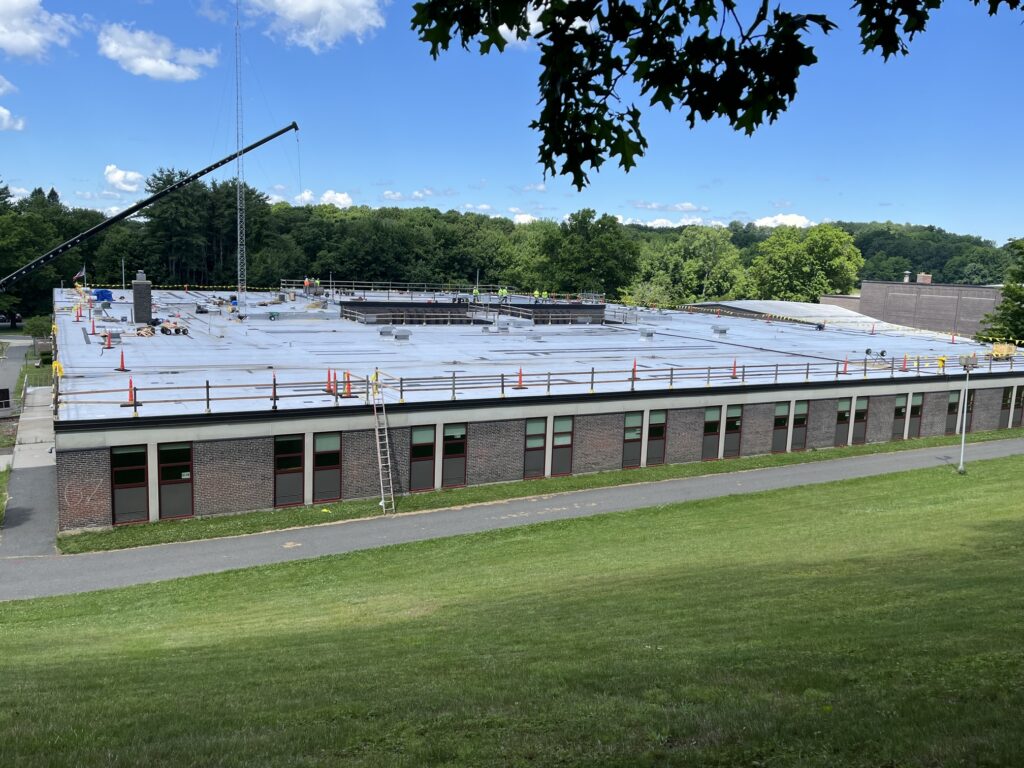
The replacement of the middle school roof is estimated to cost less than expected, and as a result the Massachusetts School Building Authority (MSBA) will lower its reimbursement for the project. To guard against unexpected expenses, School Finance Director Shannon Bernacchia said she would like to keep the excess funds allocated by the four towns in the region until the roof is complete. Doing so will require a letter from each town to delay reimbursement. The RSC agreed this was a prudent strategy and granted permission for her to contact each town.
Sports Participation Fees Rising Slightly for 2026-27 School Year
Bernacchia said sports participation fees will rise 1% to 2% next year. There will also be small increases in parking and musical instrument rental fees. RSC members questioned the high fees for alpine skiing and ice hockey ($432), given that families must also pay for equipment. Bernacchia and Athletic Director Victoria Dawson said they will reexamine, for subsequent years, the fees the RSC raised concerns about.
Marshall noted that none of the sports programs are self-supporting. She asked for clarity on how fundraising revenue and booster contributions are used.
RSC members praised the athletic department for improving fee collection.
Just to clarify… the district did respond to my complaint about Ms. Dykes’s comments although I do not know what, if any, actions were taken and continue to worry. I worry especially as my experience was feeling so consistently ignored when it came to my students’ safety while the attention of administration was, in part, distracted by the additional harm caused by the unwanted initial interaction with Ms. Dykes, and the subsequent correspondence which continues to trouble me.