
Conservation Commission Evaluates Expanding Areas for Hunting
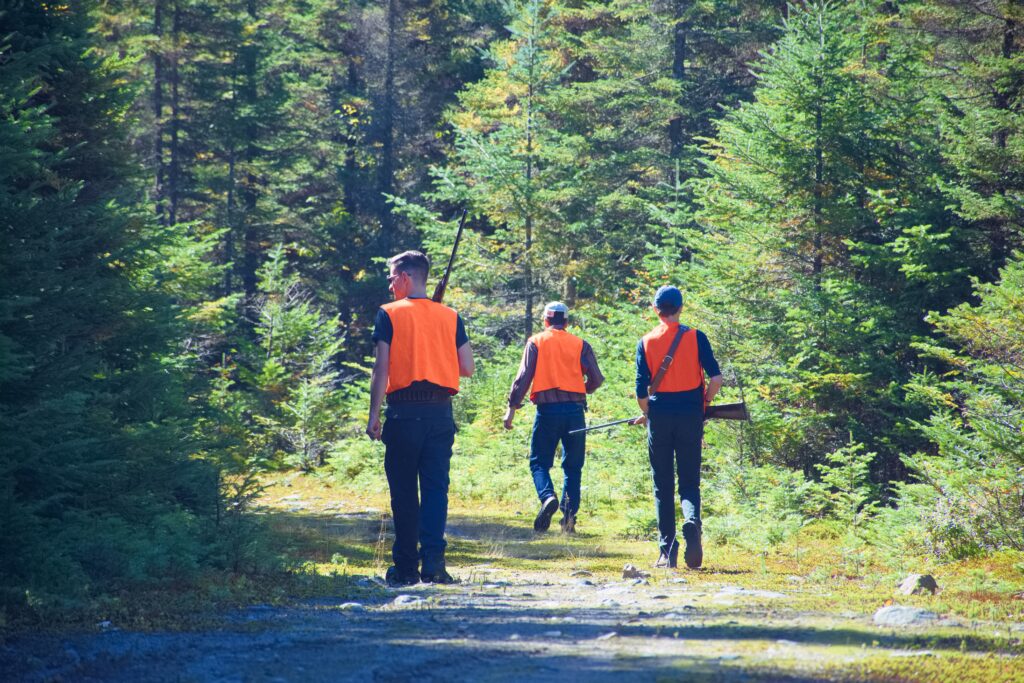
Photo: Martin Poirier c/o Shutterstock
Report on the Meeting of the Conservation Commission, June 24, 2026
This meeting was held over Zoom and was recorded.
Present: Andrey Guidera (chair) , Bruce Stedman, Tina Smith, Carol McNeary, and Rachel Loeffler. Absent: Jason Dorney and Sarah Matthews.
Staff: Erin Jacque (conservation agent) and Dave Ziomek (assistant town manager)
Should Hunting Be Permitted in Additional Conservation Areas?
The Conservation Commission continues its efforts to update the town’s Land Use Policy and Regulations. At the June 24 meeting, the commission began reviewing hunting regulations in conservation areas. Currently, hunting is allowed on six conservation areas: Podick, part of Atkins Flats, Katherine Cole, Lawrence Swamp, Simmons Farm, and the Holyoke Range (see map).
The town staff compiled a list of all conservation areas and divided them into three categories: where hunting is currently allowed, where it might be considered for permitting, and where staff recommend it be prohibited.
Conservation Commission Chair Andrey Guidera noted that, including hunting of small game, some hunting is allowed most of the year. Massachusetts general law (Chapter 131, Section 58) prohibits hunting within 500 feet of an occupied dwelling or building and within 150 feet of a paved road.
Commission member Bruce Stedman asked about the current use of 419 acres of Lawrence Swamp for hunting, since that is a complex area containing water supply and farmed areas. Assistant Town Manager Dave Ziomek said that a Conway School study of the area recommended additional signage, but did not recommend reducing hunting.
Guidera thought that the public land at Wildwood should be considered for hunting, but conservation agent Erin Jacque stated that its proximity to the large apartment complexes — with many students walking near the area to reach the middle school and high school — made it too dangerous to permit hunting there.
Edith Allison, who lives near the Kestrel Headquarters and Sweet Alice area, noted that hundreds of people come through that area. She asked how they would be safe if people were shooting nearby. She said she supports hunting but worries about safety in areas of popular use.
Guidera informed her that Amherst prohibits rifle hunting and that the slugs used for shotgun hunting lose their effectiveness at more than 100 yards, so someone struck beyond that distance would not be seriously hurt. He said that there are almost no accidents involving non-hunters and that most hunting injuries are caused by hunters falling out of their tree blinds.
Little progress was made in reviewing the list of potential hunting sites. The discussion will be continued at future meetings.
University Drive Restaurant Permitted to Add Five Parking Spaces
The Conservation Commission allowed the property at 40 University Drive — the former site of Savannah’s Restaurant and the Amherst Public House — to remove two landscape islands in the parking lot and replace them with pervious pavers, creating five additional parking spaces. Tom Reidy, an attorney at Bacon Wilson who represented owner Barry Roberts, said the additional parking spaces were requested by the prospective renter, an Italian restaurant.
The plans indicate that erosion control measures will be placed during construction to protect the wetlands to the south. Commission members wanted to ensure that the existing pervious pavers were functional and not clogged with sand and dirt. Also, Jacque said that a few conditions from the previous permit have not been met. An evaluation and possible repair of the existing pavers, as well as fulfillment of the outstanding conditions, were added to the revised permit.
The revision passed 4-0-1, with Rachel Loeffler abstaining.
Culvert Study Progressing: Public Meeting Scheduled for June 27
Stedman said that all of Amherst’s culverts have been assessed, except for a few on the college campuses. The data are being entered to develop a priority list for repairs. The Pioneer Valley Planning Commission culvert group will hold an informal public meeting on culverts and flooding on the North Common from 11 a.m. to 1 p.m. on Saturday, June 27.
Several miles of the Norwottuck/Mass Central Rail Trail pass though the Lawrence Swamp.
It’s paved, and provides motor vehicle access from WarrenWright Road to several the Town’s wells, but it’s not officially a “road” or “street” (and it’s also under the control of the Massachusetts DCR).
That portion of the trail is the most heavily used in Amherst, and among the most popular sections of the MCRT in the entire Commonwealth.
Is the “150-foot hunting rule” applied there, and is it sufficient to ensure that the public is not at serious risk from stray projectiles?
One way to reduce that risk is to require hunters to use elevated stands, so that the “cone of fire” reaches the ground closer to the target. For example, if a stand were elevated 12′ to 15′ and the target were 4′ to 5′ above the ground, then a stray projectile would reach the ground beyond the target about 1/3 of the distance between the stand and the target — similar triangles, if you want to look that up in your old geometry text!
So unless a hunter is more than 150 feet from a road or trail, and shooting from a high stand at a low target less that 100 feet way , the risk to the public seems rather high.
One hopes considerations like this would be part of the Conservation Commission’s decision-making process.
re the comment from the head of the conservation commission, that hunting near Wildwood School should be considered: Shotgun slugs used for hunting remain capable of causing serious or fatal injury well beyond 100 yards, even though their accuracy and effectiveness for ethical hunting typically decline past that distance. A common 12‑gauge rifled slug leaves the muzzle with more than 2,300 foot‑pounds of energy and still carries roughly 900–1,000 foot‑pounds at 100 yards, which is comparable to many centerfire deer cartridges and more than enough to inflict severe trauma on a person. Modern sabot slugs can retain around 1,700–1,800 foot‑pounds of energy at 100 yards, further underscoring that they do not become harmless beyond that range.
The statute says “[n]o person shall not discharge any firearm or release any arrow upon or across any state or hard surfaced highway…”
This is important because the state defines “highway” as everything including unmaintained, occasionally used roads. Bicycles are considered “vehicles” so I don’t see why a paved bicycle highway wouldn’t be considered a highway.
I realize that “gun” is a four letter word in Massachusetts, but LICENSED hunters are some of the safest people you will ever be around. The bicycle trail is elevated and clearly visible, a hunter is going to EXPECT someone to be on that trail, and isn’t going to shoot near it!
Most hunting accidents — that actually involve gunshots as opposed to twisted ankles or falls — are two hunters tracking each other by mistake, each thinking that the other is a deer, and blaze orange has prevented a lot of this. But if you’re up on the bike path, you’re not gonna be mistaken for game down in the brush.
Furthermore, there’s nothing preventing you for wearing orange yourself — and in low light conditions, it might help another bicyclist from running into you. Dressing your children in orange will make it a whole lot easier to find them if they go wandering off somewhere — particularly on the edge of darkness…
Why oh why do we need more hunting areas?
Do we charge a fee to non-resident hunters to come for Amherst for this?
We hear shooting all the time during hunting season around Lawrence Swamp area and there was a serious incident when someone was almost shot on the bike trail by nearby unlicensed hunters about 20 years ago.
How do we insure only licensed hunters use these spaces? I have rarely seen anyone monitoring this.
As someone who walks on the bike trail frequently and whose house abuts the Lawrence swamp area I object to the town encouraging this.
We have some of the highest taxes in the Western Mass area and some of the worst roads.
Why is expanding hunting a priority for the town?
The thrust of my earlier comment focused on geometry and its implications for safe distances from residences, roadways, trails, and the like. The most important implication is that aiming — a rifle, a shotgun, a crossbow … —from an elevated stand reduces the risk of an overshot or a ricochet reaching an undesired location with the projectile still carrying a potentially injurious energy. In other words, I was addressing the rare but potentially fatal accidents that fall upon the unsuspecting general public, not the more common accidents which the hunters themselves may suffer (like twisted ankles) which are irrelevant to the issue of creating a hunting safety law.
Minimizing the risk which concerns us could be codified in a law that requires aiming away from any potentially populated area, but how could that law be crafted in a way that’s easy to understand and effective in accomplishing its purpose?
One way to specify “aiming away” is geometric: in effect, requiring what I called the “cone of fire” to always meet the ground at sufficient distance from a populated area. Such a revised law would be advantageous to both hunters and the general public.
I expect smart hunters already understand this intuitively, and so what I’m suggesting is that Amherst take the lead in crafting such a smart law that could be a model for not only the Commonwealth of Massachusetts, but anywhere else in the country — or the world — where hunting interacts with other human activity.
Recommendations that hikers or bikers or parents pushing strollers — or any other users of our trails — wear blaze-orange or roadworker-yellow vests may be well-intentioned, but hunting projectiles can and often do carry the same energy as those used by the military, so if we wanted to protect the public from random rifle fare, should encourage everyone to wear kevlar helmets and vests?
In light of the ongoing discussions
https://www.mass.gov/doc/updating-hunting-laws/download
on this topic, I repeat my recommendation that the Amherst Conservation Commission take into serious consideration the “geometric” principles I mentioned earlier and above.