
Drawing the Line: Why Massachusetts Communities Are Rethinking Local Police-ICE Relationships

Photo: NARA & DVIDS Public Domain Archive.
Across Massachusetts, communities are asking a question that until recently received little public attention: What should local police do when ICE comes to town?
Holding ICE Accountable in Massachusetts
That question has taken on new urgency following a series of highly publicized ICE operations, including many in Massachusetts, that have generated allegations of excessive force, unlawful detention, civil rights violations, and disregard for state law. Reported incidents have included assaults, use of excessive force, mistaken or warrantless detentions, unexplained deaths of detainees, arrests of U.S. citizens, detention of children, courthouse arrests, and, in two widely publicized incidents, the fatal shootings of Renee Good and Alex Pretti. In its Dec. 11, 2025, letter to the state attorney general, Free Speech for People identified numerous incidents that it argues involved potential violations of Massachusetts criminal law, state civil rights protections, or constitutional guarantees. Free Speech for People has called on local law enforcement, district attorneys, and the Massachusetts attorney general to apply consistent investigative standards for holding ICE accountable when there are allegations of violations of state law or constitutional rights.
These developments challenge the long-standing assumption within law enforcement that ICE should simply be viewed as another partner agency. While local police routinely cooperate with other law enforcement organizations, many are now asking whether civil immigration enforcement raises distinct constitutional, due process, and public trust concerns that require different rules. Increasingly, municipalities are drawing clearer boundaries between local policing and federal immigration enforcement in order to preserve community trust, ensure that crime victims and witnesses feel safe seeking assistance, and reaffirm that local police serve their communities rather than function as an extension of the federal deportation system.
Questions About Amherst Town Policies
This cultural and policy shift was front and center during the Amherst Town Council’s June 8 discussion of the town manager’s executive order and the council’s February 2026 resolution concerning federal immigration enforcement. At that meeting, Town Manager Paul Bockelman and Police Chief Gabe Ting outlined a confusing array of barriers to holding ICE accountable and investigating suspected violations of state criminal law. Some of these conflicted with longstanding precedents establishing that federal agents can be held accountable under state criminal laws when they commit crimes in a state, and that police are fully empowered to investigate such crimes.
Also at the June 8 meeting, Chief Ting was questioned about an Amherst Police Department policy referenced in an Amherst Indy article about the new Shutesbury PROTECT Bylaw, published May 12, 2026. He noted that he had seen the article and was unaware of the underlying data in the ICE Out report . According to Citizens for Juvenile Justice’s ICE Out report, the Amherst Police Department had a written 2020 policy calling for nonmandatory communication and collaboration with ICE, including inquiring about immigration status and notifying ICE when immigrants are in Amherst Police custody. Questions remain regarding the current status of that policy and how it squares with the 2017 Amherst Sanctuary Bylaw.
Many in the community have expressed concern that other statements by the police chief and town manager appeared inconsistent with legal standards. On the one hand, town officials affirmed that ICE agents remain subject to Massachusetts criminal law. On the other, they suggested that the risk of retaliatory legal action by the federal government might be a barrier to such investigations. At a time when immigrant residents face arrests, detention, family separation, mistreatment, and deportation regardless of their legal status, critics question whether speculative fears about possible federal retaliation have any place in decisions about investigating state crimes.
Town Bylaws and Resolutions
Dozens of Massachusetts communities — including Greenfield, Northampton, South Hadley, Amherst, Pelham, and Shutesbury — have adopted “Safe Community” or “Welcoming Community” bylaws to establish clearer limits on local ICE cooperation and strengthen trust between immigrant communities and local government. Many of these were based on a 2019 model “Welcoming Community Bylaw” (see also here) created by the ACLU of Massachusetts.
Although many Massachusetts communities have had Safe Community or Welcoming Community bylaws in place for years, recent ICE enforcement practices have exposed gaps. Older bylaws were drafted before current enforcement tactics emerged and often focus primarily on detention requests or immigration status inquiries. Recent events have highlighted broader issues, including investigative responsibilities when ICE agents may violate state law, and informal, nonmandatory information sharing — two circumstances that earlier bylaws never contemplated. As a result, some municipalities, such as the Amherst Town Council (February 2026) and the Northampton City Council (May 2026), are supplementing existing bylaws with resolutions, executive orders, and updated policies.
State Legislative Efforts
Meanwhile, the state legislature is considering passage of some version of the Massachusetts PROTECT Act (H.5316/S.3086). Efforts to reform state law to protect immigrants date to the proposed 2013 TRUST Act, but proposed legislation stalled for years without ever reaching a floor vote. After that prolonged inaction, and despite opposition from some law enforcement organizations, the Legislature moved quickly on the PROTECT Act in 2026. This rapid shift appeared driven in part by public outcry following the Minneapolis ICE enforcement surge in January 2026 and the violence it produced. Two versions of the bill have been adopted by the state House of Representatives and the state Senate and are now before a joint conference committee, where significant revisions may still be made.
The ACLU of Massachusetts and the Massachusetts Immigrant and Refugee Advocacy (MIRA) Coalition have been among the most vocal advocates for the PROTECT Act. The Protecting Massachusetts Communities (PMC) Campaign, a coalition of immigration justice groups including the MIRA Coalition and ACLU-MA, is calling on the legislature to finalize the bill before the end of the legislative session on July 31 and to ensure the strongest possible protections. A final version is expected to include some boundaries on local police-ICE collaboration — for example, a ban on new 287(g) cooperation agreements. However, the details remain unsettled, and many observers do not anticipate that the final legislation will address every concern.
The ICE Out Report, April 2026
The emerging public debate over collaboration and communication between ICE and local law enforcement has been informed by a recent report from Citizens for Juvenile Justice (CfJJ) entitled “ICE Out: Mapping and Resisting Local Law Enforcement Collusion with ICE in Massachusetts.”
Based on more than 90 public records requests submitted to police departments, sheriffs, and district attorneys across Massachusetts, the report documents that local interaction with ICE extends far beyond formal detention requests. It identifies numerous formal and informal channels through which local agencies communicate and collaborate with ICE, including departmental policies, fingerprint-sharing following arrests, surveillance technologies such as fusion centers and automated license plate readers, field communications with ICE’s Law Enforcement Support Center, courthouse practices, and information sharing by county sheriffs. The report argues that these practices often allow local agencies to function as “force multipliers” for federal immigration enforcement — even without formal 287(g) agreements — undermining due process and eroding public trust. Because the report relies primarily on public records rather than anecdotal accounts, it provides one of the most comprehensive statewide examinations to date of local police interactions with ICE. In addition to the report, CfJJ has produced a local advocacy toolkit, linked below, that offers a practical roadmap for evaluating and improving local policies.
See related: Court Sides with Advocates Seeking Records on Mass. Sheriffs’ ICE Ties (MassLive)
Virtual Public Forum
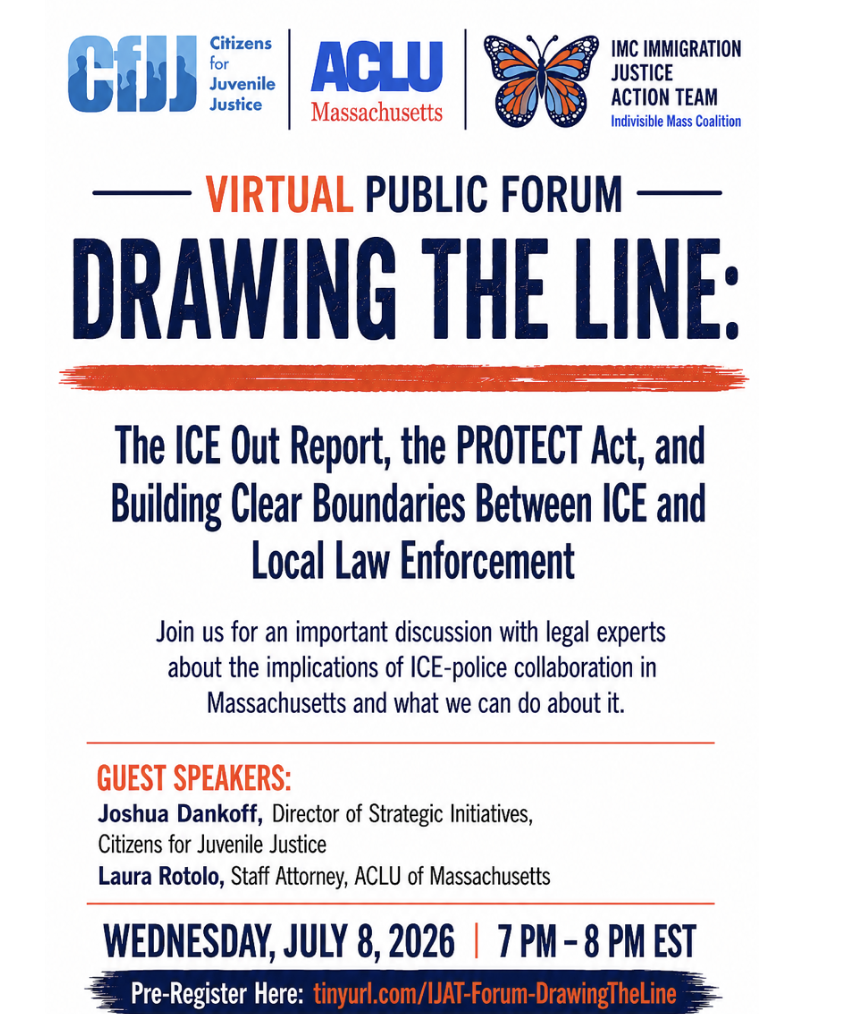
Communities like Amherst are working to protect their immigrant neighbors, respond to an increasingly aggressive ICE presence, and sort out the complexities of federal, state, and local law. With this in mind, the Immigration Justice Action Team of Indivisible Mass Coalition is sponsoring a virtual public forum featuring two legal experts who will discuss the legal and policy framework governing police-ICE relationships and what communities can do to set limits on how municipal resources are used for immigration enforcement. Indivisible Mass Coalition (IMC) is the statewide umbrella organization for Indivisible chapters and other progressive grassroots organizations in Massachusetts.
The forum is slated for Wednesday, July 8, 7-8 p.m., via Zoom. It is entitled “Drawing the Line: The ICE Out Report, the PROTECT Act, and Building Clear Boundaries Between ICE and Local Law Enforcement.”
Presenters will include Joshua Dankoff, director of strategic initiatives at Citizens for Juvenile Justice, and Laura Rotolo, staff attorney at the ACLU of Massachusetts. Dankoff led the research project that produced the ICE Out report. Rotolo has been deeply involved in immigrant justice and legislative advocacy for many years and was the principal author of the 2019 ACLU-MA Model Massachusetts Welcoming Community Bylaw/Policy.
Participants will leave with practical tools for understanding current law, evaluating their own community’s policies, and identifying opportunities for reform and action.
Interested participants can register at tinyurl.com/IJAT-Forum-DrawingTheLine
Miriam DeFant is co-chair of the Immigration Justice Action Team of Indivisible Mass Coalition and is a member of the Western Mass Immigration Legislative Advocacy Network (WMILAN) and Jewish Activists for Immigration Justice (JAIJ).
Update to program: Time is now 7 pm to 8:30 pm. We are thrilled to welcome Javier Luengo-Garrido, ACLU-MA Deputy Field Director, to the program. Register on Mobilize at tinyurl.com/IJAT-Forum-DrawingTheLine.