
Public Comment | The New Hauler Proposal: Recommendations for Maximizing Reduction of Waste and Emissions
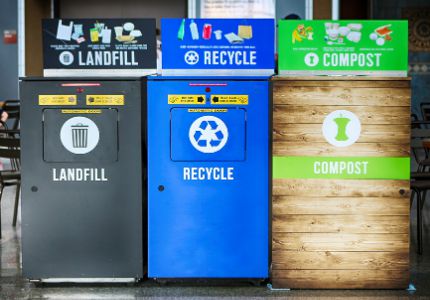
Photo: CalRecycle
The following public comment was offered at the meeting of the Town Services and Outreach Committee on August 6, 2026
My name is Darcy DuMont, and I live in District 3. I am making a comment today on behalf of Zero Waste Amherst, the community sponsor of the original proposal, on the proposed RFP assembled by Mimi Kaplan and the decision points she laid out. As we get a better understanding of the proposal, I’m sure we will have more comments. We thank Ms. Kaplan very much for making this monumental effort to put together an RFP that includes many elements.
Many of the decision points are choices between greater and lesser ways to reduce emissions. Our comments focus on making the new system as meaningful as possible in reducing trash and emissions.
Our initial comments are the following:
- ZWA recommends a three-year rather than a five-year contract if curbside compost collection is required in year one. A five-year contract would be reasonable if the compost program were to be an elective option for the whole town in years one and two and required in year three. The first two years would be used to provide outreach and education on the benefits of diverting compost from trash, with all households receiving a compost cart whether or not they elected to use it. We recommend that the program start in January or July of 2027.
- Sustainability data, including waste reduction data and emissions reduction data, must be reported to the town by the vendor. We also need to ensure that the vendor provides separate service to Amherst so that data on the tonnage of each type of waste can be compiled accurately.
- ZWA recommends that the town purchase and own the carts, while the vendor maintains, stocks, and replaces carts. This is because grants are available and because owning the carts means that the town isn’t tied to a particular vendor. It can easily move from vendor to vendor if needed.
- Trash
a. ZWA recommends using 65-gallon trash carts biweekly, a best practice which is endorsed by DEP, with grants available. Residents will find that they have much less trash when both compost and recycling are diverted. And that trash will not smell if food has been diverted.
b.ZWA recommends using a 65-gallon (biweekly) trash cart plus overflow bags. This method, used by many municipalities in MA, has been shown to be more effective in reducing waste than using different sized/priced carts because there is a direct psychological/financial trigger each trash day requiring the purchase of overflow bags for excess waste. A behavior shift occurs with the trash lid closure constraint, which forces residents to actively use their curbside compost and recycling programs for food scraps and paper goods and recyclable materials rather than tossing everything into the garbage. Fixed small carts prevent “creeping capacity,” where households with large 96-gallon bins casually throw away recyclable or compostable materials because they have empty space. - Recycling
a. ZWA recommends biweekly pickup of 65-gallon carts.
b. ZWA previously recommended dual-stream recycling, as it reduces waste more than single-stream. We are concerned that dual-stream recycling isn’t considered as an option in this RFP when it can be done with automated trucks on alternate weeks. Contamination at single-stream recycling processing facilities has been shown to be higher than at our local dual-stream facility.
c. We are interested in learning more about the proposal to revenue share with the recycling facility based on contamination amount, if we understand that correctly. Our initial take is that commodity revenue stream audits may be a good idea. - Organics
ZWA recommends using an industrial composting facility, not an anaerobic digester facility, because an industrial facility can take many more types of compostable materials, including compostable containers and utensils, dirty paper, etc. As a college and restaurant town, Amherst could reduce much more waste by composting a wider range of compostable materials than just food scraps. - Yard waste
ZWA recommends several consecutive curbside pickup weeks in the fall, and several in the spring, plus tree pickup. - Bulky waste
ZWA recommends that a fee for bulky waste pickup be included in the contract fee – for several days of pickup during the weeks of college move-out. Landlords should be factored into how this would work. - ZWA recommends keeping the transfer station as a vital element of Amherst’s waste reduction system.
a. We recommend that it be accessible to all residents via a slight addition to the curbside collection fee.
b.We recommend that the Transfer Station expand its hard-to-recycle offerings and include such things as mattresses and styrofoam recycling again.
c. We affirm using the Transfer Station as a hauler aggregation site to save trips and contract costs. - Outreach and education
ZWA recommends that the town take responsibility for creating outreach and education materials and events in coordination with the vendor. The vendor can take responsibility for affixing educational materials to carts, including those materials on its website, and providing transparent pricing.
Darcy DuMont is a former town councilor and sponsor of the legislation creating the Amherst Energy and Climate Action Committee. She is a founding member of Zero Waste Amherst, Local Energy Advocates of Western MA, and a non-voting member of Valley Green Energy Working Group. She can be contacted at dumint140@gmail.com.
Ms. DuMont, I appreciate how passionate you are about this topic. I didn’t previously know much about different approaches for trash handling, and your posts (and articles in the Gazette), have helped me understand better. Thank you for your advocacy!
In our opinion, all residents should have the choice to do the curbside pickup or continue to use the blue bag system at the transfer Station at its cost. Hopefully that’s what the ZWA recommends. We already remove compostable material from our trash and have for many years. We would love if the styrofoam recycling was returned to the Transfer Station. We miss the “Take it or Leave it” area but understand the issues that it may bring. The Transfer Station is a wonderful, well kept, organized system and we applaud the employees that run it. Thank you Darcy for your passionate work on this topic.
Thank you, Darcy and ZWA for such careful and thorough consideration of the RFP!
I want to second the comment made by Jeff Osborne that residents should have the choice of signing on to the Town’s curbside trash pick-up service or using the Amherst Transfer Station. The Transfer Station’s blue bag system works well for us for trash, recyclables and we also take our compost and yard waste there. For us, the Transfer Station is less expensive and more convenient and should remain a choice.