
Full Staffing for CRESS: A Cost-Saving Investment That Strengthens the Amherst Police Department

Photo: amherstma.gov
by The Community Safety and Social Justice Committee of the Town of Amherst
The following analysis was sent to the Amherst Town Council on Nov. 3, 2026.
The Community Safety and Social Justice Committee (CSSJC) recommends that the Town Council fund CRESS at the staffing level needed to operate as a full, two-shift department. We make this recommendation for three reasons: it will lower what the town spends to answer calls for service, it will reduce costly downstream emergency and medical expenses, and it will give the Amherst Police Department (APD) more time and capacity to respond to violent crimes.
This is not a choice between CRESS and the police. Amherst needs both. Public safety works best when each call is met by the responder best trained for it: a sworn officer for crime and danger, a firefighter or paramedic for fire and medical emergencies, and a trained CRESS responder for behavioral health crises, welfare checks, and other non-violent calls. A fully staffed CRESS completes that system. It does not take anything away from it.
Summary of the Request
We ask the Council to fund the following positions:
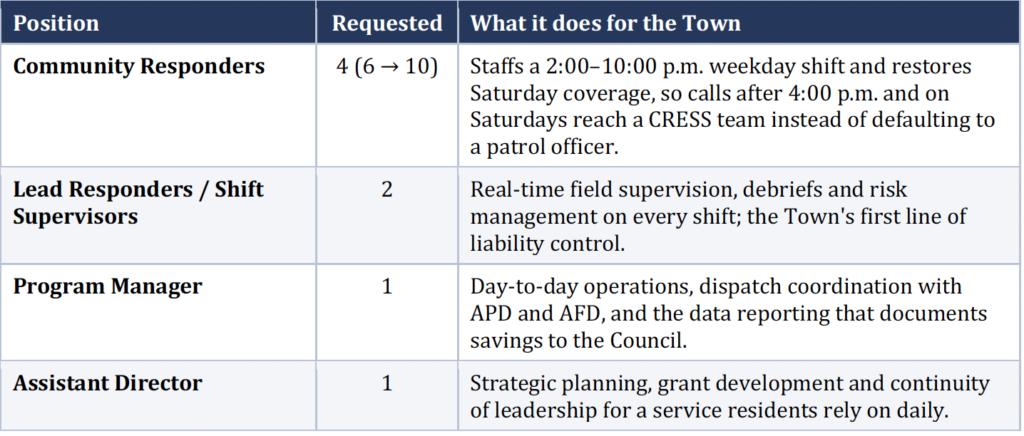
At full strength, CRESS would include a Director, an Assistant Director, a Program Manager, two Lead Responders, ten Community Responders and one Administrative Assistant. Program staff have said publicly that true morning-and-evening coverage will ultimately take a minimum of twelve responders. This request is a measured step toward that goal, not the end point.
I. The Need: Demand Throughout the Day, and No Coverage After 4:00 p.m.
CRESS currently operates from 8:00 a.m. to 4:00 p.m., Monday through Friday. Recent discussion of CRESS-appropriate calls has focused largely on the evening hours. That focus is important, but it understates the full demand for CRESS services, which is substantial during the day as well as after the current shift ends.
Daytime demand is significant. The current daytime shift is fully occupied. In addition to calls for service, residents regularly come into the CRESS office in person seeking help. Court appearances, eviction proceedings, and many neighbor-related concerns occur during business hours and require responders who are available early in the day. CRESS staff also routinely see calls on the public safety dispatch board throughout the day that fall within CRESS’s scope, including APD responses to coded medical and mental health calls, well-being checks and unwanted-person calls.
Evening and weekend needs go unmet. After 4:00 p.m. and on weekends, no CRESS team is available. Those calls do not go away. They default to patrol officers, to Fire Department EMS and, too often, to the emergency room. This gap is among the most expensive in Amherst’s public safety system: the town is paying for a specialized response service but receiving its benefit for only part of the day and part of the week.
The recommended coverage model. Based on the CRESS Director’s operational experience and on research conducted with Tury Research and the League of Women Voters, the Committeerecommends the following schedule, which the staffing in this request is designed to support:
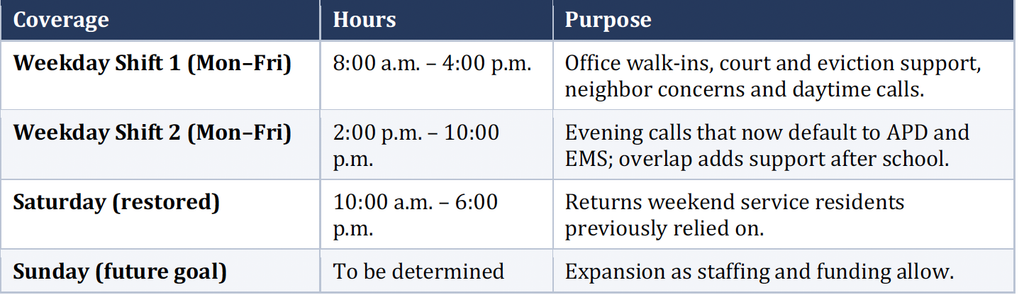
The two-hour overlap between shifts places additional responders in the field during after-school hours, when demand involving young people and families rises. The return of Saturday coverage restores service residents previously relied on, with the goal of adding Sunday coverage as staffing allows.
A complete picture of call data. To plan staffing and coverage accurately, CRESS needs a full view of the calls it is suited to handle. Today, once calls are cleared from the dispatch board, the CRESS Director no longer has access to review them, and the calls reported in public meetings as suitable for CRESS have been limited largely to the 4:00 to 8:00 p.m. window. The Committee recommends that the Council support giving CRESS leadership ongoing access to review dispatch records for CRESS-appropriate call types, in coordination with APD and Emergency Communications. A more complete and transparent view of these calls is essential to ensure that staffing, coverage and service delivery reflect the actual needs of the community.
II. Significant Cost Savings and a Reduced Financial Burden on the Town
A fully staffed CRESS is not a new expense layered on top of existing costs. It is a lower-cost way to deliver services the Town is already paying for at a higher price. The evidence from comparable programs is consistent:
1. A lower cost per call. When Denver deployed its Support Team Assisted Response (STAR) program, a peer-reviewed study published in Science Advances (Stanford University and University of Pennsylvania, 2022) found that the average direct cost of handling a low-level offense through STAR was about $151, compared with about $646 through a police-onlyresponse. That is roughly one-quarter of the cost. The same study found a 34 percent reduction in reported low-level crime in the areas STAR served, with no increase in violent crime.
2. Proven returns, and a lesson in sustainability. For more than three decades, Eugene, Oregon’s CAHOOTS program was the nation’s best-known model of community crisis response. Operating on approximately $2.1 million per year, it was credited by its operator with saving the city an estimated $8.5 million annually in public safety costs, handled about 17 percent of the Eugene Police Department’s call volume, and required police backup in fewer than 1 percent of its calls. Despite that record, CAHOOTS is no longer in operation in Eugene: its service there ended in April 2025, with its operator citing financial reasons.
The lesson for Amherst is clear. Even a highly effective program cannot survive on unstable funding and a thin administrative structure. Permanent Town funding and professional management are what protect the investment Amherst has already made in CRESS.
3. Reduced police overtime and officer hours. Behavioral health and welfare calls are among he most time-consuming calls an officer handles, frequently involving long on-scene stabilization, transport and hospital waits. Every one of those calls that CRESS handles, during the day, in the evening, or on Saturday, returns an officer to patrol and reduces the overtime needed to cover shifts. Over a year, those hours represent real budget relief.
4. Fewer ambulance transports and emergency room visits. Many crisis calls end in an ambulance transport and an emergency room visit that could have been avoided with on-scene de-escalation and a connection to appropriate care. Each avoided transport frees Amherst Fire Department EMS for true medical emergencies and spares residents, insurers and public programs some of the most expensive care in the health system.
5. Lower liability and risk exposure. Encounters involving people in mental health crisis carrya higher risk of injury to residents and officers alike, and injuries bring claims, litigation and insurance costs. Sending trained, supervised crisis responders to these calls reduces the likelihood of escalation and, with it, the town’s financial exposure.
6. Breaking the cycle of repeat calls. A small number of residents account for a large share of repeat crisis calls. CRESS follow-up and referral to ongoing services reduce that repeat demand, which lowers costs across police, fire, EMS and the hospital at the same time.
7. Leveraging outside funding. A permanent, professionally managed department with an Assistant Director and Program Manager is far better positioned to compete for state, federal and philanthropic grants and to document the outcomes funders require. Stable staffing helps the Town bring in outside dollars rather than carrying the full cost alone.
III. How a Fully Staffed CRESS Helps the Amherst Police Department
The Committee wants to be direct: a stronger CRESS is a stronger APD. Funding CRESS supports our officers in concrete ways:
▪ More time for core police work. Officers relieved of non-violent behavioral health and welfare calls have more time for patrol, investigations and responding to other violent incidents, and can respond to those calls faster.
▪ Less overtime and less burnout. Police departments across the country, including in Massachusetts, face recruitment and retention challenges. Reducing the number of difficult, time-consuming crisis calls officers must absorb, especially on evening shifts and on Saturdays, helps protect officer well-being and makes Amherst a more attractive place to serve.
▪ Greater officer safety. Crisis calls are unpredictable. Having CRESS available to take the lead on appropriate calls, or to support officers on scene, reduces the risk of situations escalating to the point where an officer or a resident is hurt.
▪ A reliable partner at every hour. Today an officer who encounters a resident in crisis at 7:00 p.m. has no one to hand the situation to. With a 2:00–10:00 p.m. shift and Saturday coverage, officers gain a trained responder they can call for a warm handoff, freeing them to return to service.
▪ Coordinated dispatch and shared training. The Program Manager will coordinate call protocols with APD and Emergency Communications so every call goes to the right responder, and can support joint training and after-action review between CRESS and APD personnel.
▪ Better data for both departments. Consistent tracking of call types, outcomes and repeat contacts gives CRESS and APD leadership and the Council a clearer picture of demand, helping both departments plan staffing and budgets on the basis of evidence.
IV. The Supervisory and Management Positions Are Cost Controls
The Lead Responder, Program Manager and Assistant Director positions are not administrative overhead. They are how the Town protects its investment:
▪ Lead Responders / Shift Supervisors provide real-time guidance during complex calls, conduct debriefs and enforce clinical standards. A department of ten responders working across two shifts cannot be safely supervised by one Director, and unsupervised field operations create liability risk and turnover, both of which cost money.
▪ The Program Manager is the position that measures and reports the savings described in this letter, including call outcomes, diversion from police and EMS, and repeat-call reduction, so the Council can verify the return on its investment.
▪ The Assistant Director ensures continuity during leadership absences and turnover, and carries the grant-writing and partnership work that brings outside funding into the town.
V. Consistent with National Best Practice
Guidance from the Alternative Mobile Services Association (AMSA) shows that the most successful community response programs use a multidisciplinary, tiered leadership structure with dedicated field supervision, which is what this request builds. The Law Enforcement Action Partnership (LEAP) report on Amherst’s call data likewise found that a substantial share of calls to public safety are suitable for a trained civilian response, and that specialist-led responses improve stabilization outcomes and reduce unnecessary arrests. Those outcomes depend on the supervisory infrastructure to support responders in the field.
VI. The Same Quality of Service at Every Hour
As the League of Women Voters has emphasized in its review of community safety in Amherst, public safety services are only effective if residents can reach them. A neighbor in crisis at 8:00 p.m. deserves the same skilled, appropriate response as a neighbor in crisis at 10:00 a.m. So does a resident who needs help on a Saturday. Today, that is not the case. An evening shift and restored Saturday coverage make CRESS a dependable service rather than a daytime one, and makes the town’s overall public safety system more consistent for every resident.
VII. Accountability to the Council
To help the Council evaluate this investment, the Committee recommends that funding be paired with regular public reporting, which the Program Manager position makes possible. We suggest reporting at least twice a year on:
1. Call volume and timing across all shifts, including in-person office visits, evening calls and Saturday calls.
2. CRESS-appropriate calls on the dispatch board, including those handled by APD, drawn from the full day rather than the evening window alone.
3. Calls diverted from APD and from AFD EMS, with estimated officer and EMS hours returned to service.
4. Avoided ambulance transports and emergency room visits.
5. Repeat-call trends for residents served by CRESS follow-up.
6. Outside funding secured through grants and partnerships.
Conclusion
Funding CRESS at full strength is a responsible financial decision. It delivers appropriate calls for service at a lower cost, reduces expensive emergency and hospital use, limits the Town’s risk exposure, and gives the Amherst Police Department more capacity to focus on violent crimesthat require a sworn officer. The Committee respectfully urges the Council to fund the four additional Community Responders, two Lead Responders, a permanent Program Manager andan Assistant Director in the coming budget; to support the recommended coverage model of weekday shifts from 8:00 a.m. to 4:00 p.m. and 2:00 to 10:00 p.m. with Saturday coverage from10:00 a.m. to 6:00 p.m.; to support CRESS leadership access to dispatch records for CRESS-appropriate calls; and to work with the Town Manager and the Finance Committee to make these positions part of the Town’s permanent operating budget.
The Community Safety and Social Justice Committee (CSSJC)