
From ‘Send it to the Human Rights Commission’ to ‘Who is Actually Responsible?’
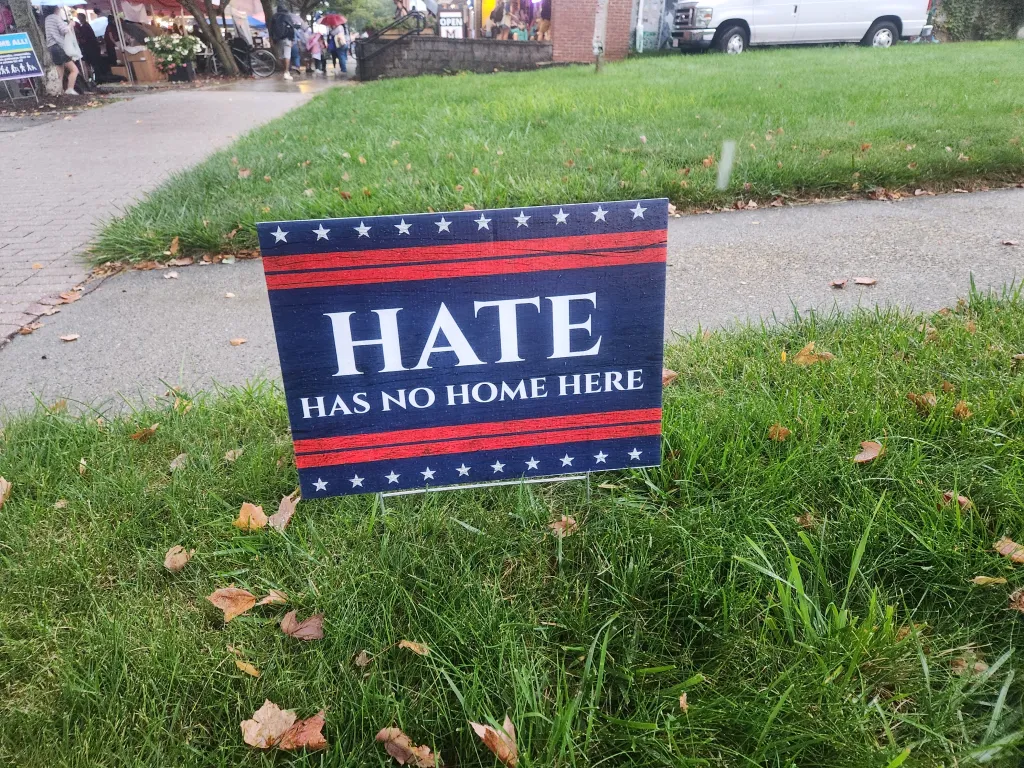
Photo: c/o Rizwana Khan
Social Injustice Goes Global

On Aug. 25, a hateful symbol was found spray-painted on electrical boxes at Kendrick Park and at the intersection of Northampton Road and South Pleasant Street. Reporting in the Indy also documented “white power” stickers depicting a gun pointed at a Black cartoon face.
The town described the spray-painted symbol as a version of a triskele made up of three 7s and called it hateful. Police opened an investigation, and the Department of Public Works and police removed the graffiti.
This was not Amherst’s first encounter with explicitly racist material in 2026. In April, racist and hateful letters were placed on multiple vehicles. The Amherst Police Department, Community Responders for Equity, Safety, and Service (CRESS), and diversity, equity, and inclusion (DEI) staff reviewed the material and spoke with residents who received it. Police said the information available did not meet the legal criteria for a hate crime. But the town’s own statement made an important distinction: The absence of a legally defined hate crime did not mean the absence of harm. Town officials specifically acknowledged the disproportionate impact on Black and African American residents.
That distinction matters because it raises a question: Once the graffiti is removed, what happens next?
Who documents the incident as a human rights concern? Who determines which department or agency has responsibility? Who follows the police investigation? Who engages the people and communities affected? Who decides whether a public statement, community meeting, education effort, or other response is appropriate? And, perhaps most importantly, who makes sure the issue does not simply disappear once the spray paint has been covered over?
On Sept. 9, the Community Safety and Social Justice Committee was still discussing the recent hate graffiti and expressing concern about the town’s response, including whether the Human Rights Commission (HRC) and other civic bodies should have been engaged in community healing. Members discussed a joint statement making clear that racism, antisemitism, Islamophobia, and homophobia would not be tolerated in Amherst.
This is where Amherst’s familiar civic problem appears: Something happens, everybody has a discussion and says, “We should do something about this,” and then institutional memory has the durability of a Snapchat story.
This is where Amherst’s familiar civic problem appears: Something happens, everybody has a discussion and says, “We should do something about this,” and then institutional memory has the durability of a Snapchat story.
Who Owns the Next Step?
The problem is more basic: Who owns the next step?
That is where the HRC needs a better system for turning human rights concerns into an institutional trace.
The HRC absolutely has a role. The town’s own description of the commission says it exists to help protect the human rights of Amherst residents and visitors, and it describes the commission’s responsibilities broadly. Its published materials also show the commission responding to incidents beyond Amherst itself while acknowledging the limits of its jurisdiction and using its position to support residents and communicate with town officials.
But there is a difference between being a place where a concern can be heard and being the institution responsible for investigating and resolving it.
Amherst’s current system already assigns operational responsibility for complaints to the human rights director and the DEI Department. Pamela Nolan-Young is both the human rights director and the director of the DEI Department. The town’s complaint process identifies the DEI Department and the human rights director as the contact for receiving and addressing complaints.
So when someone says, “Send it to the HRC” — as Town Councilor Lynn Griesemer did at a Sept. 11 meeting of the Governance, Organization, and Legislation Committee — the obvious follow-up question is:
What does “send it” actually mean?
Does it mean documenting the concern? Making a referral? Investigating? Mediating? Negotiating? Determining findings? Helping resolve the matter? Following up with the department responsible? Reporting publicly on whether anything actually happened?
Those are not the same job. And pretending they are is how a well-intentioned civic system becomes a maze.
During its May 18 meeting, the Town Council examined the respective roles of the HRC and the DEI Department and human rights director (read the subsequent charge developed for the HRC here) . The discussion included a proposal that would allow the commission to make recommendations beyond the DEI Department and seek resolution through discussion, mediation, or negotiation.
At the same time, HRC Chair Rani Parker said commissioners themselves were not intended to conduct mediation. Council discussion then raised the practical question: Who would actually perform those functions, and under what confidentiality rules?
That procedural detail goes to the heart of what Amherst expects a volunteer commission to do.
HRC members are Amherst residents serving terms typically limited to three years. The commission’s work includes advocacy, networking, public education, community events, and promoting human rights. But volunteers cannot reasonably be expected to turn every institutional conflict or community grievance into a professional investigation simply because someone at a public meeting says, “Send it to the HRC.”
That is responsibility without authority.
The recent graffiti was removed. Police opened an investigation. The town spoke publicly. Community members and committees discussed the incident’s larger meaning. But a functioning human rights system needs to answer another question: What happened after the initial response?
Because someone needs to own the institutional handoff.
When there is no clear mechanism for moving a concern forward, the problem gets sent to a volunteer commission. The discussion becomes a history lesson, and the concern gets another referral.
Human rights work requires historical context. Amherst’s history and institutional racism matter; discrimination has patterns, and communities remember things that government records do not. But history cannot become the parking lot where action goes to die.
Then, eventually, someone asks why the HRC has not fixed the problem. Suddenly, the commission meant to provide civic oversight becomes the place where institutional frustration lands.
That is the trap.
An Institutional Record: The Missing Piece
Once the HRC receives a concern, who has the authority to do what comes next — and how does the outcome come back to the commission so the matter does not simply disappear into another department, referral, or meeting agenda?
... where confidentiality and legal limits permit, the community should be able to see that the concern did not simply disappear.
That is the missing piece: an institutional trace. The outcome — or the reason there was no further action — is recorded. And where confidentiality and legal limits permit, the community should be able to see that the concern did not simply disappear.
Accountability is not just knowing that something was reported; it is being able to trace what happened next.
When someone spray-paints hate onto public property in Amherst, removing the paint is necessary. But removing the graffiti is not the same as resolving the human rights problem—or documenting what happened, who was responsible for the response, and what happened next.
The paint can disappear in a day, but the institutional record should not.
Rizwana Khan is a writer, educator, and human rights advocate in Amherst.