
Opinion: Buildings, Settings, and History
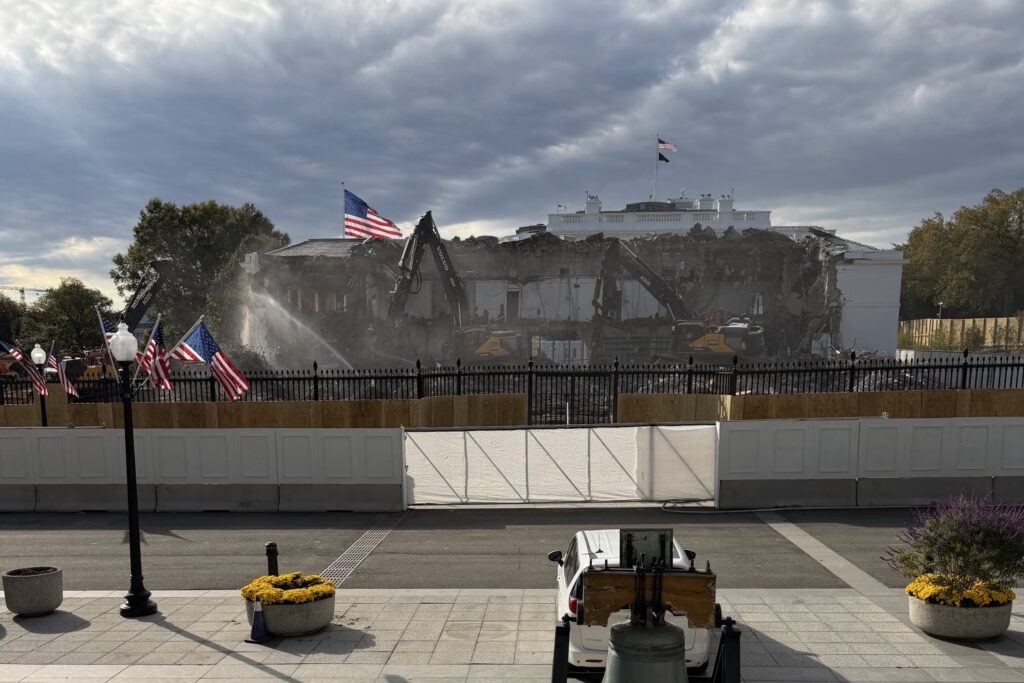
The site of the East Wing of the White House is shown on Oct. 21, 2025. The area is under construction after President Donald Trump ordered the demolition of the East Wing and construction of a new ballroom. (Photo obtained by The Washington Post for Wikipedia.
I want to thank Hetty Startup and Ira Bryck for their strong advocacy for an East Amherst Historic District. They quite rightly wrote to address current controversies, but I want to support them in larger terms, implicit in their letters to the Town Council, by arguing for preserving buildings in their settings and buildings as custodians of our history.
Years ago, Town Meeting paid its owners considerable money not to tear down a historic brick farmhouse on North East Street. We preserved the building, but allowed the owners to build a house adjacent to it – too close to preserve its character and its historic significance. In a few months we will see the consequence of preserving the front facade of the Jones Library but allowing an overly large and architecturally unsuitable addition to be attached to it. The current debate over ADUs in residential neighborhoods also speaks to the importance of settings in preserving significant buildings.
So past, present, and future examples all attest to Amherst’s paradoxical desires both to preserve and destroy our architectural inheritance. We are certainly not alone in this, and these conflicting desires are easy to understand. Land is at a premium, affordable housing is needed, and Amherst’s tax base needs to grow. These imperatives are currently engines driving the town’s approach to the land owned by the Trustees of Hampshire College. My quite urgent question, then, is whether historic preservation – both buildings and settings – can be added also as an imperative or whether it is fated always to be a “yes, but” when the town’s needs are being assessed and addressed.
My quite urgent question, then, is whether historic preservation – both buildings and settings – can be added also as an imperative or whether it is fated always to be a “yes, but” when the town’s needs are being assessed and addressed.
First I want to look at this issue in its national setting- in particular at Washington, D.C. I am quite sure that most of us look at the changes happening at the White House and Kennedy Center with disgust and anger, but they are very different offenses. The huge White House “ballroom” will dwarf and diminish the architecturally and aesthetically splendid White House and its beautiful setting. The Kennedy Center is not an architecturally distinguished building but its historical significance and its place in the cultural life of a complicated city for over half a century mark it as a structure that needs revitalization to preserve its character and history. It is not getting revitalized; it is getting destroyed. These both have their analogs in Amherst.
In Amherst, we have a long history of wanting to preserve and conserve our open lands, although we haven’t explicitly addressed the issue of adjacent open lands. The 2010 Master Plan (never approved by the town) pays lip service to the mantra of “density and infill,” driven by the hopes of builders and planners who felt stifled by the town’s attitude toward development, but these ideas were never discussed or debated. They remain the foundational hopes of the Planning Board and Finance Committee, neither of which is independent of the Town Council, and neither of which has ever been publicly discussed or debated. (Town Meeting did discuss the rezoning of the beautiful land between the Jones Library and the Strong House, and ultimately gave its approval for the library’s encroachment.)
One last imperative: our town’s history. Again, at the national level I imagine that most of us are aghast at the attempts of the Trump administration to rewrite our nation’s history and to erect imperial arches to solidify their whitewash. In Amherst, too, our buildings are the custodians of our history, as Hetty and Ira both affirm and demonstrate. That history is not wholly glorious. From the day the town’s first parson (hired by the Board of Selectmen) arrived in 1739 with his rifle and his slave, our history has been complicated. It still is. I suspect that future generations may view the buildings of the early twenty-first century as an accurate reflection of Amherst’s history and values in our time. And I fear they may be right.
Michael Greenebaum was Principal of Mark’s Meadow School from 1970 to 1991, and from 1974 taught Organization Studies in the Higher Education Center at the UMass School of Education. He served in Town Meeting from 1992, was on the first Charter Commission in 1993, and served on several town committees, including the Town Commercial Relations Committee and the Long Range Planning Committee.