DPW Building Committee Still Debating Site Selection
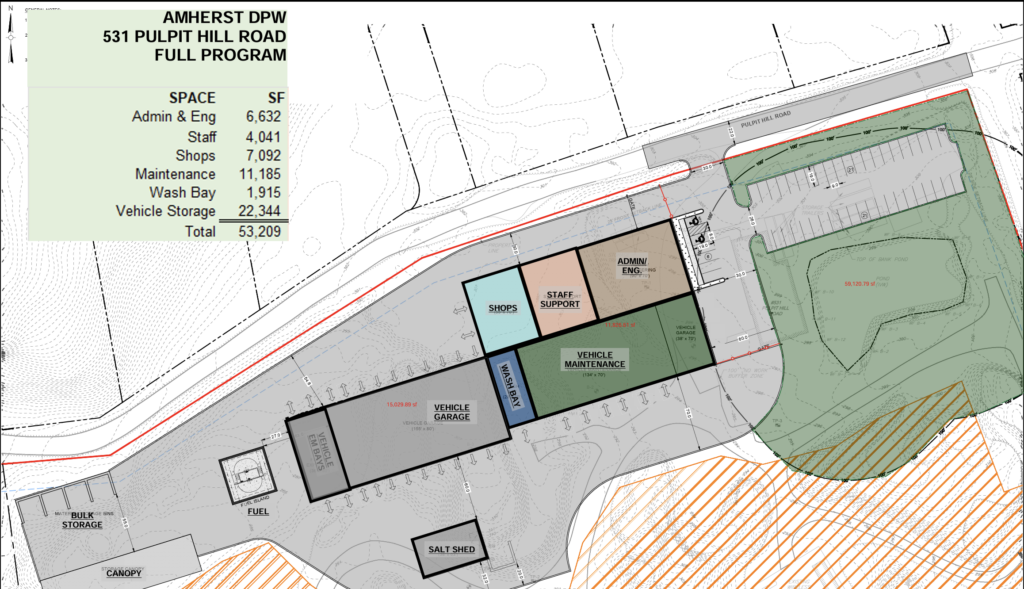
Preliminary proposed layout for DPW facility at Pulpit Hill Road. Photo: amherstma.gov
Report of the Meeting of the Department of Public Works Building Committee, Nov. 18, 2026
The hybrid meeting was held in the Town Room of Town Hall and was recorded.
Present
: Christine Gray-Mullen (Chair), Sean Mangano (finance director), Paul Bockelman (town manager), Pam Rooney (town councilor, District 4), Holly Young (town procurement officer), Jason Skeels (town engineer), and resident members David Ahlfeld and CJ Diamond. Absent: Guilford Mooring (superintendent of public works)
Project team members: Bob Peirent (OPM and town capital projects manager); Jean-Pierre Parnas and Jennifer Kady from Weston and Sampson (Designers)
Conceptual Cost Update
Jean-Pierre Parnas from Weston and Sampson shared a conceptual cost update to show how the public works facility project could be completed for $35 million. He cautioned that these very preliminary figures are for planning purposes only and do not reflect costs specific to the two sites being considered (South Pleasant Street and Pulpit Hill). Construction costs for the different types of spaces range from $350/sf for the larger vehicle/equipment storage area to $680/sf for the smaller wash space, which requires expensive equipment, for an average building cost of $625/sf. While the targeted $35 million total project cost provided also includes site work, demolition of the existing building, accessory structures such as a salt shed and fuel island, and soft costs, it does not include environmental remediation, utility extension, solar panels, owner’s contingency, or cost escalation beyond 2027. Parnas showed a space needs summary illustrating proposed reductions in square footage to bring the estimated project cost within the target budget.
Committee members had several questions and comments.
David Ahlfeld suggested carrying forward the 7,500 sf of space for maintenance and vehicle storage that was reduced to keep the project at $35 million, as an alternate to add back if possible, noting it would be less expensive to build now than to add later. Parnas offered that bids for a project in another Massachusetts town just came in substantially under budget, suggesting that “it’s a good market right now”.
Chair Christine Gray-Mullen questioned how long the fabric salt shed would be expected to last. Parnas thought 15-20 years and estimated that the alternative, a wood-framed structure with a roof, would cost about 30% more than the fabric version.
C.J. Diamond wondered whether the fuel island could be removed from the plan and have fueling take place off-site. Mangano noted that the North Amherst Fire Station has pumps with both gasoline and diesel. Both Parnas and Peirent, however, pointed out that the nature of the DPW’s work, especially multiple refueling events during snowstorms, makes relying on off-site sources or deliveries problematic.
Town Councilor Pam Rooney expressed concern that the costs for demolition ($160,000) may be an underestimate since it excludes environmental remediation of the current site (Parnas acknowledged that the hazardous materials report has not been received yet), and that the pricing contingency at just 5% seemed low for this stage of the project. Rooney also pointed out that the costs for PV panels should be included since it is to be a net zero energy building. Without PV included, this would only be net zero ready, which is not allowed by the town’s bylaws.
Conservation Compliance
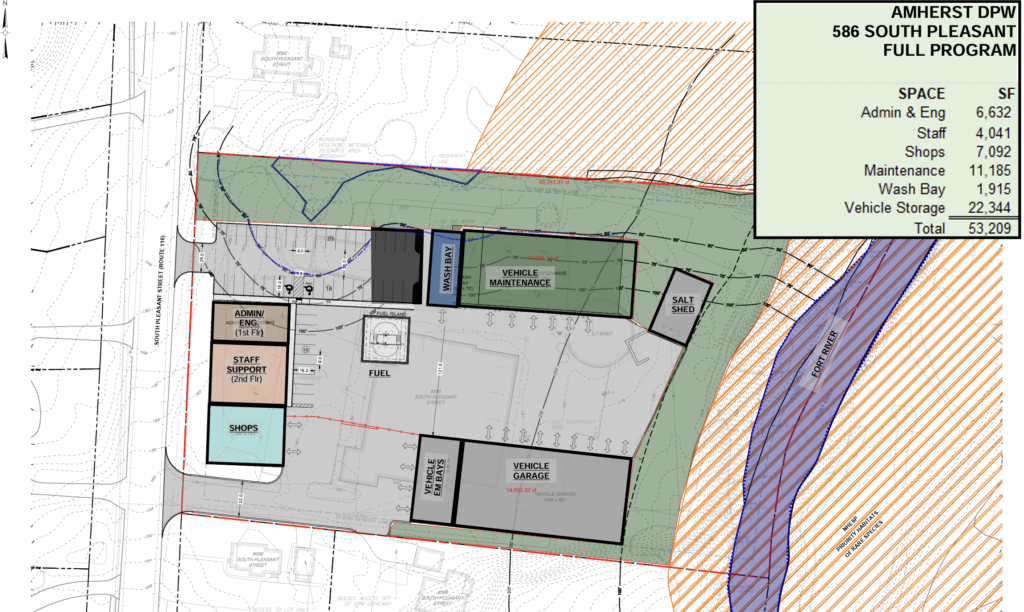
Ahlfeld had inquired about the effect of encroaching on the parts of the Pulpit Hill site that are protected by the Natural Heritage and Endangered Species Program. Parnas responded that this would be complicated and could trigger other state permitting in what could become a long process. Peirent added that the current plan would produce a good project that respects those boundaries.
Parnas also reported positive interactions with the town’s conservation agent regarding stormwater management, with increases in impervious area being offset by giving back space to wetlands buffers. He added that the project will need to undergo a thorough review by the Conservation Commission for permitting.
Site Comparison
The committee continued deliberating whether to choose the South Pleasant Street or Pulpit Hill site for the new facility. Until that decision is made, schematic design cannot begin. Members offered multiple suggestions for revising the Weston and Sampson site comparison chart to help reach that decision (color-coded, numbered/ranked, list of pros/cons, items to add for consideration). Gray-Mullen asked members to send her their suggestions and comments by December 9 so that they could be compiled and ready for their next meeting on December 16. Parnas offered to lead the committee on site visits of other DPW sites that utilize similar site layouts to the two under consideration. The committee may pursue this.
Financial Constraints
Mangano had been asked to explain the reasoning behind the $35 million total project figure. He characterized it as a “target” based on what the town can afford given its other obligations, rather than a “budget,” since the Town Council has not yet voted to appropriate funds. He noted that the figure has increased by $5 million in recent years and suggested that additional funding sources may be possible, including an investment tax credit for geothermal (similar to the Amethyst Brook Elementary School) or the use of Enterprise Funds (since 10% of the building area involves services that may be supported by this type of funding). Gray-Mullen asked whether the town would consider a debt exclusion override to pay for the project, but Mangano thought that the Town Council did not seem to have an appetite for that approach.