
Opinion: When Five Is Better Than Four: Can Hampshire College Still Be Saved?
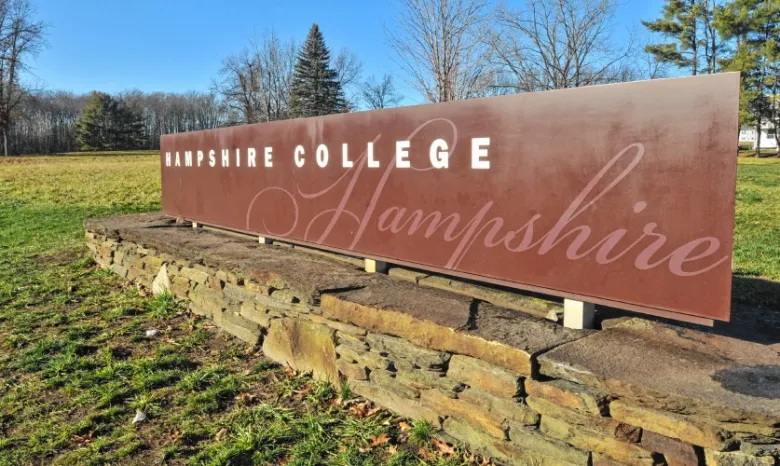
Photo: hampshire.edu

On April 14, 2026, Hampshire College announced that it will close permanently. This surprised many people, coming just two months after a letter to The Boston Globe by the leaders of Amherst, Mount Holyoke, and Smith Colleges and the University of Massachusetts Amherst stating that “It’s Not Too Late to Save Hampshire College”, and stressing the importance of the college to the Five College Consortium — and to higher education nationally.
“For more than five decades, Hampshire has been a national leader in educational innovation, emphasizing interdisciplinary study and student-driven inquiry long before such approaches became widely adopted and respected,” they wrote, in response to a recent Globe story on the college’s ongoing financial struggles.
But was their letter merely rhetoric?
It appears that they wrote their letter while their institutions were negotiating teach-out plans (that is accredited plans to ensure students can complete their education if a college or program closes unexpectedly) because all four schools are transfer partners for Hampshire’s students. Many students are planning to transfer out, but quick action from any one of the consortium schools could reverse that.
Willingness to buy Hampshire’s bonds could halt the closure and begin saving the college. Hampshire’s other problems are much more solvable than it seems to many, as they could eliminate the staffing cuts that caused the admissions downturn and update their business model.
An Investment, Not a gift
In total, the four other schools in the consortium have nearly $8 billion in endowment. Colleges typically allocate a portion of their endowments to bonds. For example, Amherst College has 6.6% of its portfolio in bonds. By reallocating just 1% of the endowment from other investments, the consortium members could buy Hampshire’s tax-deductible, interest-bearing, land-secured bonds.
This would alleviate Hampshire’s refinancing hurdle and provide enough money to invest in multi-generational housing on Hampshire’s land behind Atkins Market in Amherst and in an innovation center.
Municipal bond funds are investment vehicles that can be purchased and may include bonds issued by private colleges. MassDevelopment, a state agency, is the conduit issuer of tax-exempt bonds for Hampshire. MassDevelopment recently explained to me that, “The bonds are either sold in the capital markets (public placement) or directly to a borrower’s bank or another financial institution (private placement).”
Warren Gorlick is a Hampshire alum, former trustee and former Deputy Director of the U.S. Treasury. He told me, “The [Globe] letter implies that Hampshire is integral to the consortium’s collective mission. If that is genuinely true, then financial participation should follow from it — not as a gesture, but as a modest, time-limited commitment that could stabilize Hampshire while longer-term reforms take hold. If we value the Five College model, preserving all five of its institutions must be a shared responsibility — not merely a matter of words, but of resources.”
There is superlative logic to saving Hampshire right now as a bridge for alumni to transfer generational wealth to the college in a significant way.
Gorlick wrote this in a recent column in The Republican: “Over the long term, Hampshire’s endowment is likely to grow, as significant giving often comes later in alumni lives or through bequests. Hampshire’s first class entered in 1970, so its alumni base is still relatively young, but with the oldest now in their seventies, bequests and major gifts should increase in the coming years.”
A Five College innovation center with three incubators
But what if the other presidents want to support Hampshire, but determine that buying Hampshire’s bonds is not in alignment with their investment priorities and strategic plans?
One viable way of lending financial support, while expanding the consortium’s educational scope, would be to invest in new Five College incubators – an idea that has historical precedent.
Hampshire has 800 acres of land and could potentially add a center adjacent to its cultural village (already home to the Hitchcock Center, Yiddish Book Center and Eric Carle Museum), including education and business incubators.
Center for the Future of Higher Education
This incubator could be a neutral, flexible space to experiment with educational innovations that no single college can tackle on its own. A variety of funding sources and partnerships would be possible, including foundation grants, industry partnerships and nonprofit partnerships.
A similar idea from Charles R. Longsworth, one of Hampshire’s founders, was mentioned in “The Making of a College” (Hampshire’s foundational planning document): “An RD Laboratory (not Research and Development, but Radical Departure) … ‘a special educational laboratory on the campus for the really wild things to be tried … where institutional or faculty reputations would not be lost; only made.’”
I mentioned the idea to Michael Horn, an author, educational futurist, and co-founder of the Clayton Christensen Institute. He responded: ”I do think there’s a space and a need for it. It’s ironic, right? You’re going to have a lot of colleges close, and there is a space and a need, in my view, for new models of higher education at the same time. So if Hampshire could serve as that autonomous unit for ongoing experimentation and creation, I think that would be a gift to the sector.”
The incubator would seem to fit with this idea, expressed by Jennifer Chrisler, Hampshire College’s president: “Together, we get to imagine the next chapter of the college’s history, and we have to be brave enough to ask ourselves, ‘What’s next?’ Hampshire’s job at this moment is nothing short of reinventing liberal arts for the 21st century.”
A Five College Business Incubator
An incubator could begin by focusing on societal problems. There are big donors out there who would be excited by bold, different opportunities that let them make an outsized impact.
Matt Hoey was a co-founder of Canopy, an international business incubator headquartered in Boston, and worked closely with MIT. Here’s what he has to say on the topic:
“Hampshire’s experimental, interdisciplinary identity is a strong brand for an incubator – especially one tilted toward social impact and public problem-solving. That gives it a unique market niche compared to tech-centric incubators, but combined with tech-centric, it’s a complete package for solving a range of industry and social challenges.”
Hoey envisions a hub-and-spoke model in which a Five College incubator would eventually connect entrepreneurial programs and incubators at other colleges, such as the Springfield Incubator. This would attract students, provide work-study jobs and funding for faculty and staff positions in entrepreneurship. Connecting the hub with the Western Massachusetts entrepreneurial ecosystem would help provide jobs after graduation.
Science for the Public Good Incubator
There is a precedent for such bold initiatives at Hampshire. Venturewell was founded at Hampshire College as part of the Lemelson program (initially called the National Collegiate Inventors and Innovators Alliance). It is now an independent program and, over 30 years, has helped start ventures that have received $7.9 billion in funding.
Hampshire has a long history of engaging students in science. At Hampshire, there is particular interest in science for the public good, including at its Center for Design.
The other colleges of the consortium created Hampshire College in 1965. Will its leaders follow up on the strong words in their letter to The Boston Globe with concrete support for a plan that could help save the college – and benefit the consortium, the region and higher education?
If you’d like to join groups of supporters discussing Hampshire 3.0 and options to save the college, please fill out the form at frogcollabs.org
Jonathon Podolsky is a journalist, Hampshire College alum, member of the Education Writers Association, and a Boardsource Certified Non-Profit Board Consultant. His work can be found at www.Podolsky.cc
I’m a proud Hampshire alum myself, but I disagree with Podolsky’s premise that Hampshire “should” survive. Like any good “Hampster’, my first question is “Why?” Though it might make sense in a pedagogically perfect world, it makes little sense from a business standpoint. I’d be run off campus for saying so, but like all colleges, Hampshire is a business that sells an academic product. There weren’t enough buyers. Even if the four neighboring colleges stepped up to buy Hampshire’s debt, it would not solve the overarching problems. It would take perhaps hundreds of millions of dollars to reverse decades of deferred maintenance, restore a faculty hollowed out by cuts, and probably reimagine the pedagogy. And even if Hampshire’s debts were wiped clean, it would still face an additional problem: who would “gamble” on a college following two near-death experiences?
I respect Chapman’s views and have been familiar with them for quite some time. I’ll respond to the “Why?” question, followed by the business model issue. I was on campus for meetings just after the closure announcement was made; students were devastated, and since then, I’ve continued to hear from current and prospective students who are gutted. This is the college that was a perfect fit for many of them, whether it’s the pedagogy, culture, or community. Students, staff, and faculty affected by the sudden closure are organizing a protest. Meanwhile, while many alumni are resigned to the closure, many others are actively working out plans for various options.
There continue to be students for whom Hampshire is just right, despite poor decisions at the top that have hurt admissions over the years, which I’ve written about in great detail in several articles, as Amherst Indy readers may recall (it has also been covered a bit in the Chronicle of Higher Education). Admissions increased by 79% over three years and declined in 2025 due to direct admissions and a ⅓ reduction in admissions staff at the start of the recruiting cycle. Regarding the business model, I wrote about that in great detail in a previous Amherst Indy article, long before the closure, in addition to the three revenue ideas I’ve mentioned in this one. Restoring a college that is about to close happened at Sweet Briar, and Antioch restarted after closing. They still face challenges but continue to serve students who are a good fit for them. Deferred maintenance isn’t fixed all at once, and Hampshire wouldn’t need hundreds of millions all at once to reopen in some form. Hampshire doesn’t attract new students focused on amenities and new buildings, but deferred maintenance would need to be addressed over time.
The school could be saved, the “Hampshire College” brand however will have to die to do it. Along with it the old guard will have to go. The school had ample opportunity to turn itself around, it just actively crushed the assistance and vision of alums in order to perpetuate “holding the course” which is why its where it is today. To Mike’s comment I think he is right in some regards, as is Jonathan.
A post by an engineering colleague – check it out Bob Greeney – Physics – HCC
https://www.gordostuff.com/2026/04/the-wrong-engineering-school-is-closing.html
This is an immensely exciting project. It is an opportunity to create a community of collaborators across a broad range of political and ideological orientations. An opportunity for differing views to constructiveIy collaborate toward the collect good. I think it is possible to transform the original and evolving foundational principle is a way honors the past, embraces the reality of the present and envisions a future that leads to better social, political, economic and ideological outcomes. Educational institutions are a unique and important pillar of our cultural and social organization and structures. A diversity of ideas and operation principles (almost) always leads to better overall outcomes. I am totally in.
Interesting proposal by “retired Gordon” — let me add my endorsement for this model to Bob Greeney’s — two thumbs up!!
Seems like this program would inculcate life-long skills—similar to a liberal arts education—that won’t be obsolete five years later.
However, I would push for a taxable component to help support excellent roads and schools among other neglected services.