
Updated: Hampshire College Alumni Reflect on an Education That Changes Lives
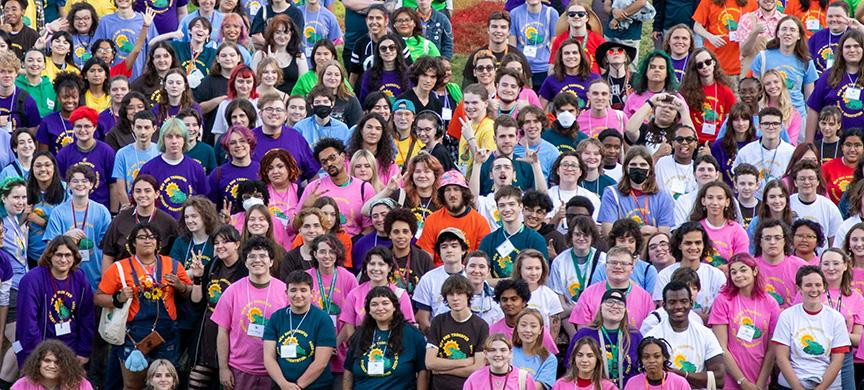
Hampshire College Students (F23). Photo: hampshire.edu
by Evangeline Weiss, Kristen Harbeson, Anthony Thomas, Dani Slabaugh, Gillian Parent, and Roger Sherman
Several Hampshire College alumni have shared their personal reflections with theIndy on the announcement that the college will close permanently at the end of this year. We share six of those reflections here, and will continue to post personal reflections and commentary about Hampshire through the end of April. Note that the (F) listed for the authors below indicates the term and semester in which the person entered Hampshire, designating a cohort.
When I Left, I Was Confident I Knew My Own Mind
by Evangeline Weiss (F85)
Not many people have a good guidance counselor story from high school. But I do.
Pete Williams listened to me. I was not an easy high schooler. My temper ran hot and my upbringing made me eccentric, anti status quo. At Eastchester High School, I attended the alternative school with classes like “Human Beings Being Human.” I was pissed off all the time. And curious and engaged. Set to graduate early, I was headed to Spain and frankly pretty skeptical about college. When I walked into Mr. Williams’ office, my expectations were low.
But Mr. Williams listened to me. When he asked me about the kind of college experience I wanted, I told him, “I don’t want to be student #3456231.” And we laughed. He knew I was smart and odd. He opened a folder on his desk and slid the brochure across to me. Hampshire College. The leaf logo. Amherst, Massachusetts. The Five College Consortium. My mom had gone to Smith. The proximity to her old stomping grounds appealed. Mr. Williams said students could take courses at any of the five colleges.
But what really hooked me? No prerequisites and no grades. Just my kind of place. Hampshire was the only school I applied to. I went to Spain. I told my parents, if I don’t get in, I’m not coming home. A few months later, my mom telexed the good news: you got in, come home immediately.
Hampshire wasn’t the right school for everyone. My advisor, Mike Ford, handed me the course catalogue. “Take anything you want.” I was in heaven. Some people need more structure.
I remember the course, “World Food Crisis,” where Frank Holmqvist and Ray Coppinger took turns arguing whether the food crisis was about natural resources or political will. Of course, we killed that binary, learned about framing an argument and appreciated the complexity of the issues. My studies centered on education and anthropology. It was all about writing, editing, writing. Over and over again until the professor and student agreed “enough.”
The housing was funky and fun, living in Mods. Modular living units. Prescott 77. Enfield 54. I found queerness there: real and sassy, ridiculous and serious as hell. So many friendships and loves.
Yes the drugs. But also worm gods soccer, theatre, feminism, third world and community service requirements, kayaking, pets! At the Tavern, I spent many nights dropping those stuffed mushroom caps and zucchini into the frialator. Later, working for the admissions office, I traversed the campus walking backwards across pastures, below the Div III bell and over the bridge. Parents asked about the bus system, the lack of grades and coed bathrooms. Prospective students asked about professors and classes, what we did for fun.
Hampshire was expensive! It took me 20 years to pay it off. I worked two jobs. I don’t have one fucking regret. I remember when we put a proposal to the board that if every student on campus worked two hours a week, work study students wouldn’t have to keep 20 hours a week jobs. A total non-starter, but I’m proud of us for coming up with it.
In F85, I walked in awkward and defensive, curious and passionate. Hampshire respected me and gave me the space to discover who I was politically, culturally, intellectually. I learned that creativity is the ultimate source. That as long as I found ways to be creative in my work, I would be grounded and gratified. When I left in May of ‘89, I was confident and knew my own mind.
A world without Hampshire College is a shittier place. I am grateful for the values and beliefs that made Hampshire astoundingly bold and courageous.
Non Satis Scire.
Evangeline Weiss (F85) facilites culture change work and makes her home in Chapel Hill, North Carolina.
Hampshire Saw Our Eccentricities as Superpowers
by Kristen Harbeson (F 92)
If there is one thing that anyone who has gone to Hampshire College knows, it is how to write an evaluation: to tell the story of the experience, where we were, why we were there and what we learned. For every class, we wrote self-evaluations and course evaluations. We wrote self-evaluations on our cumulative bodies of work. We set out a proposal for what we would do to demonstrate our expertise and then, at the end, we evaluated how we did. We reflect. We process. We analyze. We lay out our next steps. At the news of my alma mater’s closure at the end of the year, I feel like I need to write one more. An evaluation of my thirty-four years of active Hampshire education.
Hampshire College is not the first small, liberal arts school to close, and it won’t be the last. It is small, largely unknown, and there have been fewer than 13,000 people in the world who have ever received the signature, beautiful, round peg in a square hole diploma. Fellow Hampsters can call me on this, but I would be willing to bet that very few of us were [high school] class valedictorians, and the vast majority of us were told, at some point in their education, that we were not living up to our potential. I expect that almost all of us would have been described – with admiration or disdain – as odd, peculiar, strange, weird, unusual, eccentric. Loners. Outsiders. A lot of us were reprimanded for being too loud, too angry, too….something. Or not enough of…something else. It was all of those qualities – those traits that made us not fit with our peers, or that frustrated our teachers, or angered people who enforce laws – that are why Hampshire wanted us. Hampshire saw these as our superpowers.
I remember watching War Games with Excalibur – the Sci Fi, Fantasy, Role-Playing Club – which showed a double feature movie every Saturday night. There is a moment when the Pentagon is trying to figure out who has hacked their system. They find out it was a high school student (played by Matthew Broderick) and they are trying to figure out his profile: “He’s intelligent, but an underachiever, alienated from his parents, has few friends. Classic case for Soviet recruitment.” The room went dead silent until someone said what we all were thinking: My God! We’re ALL Russian Spies.
And there was never a line in any movie that got more laughs than in Monty Python and the Life of Brian, where Brian says “you are all individuals” and the crowd intones back “we are all individuals”, and one person pipes up “I’m not!” And he’s shushed by his neighbor who says “shut up. Yes you are.” Hampshire.
To be clear, I grew up in a stable and loving home, with parents who supported me in whatever I wanted to do, even when it might not have made sense.
(“You say she is unteachable on the flute after three months of not being able to make a proper sound out of it and maybe should try another instrument? No, fifth grade music teacher, she wants to play the flute. You will teach her to play the flute. It’s your job.” )
I never became a good at the flute. I never even became mediocre at the flute. But that was due to my own failings.
But literally from the moment of my birth I didn’t belong anywhere but in my family. In every new group, I’m generally something of an acquired taste. Not bad, just…not sure yet. Except at Hampshire, where I found people who accepted me for my whole, oddball, self without preamble or trial period.
I remember the last night of first-year orientation, before all the returning students would descend upon the dorms, a drum circle had formed in the quad of my dorm (Dakin), and brought us all out with instruments and dancing feet. At one point, a security guard gently suggested that it would be better to move to the main quad so that people could sleep, and so we did. A few people tried to create some sort of order in what had grown organically. Behind me, I heard a voice say “HA! Organization. They MUST be first years.” I turned around, as sassy as you like, and said “And YOU, I take it, are NOT first years?!” And the two men smiled and said “no! We’re bitter older students!” I don’t remember anything more about what we talked about, except that from that moment on, I was a favorite. Loved and accepted without reserve. At one point, certain that I was overstaying my welcome, I purposely stayed away for a full two days before I tentatively went up to their hall. The same bitter older student rushed up to me and gave me a huge hug and said “I haven’t seen you ALL DAY” and pulled me in to the greater group of self-professed nerds. That group evolved to include four women who I lived with my final year, who spent the year crying, and laughing, and hugging, and baking, and drinking tea, and moving through the world together as the Grand Divas of Greenwich – named so lovingly by another friend who was one of the regulars who dropped by on Friday afternoons when it a safe bet that one of us would have baked bread, and there was probably homemade applesauce, and there was never a shortage of tea. Divas we were. Divas we remain. Where Excalibur is, where the Divas are. That is where I belong. Hampshire.
It would be easy to just dismiss Hampshire as a colony of weirdos, and assume that “no grades, no tests, no majors” means an easy diploma and no accountability. And that would be a mistake. Hampshire was nothing BUT accountability. With every course we took, we had to assess ourselves before we received an assessment from the faculty, and if our self-assessment didn’t match up with their assessment, they’d say so. Did we, in the course of the semester, meet our own potential by our own lights? Or could we have done more, or better? What did we learn in the class, and how did it fit with the goals that we, ourselves, had set?
I remember one evaluation by a professor in a philosophy of language class I took, which I found challenging – but with occasional, brilliant flashes of illumination. I don’t know what my self-assessment said, but I will always remember his: “Kristen’s work is always good, and occasionally excellent. When she realizes the kind of sustained effort it takes to be excellent, her work will be consistently excellent.” I don’t remember much about the class – except that I found Wittgenstein confusing – but I will never forget that assessment. In the nicest way possible, he told me “Don’t be lazy. You’re better than that. Do the damn work.” Thirty years later, that evaluation might as well be tattooed on my heart. I carry it with me every day, in every job I take on. Beyond, “don’t be lazy,” the message was “don’t be a coward.” That professor, introducing us to Wittgenstein, said “you’re not going to understand, but you’ll be better for having read it and if you ARE able to catch a glimpse of understanding, you will be better still so try.” If it’s easy, it isn’t worthwhile. If you don’t push yourself, you’ll never learn. I may not be the best in any particular task or profession, but I’m going to bring a sustained effort to try my damnedest to be as excellent as is in my power, and to learn and listen and find ways to push that boundary. No one will ever expect more of me than I do of myself. Hampshire.
One of the things that people say about experiences like college, when they are fortunate, is that “it made me who I am today.” But when thinking of Hampshire, I think more of the lesson I learned first from (now Congresswoman) Sarah Elfreth who said about lobbying: “Your job is not to change their mind. It’s to give them the information and the space to change their own mind.” Hampshire didn’t make me who I am today. It gave me the space for me to make myself who I am today, guided by professors who we called by their first names. They were our professors. They were also our guides, our mentors, our colleagues, and when we were truly fortunate, our friends. They presented us with lesson plans and challenges: to think critically, to write convincingly, to document fastidiously, and to do something with the information. Not for nothing is the school motto “To know is not enough.” We made ourselves, by building our own education, which rarely could have fit into any pre-set major.
When I started, I entered with a love of literature and theater, but theater slid out as literature and fairy-tales emerged, literature and fairy-tales became folk tales and story-telling, which became story-telling and anthropology, which didn’t actually end up as history until I entered into my fourth and final year, at which point all of the above consolidated into my final Division Three project about the Underground Railroad: literature, history, folktales, storytelling, anthropology…all wrapped up in one 90 page, four-part thesis, with an additional 20 pages of bibliography and endnotes. My committee challenged me to understand both the historiography of the study, how the understanding had changed over the years, the external modern factors that shaped how history was understood – the history of history. My principle advisor helped me to remember that I needed to meet my readers where they were. I couldn’t just start at the end, and assume that everyone knew what I did. Remember where I started and, without judgement or making anyone feel dumb for not knowing, bring them along so they can understand where you are.
One doesn’t graduate from Hampshire. One moves through the four divisions. Div I, broad knowledge. Div II, finding understanding. Div III showing mastery. Div IV, practicum. Between Div III and Div IV, we each have our own private graduation, ringing a bell that can be heard all over campus (popping a bottle of something sparkling to try to get the cork to hit the bell is a tradition within a tradition), and then a second graduation in front of family. On May 20th, I’ll enter my fourth decade in Div IV.
You may not have heard of Hampshire until just now, or possibly until you saw some news article about its announced closure, but you have been a beneficiary of the people in their Div IV. Among just the people that I started with, that I know of and can name, are a MacArthur Fellow, an internationally known comedian, the co-founder of one of the most important documentary film festivals in the country, the author of a book that broke down reality television fifteen years before all the high-profile programs and news stories, actors, tech geniuses, producers, filmmakers, musicians, scientists, reporters. We are not joiners. We don’t have chants, or cheers, or sports teams. But we are all taking our Hampshire education and doing what we can to fix the corners of the world that we can. Our oddball super-power, honed and disciplined, and set loose in the world to continue to learn, grow, build, change, teach, and embrace the other oddballs who were not so fortunate to have found Hampshire.
The closure of any college is heartbreaking and tragic for its students, staff, faculty, alumni, and everyone else who is part of its community. The closure of Hampshire is actually the closure of two schools – Hampshire, and New College of Florida which remains open but whose mission changed from one that embraced and glorified difference and non-conformity to one that oppressed it. When that happened, Hampshire invited those students to come as intellectual refugees from Florida to Western Massachusetts. Walking around campus last summer, the presence of New College was evident in many beautiful, sometimes subtle and sometimes less so, ways.
The closure of Hampshire hits so many of us so hard because it demonstrates, once again, that there is no place for us. The society that we live in is not one that can support, tolerate, or allow the cultivation of rebellious, relentless, unconventional, intellectual inquiry. And it’s a tragedy for us – the small and loud, tiny little community of people who lived on a farm with sheep and pine groves, and rickety and utilitarian architecture. And it’s a tragedy for the the Pioneer Valley, where the five-college Scooby Gang is losing its Shaggy. But whether or not you’ve ever heard of Hampshire, it’s a tragedy for American education. Which means it’s a tragedy for everyone who cares. About anything.
Non Satis Scire.
Kristen Harbeson (F92) lives in Baltimore. Her Hampshire education has led her to be the Political Director at the Maryland League of Conservation Voters, working to advance strong, just, climate policies.
Hampshire Was Never Just a College, It Was A Quiet Rebellion
by Anthony Thomas (F 07)
I first walked onto Hampshire College, having already been told in a hundred quiet and loud ways what I was not.
I did not come there with proof; I came there with hunger.
I remember sitting with Maddie. She did not rescue me with kindness, nor dismiss me with doubt. She simply told me the truth: if you want to be here, your high school diploma is a requirement.
And something in me, something that had been waiting, answered.
A year later, I returned; not as a visitor, but as someone entrusted with a chance, accepted into the James Baldwin Scholarship Program.
And that place, it did not fix me. It revealed me.
At Hampshire, I found people who insisted on my becoming.
I found friendships that did not ask me to shrink.
I found love—messy, real, unfinished.
I learned grief, the kind that rearranges you.
And I learned to think not as an act of compliance, but as an act of freedom.
Hampshire was never just a college.
It was a quiet rebellion against the idea that some of us are too far gone, too late, or too much.
To watch it close feels like watching a door disappear: one that so many of us needed, one that so many have yet to find.
But I know this: what was given there cannot be shuttered.
It lives in us, in how we question, how we love, how we refuse to accept the limits placed on us.
Hampshire did not save me.
It revealed that I had always been more than the world had the language to name.
Anthony Thomas (07) was a James Baldwin Scholar and is a former Hampshire Trustee. He lives in the Bronx, NY.
We Know a Different World is Possible Because We Previewed It at Hampshire
by Dani Slabaugh (F05),
The grief of Hampshire’s closing feels like losing a family member. I’ve cried a lot this week. People do not cry over schools. This is how I know that Hampshire College was not a school.
It was a revolutionary project that invited young people to embody radically reimagined ways of being. It was homo-normative. It was ridiculous. There was a surprisingly skilled student circus and a mock-communist ultimate frisbee team called the Red Scare with campy chants about Mother Russia. It was egalitarian – the campus farm fed most students a challenging quantity of low-cost organic vegetables, and for a while in my second year, a guy sold fair trade bananas off his porch.
There were ridiculous parties, fantastical art. Drag balls and easter keg hunts and skinny dipping in the reservoir until a park ranger busted you. All night campfire parties-slash-poetry readings – the Dead Pyros Society. One mod – on campus apartment – had an ad-hoc greenhouse built onto the side by passionate horticulture students. The joists of the first floor caved in during “come on Eileen” at a mustache-themed party one night – too much jumping on the dance floor.
There were veggie oil-powered buses, sit-ins, walk-outs, teach-ins, and divestments. 21-year-olds making full-length social issue documentaries. Trapeze swingers and angsty modern dance – for social change. There was a conscientious objector registry in the library, and everybody signed up. There was mutual aid – a student-run harm reduction-focused EMT program with some of the strongest pipelines to med school acceptance anywhere, a student-run chair massage program for stress relief, and a campus mental health crisis line specific to the school – staffed by trained students. There were very well-trained student sex educators peppered through the dorms, and assuming anybody’s gender or sexuality was poor taste even in the mid-2000s. There was always leftover pizza in the women’s center fridge. There was a yurt with a radio station inside that was somebody’s Division III project. The equipment was still functional, last I knew.
We played sardines in the lecture hall at midnight, climbed the Hampshire tree – took turns on the rope swing and passed a joint around a circle at its base. We tromped through the woods finding art installations left by others in the miles of winding trails that wrapped us up in our experimental cocoon. We were nerdy, and queer, and barefoot and punk, and maybe a bit strident but earnest, and never not banging ourselves up against the world trying to make it better. We did. We still do. Most of us do professionally or passionately or both in some capacity years later, knowing in our bones that a different world is possible because we were able to live a preview of it at Hampshire.
Whatever the campus is next – let it be 1/100th of what Hampshire has been and it will be better than the many, many educational spaces I’ve known before and since. Let it be an artist residency and a social movement strategic planning retreat venue a la the Highlander Center. Let it be a worker-owned cooperative organic farm. Let it be conservation land and an affirming summer camp for queer and trans youth. Let it be a revolutionary puppet workshop, or co-housing for single moms that want to co-parent in community. Let it be something that honors the love and care and community spirit that is infused in that land.
Dani Slabaugh (F05), MLA, PhD, is a community-based researcher, designer, and systems thinker currently residing on the territory of the Ute, Cheyenne, and Arapaho.
To Know is Not Enough
by Gillian Parent (F 07)
To know is not enough.
I wish I could tell you all that Hampshire means to me. I wish I could share some of my memories of the place. I wish I could explain how the professors who guided me and the students I learned alongside shaped me into the person I am today. I don’t have the words.
Hampshire is a truly special place. When I started there, I wanted to be a forensic pathologist or a forensic psychologist. By the time I left, I had immersed myself fully in gender and sexuality studies and had stopped shaving because, well, fuck the patriarchy.
There is a joke at Hampshire that you can add “for social justice” to the end of anything and make it your Div III (a Div III is like a senior thesis, for those who might not know). When I started at Hampshire, I felt out of place there. I didn’t have blue hair, I didn’t have any piercings on my face, I didn’t smoke cigarettes, and I didn’t really think that social justice was something I cared about all that much.
After about a month at Hampshire, I started to feel at home. I met people who gave me the space to grow, to reflect, to fuck up, to fall down, and to get back up and keep learning. I met people from different backgrounds than myself, people with different worldviews. I learned terms I had never heard before. My world started to expand.
Today, thanks to my Hampshire education, I am a social worker for whom the pursuit of social justice is an everyday fight. Sure, the term “social justice” might be played out. And sure, Hampshire kids might be idealistic. But they care deeply about the world and the people in it, and that is what is needed at this moment.
I can’t thank my Hampshire professors and fellow students enough for what you have given me. You have taught me how to be in an unjust world. You have taught me how to uplift the humanity in myself and others. You have taught me how to live my values. You have taught me that
to know is not enough.
Gillian Parent, a licensed clinical social worker (LCSW-C) working in crisis services, lives in Baltimore, MD.
Hampshire Changed My Life Forever
by Roger Sherman (S73)
I became part of the Hampshire community before I enrolled. I may have been the first person ever to audit a class. Spring 1973. I was living in Amherst after dropping out of college and spending a year in Denmark and Val d’Isere, France. Trying to be a photographer, I worked at Lang’s Photo in Amherst and Mt. Tom Ski Shop in Holyoke. The photography part wasn’t going so well. Then I learned about Hampshire and thought it might be time to go back to school. I don’t know how my father, in the shmata business, knew a dean at Yale, but he called and was told not to worry about Hampshire’s lack of accreditation, it would come. My father insisted I audit a class before applying.
I put a portfolio together and more or less stormed into Elaine Mayes’ office. I think I did most of the talking and started her photo class soon after. One of the initial assignments was to read Meetings With Remarkable Men by G.I. Gurdjjieff. What did spirituality have to do with photography? The small class met in the basement of the library; we sat around in worn out sofas – U. Mass cast offs? This was a brand new school – and what might have once been comfortable chairs, and we sat on the floor.
“Class” didn’t end when time was up. After-class gatherings were at Elaine’s house in Florence, which she shared with her husband, photographer Bill Arnold. Conversations about all and everything continued. One day I was at their house, just Bill and I. I showed him some pictures. He took his time looking at them and then said, “I see you take photography very seriously.” I thought it was a compliment. “But, he continued, “it’s a lot more serious than that,” meaning photography can be light, even funny.
Then I met Jerry Liebling. You’d spend a week in the darkroom, put your work up on the wall and Jerry would talk about life, or anything but your photographs. Sometimes I didn’t understand the connection, some students cried after those classes, let down that he didn’t speak directly about their work. And there were times, even months later, when I’d be walking down the street and all of a sudden I understood something he’d said in class. “Ah, that’s what he was talking about. BANG!” Jerry’s house also served as our after class hangout. Jerry and Elaine are still incredibly strong influences in my life making films and taking photographs.
Hampshire changed my life forever.
Thank you Hampshire College –– 1973-1975.
I will be forever in your debt.
Roger Sheman is a filmmaker and photographer. He lives in New York city.
These reflections are so rich, and completely heartbreaking….
Clearly, Ken Burns needs to create his next documentary on Hampshire College’s impact.
I wish I could feel so passionate about my years at Mount Holyoke! But I still value the intellectual skills of the (moribund) liberal arts education.