
Letter: Proposed Design Standards Will Yield a Better Downtown for All
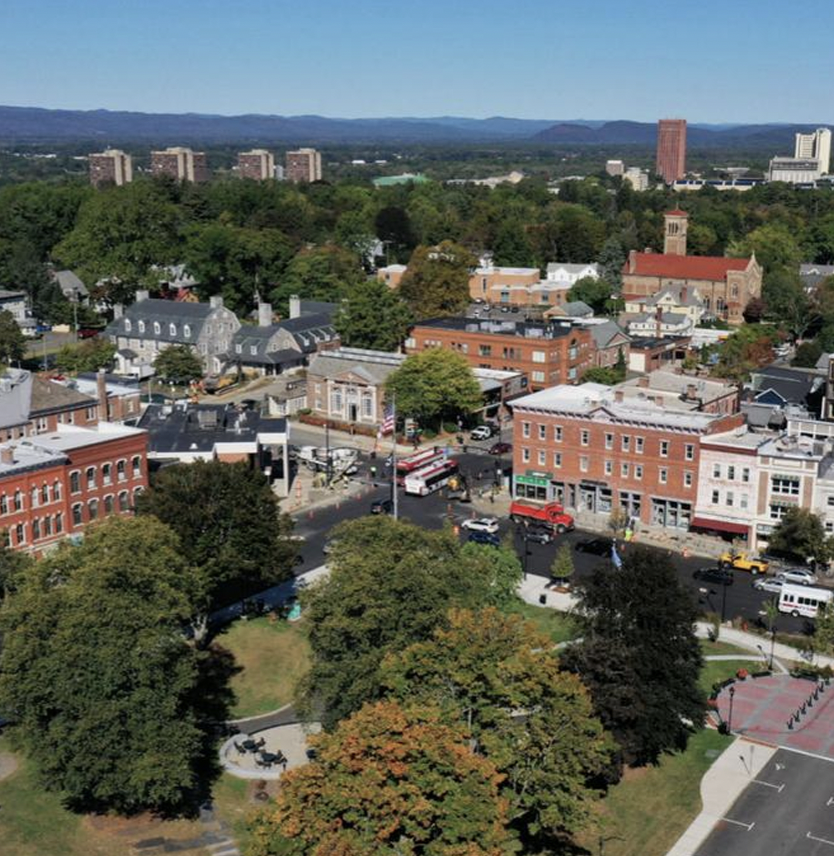
Photo: amheratma.gov
The following letter was sent to the Amherst Planning Board on April 20, 2026.
Amherst now has in hand a thoughtful, community-based roadmap (see also here) for its future downtown, and the Planning Board should rely on it: the Dodson + Flinker work was commissioned precisely to balance economic vitality, livability, and Amherst’s small-town character. Their recommendations show a way to have more housing and stronger commerce without turning the center of town into a narrow niche product that serves only one slice of the population.
Our Master Plan is long outdated, yet certain “prime directives” in it — like “densify!” — have been treated as simple marching orders, even though they are hard to measure and even harder to manage in ways that protect community character and quality of life. Treating “densify” as a blunt instrument has helped drive us toward overdevelopment that does not serve year‑round residents, local businesses, or long-term resilience. Over the last decade, I have written repeatedly about the dangers of single‑purpose, student‑dominated overdevelopment: erosion of year‑round population, loss of everyday services, and a downtown that feels disposable rather than built to last. Amherst already sees the effects when large private dormitories and weakened mixed‑use requirements tip the balance away from local residents, local businesses, and the “third places” that make a town worth caring about.
The committee that met regularly for two years with Dodson + Flinker was itself overrepresented by strongly pro‑development voices, yet Dodson fairly represented the compromise sought by the few members who pushed for more balance and less “bias to yes.” That compromise is what is now on the table. The stronger pro‑development forces should fairly accept that compromise as the will of the people. Most residents are not active in local politics, yet about 1,000 people signed a petition for a one‑year pause to stop the “fail to plan, plan to fail” inertia.
Dodson + Flinker’s draft standards, with their distinct downtown zones, are an explicit attempt to find the sweet spot between limiting overdevelopment and allowing more housing, while protecting what is distinctive and walkable about Amherst. They emphasize building form, streetscape, trees, benches, and public spaces that invite wandering and lingering—exactly the sort of interesting downtown that residents, students, visitors, and businesses all say they want. That approach is far more sophisticated than a simple call for “more units” or “more height” everywhere.
I urge the Planning Board to treat these standards as a floor, not a ceiling; to resist pressure to dilute them into a generic “build baby build” framework; and to remember that your charge is to represent the full balance of Amherst, not only the most vocal development interests. A commercially strong, mixed, enduring downtown—rooted in the Dodson + Flinker recommendations, a more nuanced reading of the Master Plan, and in genuine public input—is how Amherst can thrive, not just grow.
Ira Bryck
Ira Bryck has lived in Amherst since 1993, ran the Family Business Center for 25 years, hosted the “Western Mass. Business Show” on WHMP for seven years, now coaches business leaders, and is a big fan of Amherst’s downtown.
write before or speak at Wed 4/22 Planning Board meeting, in the public comments part in the beginning; this topic will be covered tonight: https://amherstma.gov/Calendar.aspx?EID=35125