
Despite Rent Control Defeat, Tenants Continue Organizing
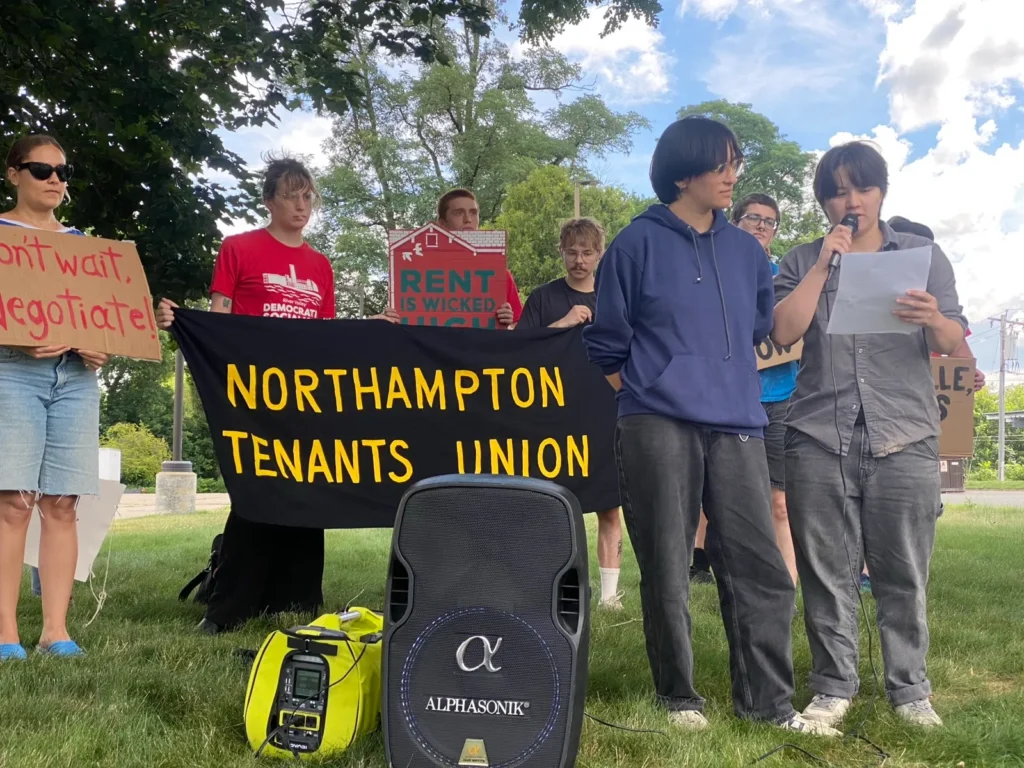
Maia Penuel and Milla Wenick, tenants of 126 King St. in Northampton, speak at a rally they organized with their tenants union on July 10, 2026. Photo: Dusty Christensen
by divina cordeiro and Dusty Christensen
The following article appeared originally in The Shoestring on July 16, 2026. It is reposted here under a Creative Commons license.
Last month, Massachusetts’ highest court tossed out a rent-control ballot measure. But tenant organizers say the setback won’t stop their work fighting against climbing rents.
This past fall, Milla Wenick was sleeping in bed in their boxers when they said their landlord pushed into their Northampton apartment for an unannounced inspection. Wenick was shocked at what they described as a violation of their privacy and, as they soon learned, a violation of the law.
As it turned out, their neighbors had also had problems with the landlord, Michelle Sun. Some were facing rent increases of up to 9% and worried they would be pushed out of their homes and farther away from their downtown service-industry jobs. Others had to suffer through a recent heat wave with broken air-conditioning units. (Sun did not respond to a voicemail left Wednesday.)
So the group got together and formed a tenants union — the latest in a trend sweeping across the region. Last week, the 126 King St. Tenants Association held a sidewalk protest down the street from their apartment building. Flanked by fellow tenants and housing organizers from across the region, Wenick said their stories represent just one building in a city where rents have skyrocketed in recent years.
“So many of our neighbors are fighting the same fight in buildings scattered across the city,” they said. “It’s time for us to come together and take back our power as tenants.”
It’s a sentiment that tenants from Springfield to Greenfield have shared in recent years as they’ve organized unions amid a housing crisis that shows no sign of slowing down. Over the past year, many have also poured their energy into campaigning for a ballot question that, if it had passed, would have established rent stabilization in Massachusetts, limiting annual rent increases in the state to 5% or the Consumer Price Index, whichever was lower.
Despite strong opposition from landlords, developers, and some politicians, the ballot question was polling favorably with state voters ahead of November’s elections. However, late last month the state’s highest court tossed out the ballot question on a technicality, leaving organizers devastated. Now, Massachusetts residents won’t get to decide this election cycle whether to bring back a form of rent control, which voters banned in a 1994 statewide ballot initiative.
The death of the rent-stabilization ballot initiative has been a regular topic of conversation for housing activists in recent weeks, including at last week’s protest in Northampton. Organizers expressed anger that after nearly a decade of activism, the ballot measure “died with a whimper.”
“There’s no place for our voice to be heard,” said August Nelson, a member of the grassroots housing-justice organization Springfield No One Leaves who had shown up in support of the King Street tenants. “So here we are.”
Now, renters and their allies are asking themselves: What comes next?
Those who spoke to The Shoestring said they have begun shifting to supporting legislation like a local option bill, which would put decisions about rent stabilization into the hands of the state’s cities and towns. And they are working to educate renters and the general public about tenants’ rights, too.
But the pivot doesn’t come without deep indignation from activists who say that residents continue to face precarious renting situations while lawmakers have still failed to address the statewide housing crisis.
“We’re frustrated and we’re angry,” Kat Miller, an organizer with the Greenfield Tenants’ Union, said in a virtual interview. “It would just be nice if, for once, the people who were in charge would listen to the people that hired them to be in charge.”
On top of losing the ballot measure, it seems that renters have also lost out on the possibility of a legislative compromise that would have brought some form of rent stabilization to Massachusetts. Several organizations and a coalition of tenants unions had been working on that compromise legislation, despite the fact that others who were energized by the ballot-question campaign felt “blindsided” but the willingness to compromise with landlords and developers.
But lawmakers never ended up submitting that legislation, according to Katie Talbot, the organizing director of Springfield No One Leaves.
Despite rent control not being on the ballot, Talbot said that there were still immense wins that came from the campaign, like advocates collecting over 157,000 signatures from residents who supported rent control. She said that the statewide relationships built during that process will be valuable for organizers as they continue building tenant power.
The local option bill that organizers are shifting their efforts toward is supported by state Sen. Adam Gomez, D-Springfield. Gomez told The Shoestring that there’s an urgent need for the Legislature to take action.
“Individuals are playing with the realities of: ‘Do I buy this medication or do I pay the rent? Do I go to this appointment or do I pay for the rent? Do I buy this food or do I pay for the rent?’” Gomez said. “You get into this whirlwind of robbing Peter to pay Paul — living on credit.”
And, Gomez added, implementing rent control would be the cheaper option to meet housing needs. He said that the fewer people who can pay rent, the more unhoused people the state will have, resulting in a population that has more needs to meet.
Local officials are getting behind the local option bill, too. Springfield’s City Council, for example, voted unanimously to pass a resolution backing the legislation.
The Senate bill, filed by over 20 members, has been reported favorably and is currently sitting in the hands of the Senate’s Committee on Ways and Means.
Despite losing rent control on the ballot, people across the western part of the state are pushing forward with their organizing efforts. Tenants unions are sprouting up as renters and allies continue to organize for safe, affordable, and equitable housing.
One of these is the Greenfield Tenants Union.
Though only about three months old, the organization has attracted dozens of people to its meetings. Part of the reason the union took shape is because of Miller. She’s a graphic designer and a life-long resident of Greenfield who got into tenant organizing after her landlord raised her rent by 20%, and then 40%. The Easthampton Tenants Union supported her through the process of attempting to negotiate rent, which inspired Miller to start organizing in her hometown.
After the Supreme Judicial Court decision tossing out the ballot initiative, Miller said the union’s priorities include continuing to research key questions like who the biggest landlords in the area are. The union has also been working to resolve housing issues that members themselves are experiencing, she said.
“I think we’re going to see more tenant unions,” Miller said. “I think we’re going to see more local organizing. I think we’re going to see more regional organizing.”
Natalia Ruiz is an organizer with the Easthampton Tenants Union who got involved in tenant activism after her own conflict with a former landlord in Northampton.
Within the last year, Ruiz started campaigning for rent control. She would talk to people at farmer’s markets and outside of grocery stores with a big stack of papers to collect signatures. Throughout the campaign, Ruiz said she talked to lots of people, from renters to small landlords, who she said play an important role in efforts to get support for rent control.
Despite the ballot-question setback, those campaign efforts connected tenants unions across the state in a new and formative way, Ruiz said. Easthampton organizers are planning on continuing to connect and coalition-build with other unions based in eastern Massachusetts.
For her, unions need to think about how they organize outside of the support of policymakers.
One of the ways that Ruiz said the Easthampton Tenants Union has done that is through public education. She said that she’s personally benefited from those efforts, and that if she had known how many resources were available to her as renter, she would have been more equipped to navigate issues with her landlord in the past.
Ruiz said that the union has done outreach in the form of door-knocking and tabling. The union has also prevented rent increases and evictions, and won rent rollbacks, too.
All of those things, she noted, happened outside of the political system.
“These are things that we have been able to win for ourselves, within the system that currently exists,” she said. “While I do think that there is absolutely a legislative regulatory path … there’s a ton of work that we can do right now to push back against our circumstances.”
Ruiz isn’t the only organizer who is thinking about coalition-building. And she’s not the only one with sharp criticisms of the state’s Legislature, which is controlled by a Democratic supermajority.
“When it comes to policy, we are playing the same old playbook that is being played in red states across the board,” said Talbot, of Springfield No One Leaves, who has lived most of her life in Springfield. “It’s a falsehood that we have allowed ourselves to believe — to feel like we are somehow in a better position than we are.”
Despite inaction from the state’s Democratic lawmakers to alleviate the housing crisis, Talbot said that organizers don’t intend to give up the fight.
“What’s the alternative? Lay down and die?” Talbot said. “Organizing people and resources is the only way we are going to get out of this downward collapse of our society, our economy, and our environment.”
divina cordeiro is an independent reporter covering labor and social movements, pursuing a degree in journalism and social thought & political economy at UMass Amherst. They have worked for three years in legislation, policy, and research on education, child welfare, and race equity. Reach them at divina.cordeiro@proton.me or on Instagram and Twitter @divi_cordeiro
Dusty Christensen is The Shoestring’s investigations editor. Based in western Massachusetts, his award-winning investigative reporting has appeared in newspapers and on radio stations across the region. He has reported for outlets including The Nation magazine, NPR, Haaretz, New England Public Media, The Boston Globe, The Appeal, In These Times, and PBS. He teaches journalism to future muckrakers at both the University of Massachusetts Amherst and Smith College. Send story tips to: dchristensen@theshoestring.org.