
The Gift Article You’ll Never Read and the Greeting I’ll Never Pass Along
Information transfer of social nicety? Photo: Eben Shapiro
The following column appeared originally in Eben’s Substack on Sept. 20, 2026 and is posted here with permission.
I have a penchant for making bold assertions that can’t be backed up with any evidence. Here are my two latest.
More than 90% of the articles that people send to their friends and family to read are never read by the recipient. I know this because if you send me an article to read, I will not read it. A link to the piece on the fact that Matt Damon’s biceps in The Odyssey actually belong to a 4 foot, 6-inch female stunt double? Unread. Ezra Klein on China, AI, progressives? Unread, unread, unread.
One might think that that conclusion and experience would stop me from sending people links and articles. One might be wrong. In fact, I’m a prolific gifter of gift articles. I have sent my adult children in the Bay Area at least a dozen articles on the ridiculous heights of the AI-fueled housing boom. Number they have read? I’m guessing it is zero. They live there. They know. So what accounts for this behavior? I have some thoughts that I will share, but first I want to make a second, separate but related claim.
That when people ask you to “say hi” to someone they never do. Say you are on a road trip with Chris and you text Nancy to thank her for the blueberry crumb cake she gave you to start your drive. She replies, “Thank you. Say hi to Chris.” Chances are I won’t pass on that greeting. Actually, in that rare instance I did because I happened to be sitting right next to Chris during a nine-hour drive. But 99% of the time, I fail to pass on the greeting and I’m equally certain that I am owed many “hi’s” from negligent greeters. (Nancy tells me the she always passes on say Hi’s.)
What explains these twin impulses and tepid responses? Let’s start with saying hi. Linguists have a term for this: “phatic communication,” speech whose function is purely social lubrication, not the actual transfer of information. There is a quote I always attributed to Oscar Wilde, although it appears he did not actually say it: “How are you?” is a greeting, not a question. I’m not interested in the state of your digestion.”
My guess is that Nancy did not truly want to be remembered to Chris. (She says that she did.) But me view is that she was making a kind-hearted gesture toward me, acknowledging my present reality: “I know you are with Chris and my thoughts are with you and I’m wishing you well.” Or perhaps Nancy genuinely wanted me to say hi to Chris, but to what end? And if Chris replied, “say hi back to Nancy,” am I trapped in an endless loop of social nicety?
Likewise, there is the burden and obligation that falls upon the recipient of a sent link, the sheer, unreasonable optimism of the sender versus the defensive exhaustion of the receiver. When someone texts you a 6,000-word piece from The Atlantic at 2:00 PM on a Tuesday, they haven’t sent you a gift; they’ve assigned you homework.
So what is the impulse behind my prolific article sending? It is all about connection, a gesture to my far-flung adult children and friends that I’m thinking about you and I know you well enough to be cognizant of your particular interests. It’s the same impulse that makes me want to enthusiastically share a photo of a piece of art that I like.
The question does arise: Is the act of sending more for the sender or the recipient? I would argue that is for the sender, allowing them a hit of connection in a lonely world. I feel that when I receive a carefully curated article from my friends Jeff, Deane, or Jim. They know what I’m interested in and they have taken the trouble to reach out and share it with me. I haven’t talked to Deane for a while, so I greatly appreciated his note that the NYT story on bigotry, attached, is “a frightening but good read.” Or a good unread.
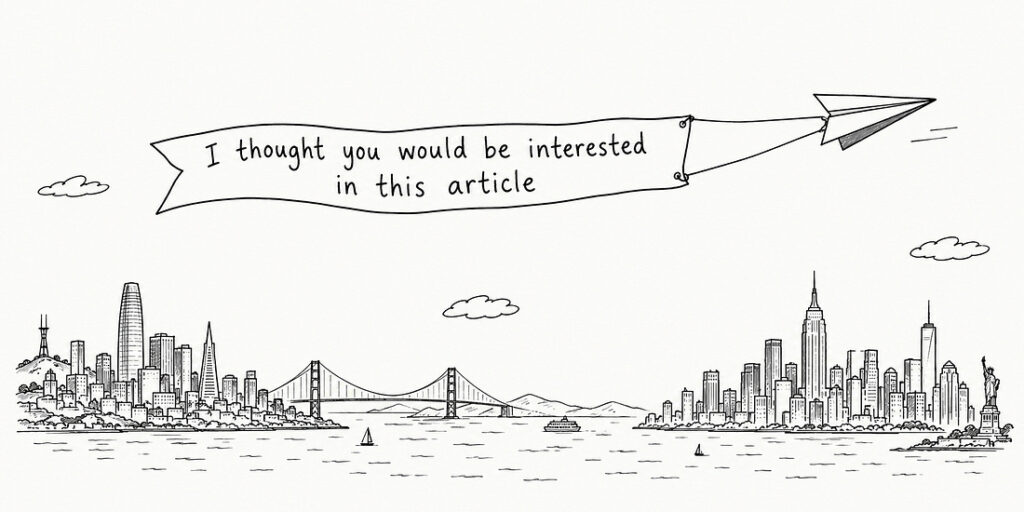
It’s all about the gesture, not the information. So I will keep sending my kids real estate dispatches about East Bay hyper-price inflation that they will never open. We don’t read the links, and we don’t pass along the hellos. But in a world where many of us are starved for connection, there are worse actions than flying little paper airplanes of affection across the void and not caring where they land.
Eben Shapiro is a veteran reporter and editor (NYT, WSJ, TIME) specializing in culture and business.