
Treating Breast Cancer with Bacteria: UMass Amherst Leads $13.1 Million Research Effort
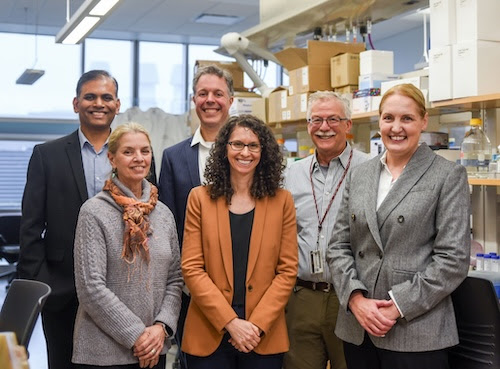
Ashish Kulkarni, Lisa M. Minter, Neil Forbes, Lauren Andrews, Joseph Jerry (UMass Amherst); Sarah Cheal (Weill Cornell Medicine)- Image credit UMASS
Scientists are designing custom strains of Salmonella to counteract cancer’s invisibility to the immune system, detour drug resistance and re-route radiation toxicity
AMHERST, Mass. — Scientists at the University of Massachusetts Amherst have been awarded $13.1 million to lead new, complementary research efforts engineering therapeutic Salmonella to target critical gaps in treatment for drug-resistant triple-negative breast cancers. The five-year grant, the first of its kind for bacteria cancer therapies awarded by the U.S. National Institutes of Health, will support research to design nontoxic bacteria strains that can deliver three treatment options.

Neil Forbes, a professor in the Riccio College of Engineering at UMass Amherst, and a member of the Center for Bioactive Delivery in the Institute for Applied Life Sciences will oversee five interconnected research efforts that will tackle different ways breast cancer cells escape attack from the immune system and further untangle the “whys” behind the science.
“What excites me is that engineered bacteria give us a way to image tumors and train a patient’s own immune system to find and eliminate them wherever they occur in the body,” said Forbes. “We look forward to generating several interrelated microbial therapies that will greatly improve the treatment of triple-negative breast cancer.”
“The work enabled by this award and by Ernest Pharmaceuticals – a start-up company co-founded by Forbes to develop therapeutics to develop bacterial cancer therapies – has the potential to establish highly differentiated and novel cancer treatments,” added Peter Reinhart, director of the Institute for Applied Life Sciences.
Specific award-related efforts include:
1. Using genetically engineered bacteria to “decorate” cancer with a COVID-derived protein, essentially tricking the immune system into recognizing and attacking a tumor;
2. Building on previous research to kill cancer cells with viruses—delivered by Salmonella—instead of with drugs, to address the challenge of tumors evolving to resist treatment;
3. Combining imaging and treatment by using the bacteria that can be guided directly to tumors as homing beacons for radiopharmaceutical therapy (RPT);
4. Creating a massive library of Salmonella genetics to enable the precise tailoring of the bacteria to serve as vehicles for different therapies; and
5. Refining light-emitting molecules to study real-time behavior of immune cells in response to the various Salmonella-based treatments.
Full descriptions of the research can be found at umass.edu.
“Doing these projects in parallel, instead of doing three separate projects, will be synergistic,” says Forbes. “As we understand mechanisms for one of the pieces, it’ll help us understand the others.”
Joining Forbes are Lisa M. Minter, UMass professor of veterinary and animal sciences; Lauren Andrews, UMass associate professor of chemical and biomolecular engineering; Ashish Kulkarni, UMass professor of chemical and biomolecular engineering; Joseph Jerry, UMass professor emeritus of veterinary and animal sciences; and Sarah Cheal, assistant professor of biological chemistry in radiology at Weill Cornell Medicine.

Ashish Kulkarni, Lisa M. Minter, Neil Forbes, Lauren Andrews, Joseph Jerry (UMass Amherst); Sarah Cheal (Weill Cornell Medicine)
While using bacteria to attack certain forms of cancer has been around for more than a century, Salmonella has become an attractive vehicle due to its ability to proliferate inside tumor microenvironments while delivering toxins to kill cancer cells.
“I wrote my first paper about this topic in 2001,” says Forbes, whose research has been published in journals including Nature Communications, Cell Reports Medicine and Frontiers in Immunology. “Recently, I found papers going back to the 1700s when people had been talking about it, before we even really knew what bacteria were. It’s old, but at the same time, it’s all new technology. There are things that we have not been able to do until fairly recently.”
Contacts:
Neil Forbes forbes@umass.edu
Julia Westbrook jwestbrook@umass.edu