
Letter: It’s Time to Revisit Fieldstone Apartments’ Tax-exempt Status
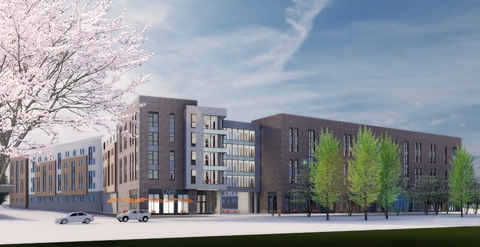
Rendering of the Fieldstone Apartments on Massachusetts Avenue. Photo: umass.edu
The following letter was sent to the Amherst Town Council on May 5, 2026.
Amherst and UMass depend on each other. The town benefits from the university’s presence, and UMass depends on town roads, public safety, utilities, and the broader civic life that makes Amherst a strong host community. That is exactly why the issue of public-private dormitories such as Fieldstone should be addressed directly, fairly, and without hostility.
Fieldstone may sit on UMass land, but in substance it operates as a private student housing business. Private developers paid for the right to build and operate there, private managers collect market-rate rents from students, and the project generates private revenue on a large scale. That is not the same thing as a classroom, laboratory, library, or university office. It is housing, and more specifically, housing run as a profit venture.
That distinction matters under Massachusetts tax principles. Property owned by government and used for public purposes may be exempt, but state guidance also says that when exempt property is leased, occupied, or used for business or non-public purposes, the private lessee, occupant, or user can be taxed. Likewise, charitable or educational exemptions apply only when property is actually occupied and used for the exempt purpose; property used for commercial or non-charitable purposes is taxable. The basic rule is simple: exemption follows real use, not labels.
By that measure, student housing operated for profit should not automatically be treated as an educational use. A student renting a house on a street in Amherst does not convert that house into tax-exempt educational property. It remains taxable housing. The same common-sense principle should apply when the landlord is a private entity operating a large dormitory on university land. The resident is still renting housing, and the operator is still running a business.
The current arrangement appears to rest less on the actual use of the property than on a legal structure designed to preserve tax exemption on paper. That may have been accepted in earlier negotiations, but it should not be the last word. A contractual framework or past understanding between town and university leadership should not become a permanent workaround that allows private profit to avoid the same local tax obligations borne by every other housing provider in Amherst.
This is also a matter of fairness. Local landlords who rent to students pay property taxes. Homeowners pay property taxes. Taxable private dorms off UMass land pay property taxes. When one large, privately operated student housing venture is shielded because of how the paperwork is arranged, the result is not neutrality. It shifts more of the municipal burden onto everyone else.
The point is not to attack UMass or oppose student housing. Amherst needs a healthier town-gown relationship, and additional student beds can help reduce pressure on neighborhoods. But private benefit should come with public responsibility. If a project functions as a business, then it should contribute to the town that supports it, either through ordinary property taxation or through a binding payment structure that closely matches what comparable taxable property would pay.
Now is the right time to revisit this issue. Amherst officials, councilors, and residents are already discussing the town-gown imbalance and possible solutions. That conversation should include a clear principle for all current and future public-private dormitories: if the project is privately operated, rent-producing, and functionally commercial housing, Amherst should not be asked to treat it as tax-exempt educational property.
A stronger, more transparent agreement would not weaken the Amherst-UMass relationship. It would improve it by replacing ambiguity with fairness and by asking all parties to recognize the same neighborly standard: when a private business benefits from Amherst, it should help pay for Amherst.
Ira Bryck
Ira Bryck has lived in Amherst since 1993, ran the Family Business Center for 25 years, hosted the “Western Mass. Business Show” on WHMP for seven years, now coaches business leaders, and is a big fan of Amherst’s downtown.
Yes, the private on campus Fieldstone apartment complex arrangement needs to be revisted by the Town. The tax principles described in the article above is the reason the Town of Amherst receives a 5% occupancy tax for every guest who pays for a room at the UMass Hotel. The tax is collected by UMass and then transferred to the Town. It seems logical for Fieldstone to charge their tenants an additional 5% of the monthly rent, call it the Amherst occupancy tax, and transfer the funds to the Town.. Apartments on campus are not an educational mission.
Additionally and furthermore, there are large private high tech, pharma and manufacturing corporations who “rent” lab equipment and lab space in the UMass science buildings to conduct their proprietary research and development activities. These activities could possibly fall under the “non educational umbrella” . The Town deserves “rent” from them too in the form of charging these companies a Town user fee tax.
This article is accurate. Everything above ground level was built, is owned and maintained by the private company that entered into the agreement with the University. There are no R.A.’s, no state employees engaged in maintenance and no state employees involved in the leasing or collection of rent/ fees. The same should ne true for the property located on 93 Fearing Street and the corner of Eastman Lane and E. Pleasant Street. These are also residences. In the end the tax should be paid by the lessee, the company that leases the land for $1 a year.
I concur with the article and the comments so far. In addition, the primary reason Amherst is constantly under financial pressure is the loss of revenue from the tax exempt status of non-profit educational institutions, and the MA Payments in Lieu of Taxes (PILOT) plan controlled by the State Legislature. The fair market value of the developments to raw land is not included in the formula, Yet the huge increase in economic activity abetted by larger user populations, with the lockstep increases in trucking and other vehicular traffic, increases the damage to our roads. Most residential roads are in poor condition as the main roads getting the heaviest traffic get the lions share of repair. It’s inexcusable for MA to continue to burden Amherst with this parasitic situation.
American Campus Communities, the developer that UMass has chosen to modernize student housing, was recently involved in a legal decision that may be pertinent to Amherst.
In 2012, ACC built and began renting out 501 student housing units for University of New Mexico Albuquerque. They claimed to be exempt from property taxes, arguing that the buildings were for educational purposes and on UNM land. The county assessor sued and last November the New Mexico Court of Appeals ruled that the properties were primarily residential, not educational, and were fully taxable. ACC ended up owing $6 million in back taxes.
I have read the explanation in the Indy that the Fieldstone project falls under a specially-structured “Service Concession Arrangement” that purports to enable the owners to avoid paying property tax.
This raises two thoughts. First, would it be worthwhile for Amherst to file a legal complaint as was successful in New Mexico?
Second, it appears that the UMass Building Authority knowingly worked out an agreement with the Fieldstone developers that has deprived the Town of Amherst of millions in tax revenue. This seems pretty poor partnership with the community that provides so many services to the University and whose financial and town-gown relationship challenges are well known.