
UMass May Day Fest Calls on University to Democratize, Decolonize, and Demilitarize
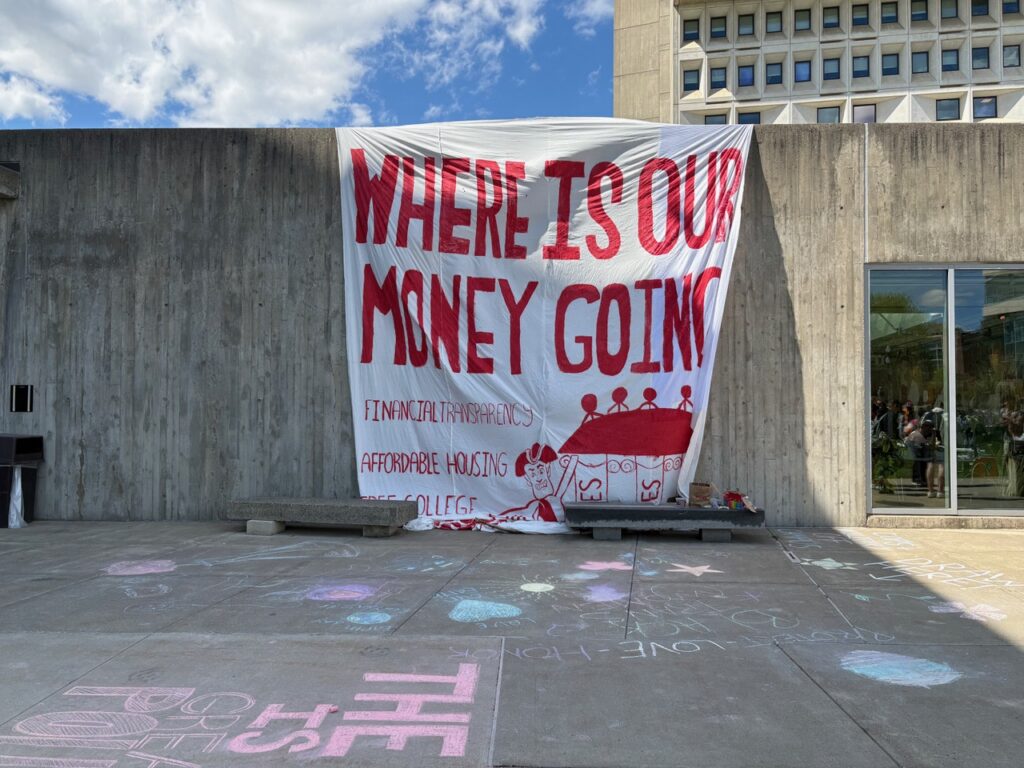
Banner from Sunrise UMass at the UMass May Day Fest, May 1, 2026. Photo: Bella Astrofsky
Organizers Heartened by Strong Turnout Across the Nation
On Friday, May 1, the University of Massachusetts Amherst Solidarity Coalition hosted May Day Fest: A Festival of Student & Worker Power on Metawampe Lawn to mark International Workers’ Day.
The all-day festival featured hourly teach-ins led by organizations within the Solidarity Coalition, including student activist groups and unions, performances from local artists, and activities such as crafts, meditation, face painting, and banner painting. Organizers also led a “power hour” beginning at 1 p.m., during which representatives from campus organizations gave speeches as listeners gathered on the lawn and at surrounding information tables.
Members of the Solidarity Coalition include UMass Students for Justice in Palestine (SJP), UMass Sunrise Movement, UMass Young Democratic Socialists of America, UMass Dissenters, University Staff Association (USA), UMass Grad Workers for Palestine, Professional Staff Union Solidarity Caucus, UMass Faculty and Staff for Justice in Palestine, and Western Massachusetts People’s Tribunal.
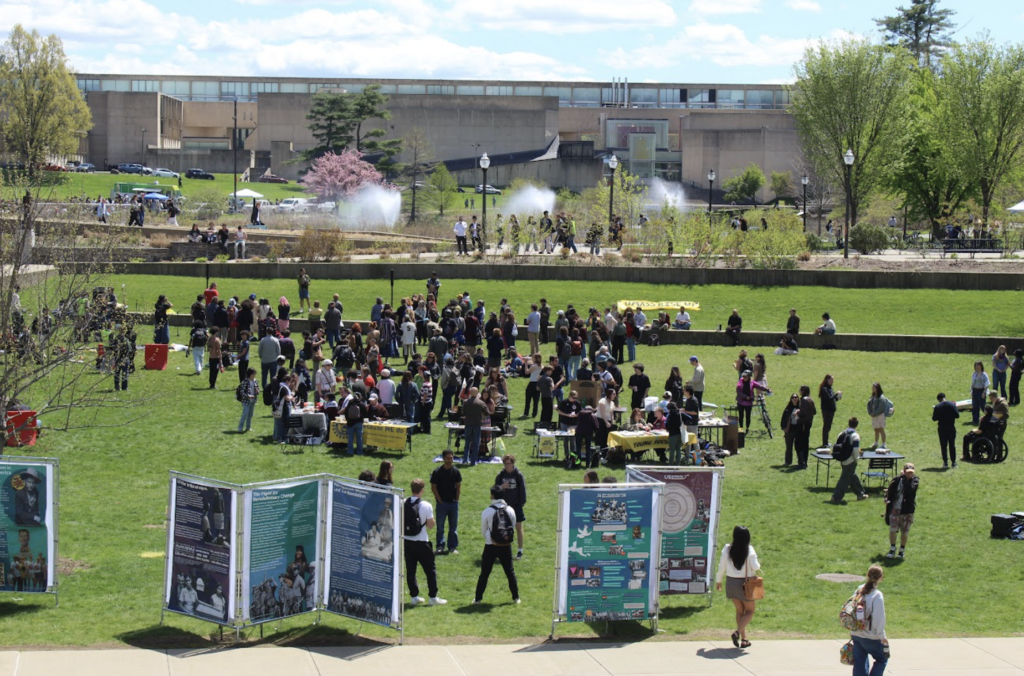
“The only way that we will survive and make this institution into one that actually serves the public good is through mass solidarity as workers with all the workers and students on this campus,” said Marianna Ritchey, a representative from the Massachusetts Society of Professors solidarity caucus. “I believe that together we will be able to fight for that and win that, and make this campus into something that is good for the world.”
International Workers’ Day, or May Day, commemorates the longstanding global struggle for workers’ rights and honors the progress of labor activists past and present who fought for safer working conditions, unionization, and bargaining rights, as well as the standardized eight-hour workday.
Union representatives spoke to their experiences facing cuts from UMass administration and organizing for better working conditions. In September 2025, graduate student workers filed grievances against the university over health and safety concerns stemming from hazardous building conditions in the Lederle Graduate Research Tower (LGRT) and Machmer Hall. According to the Massachusetts Daily Collegian, workers in those buildings cited frequent flooding, water damage, missing ceiling tiles, and concerns about asbestos.
“We work in buildings that have hazardous conditions like asbestos…ceiling tiles that fall onto our desks, flooding, mold, pests…We now know that maintenance workers and building maintainers are severely understaffed and under-supported by the university,” said Sarah Bodansky, a graduate worker and Ph.D. student in the astronomy department. “I feel like what we’re doing here is the theme of [how] this university runs because of the workers on this campus and students on this campus, and if this was a democratically run institution, we would be appropriately funding the workers and the employees on this campus.”
Bodansky tabled during the festival with leaflets featuring an image of a crumbling building and a QR code linked to a demand letter urging the university to “increase facilities staffing,” communicate with workers about potential health and safety risks, and conduct asbestos abatement, mold remediation, and heat repair. The letter also calls for further “University cooperation with departments on department-specific problems.”
“Throughout the whole year we’ve noticed that this is not just two buildings in isolation,” said Cristina Otero, a graduate Spanish language instructor. “And we’re just expected to work there and have classes there, and the university kind of shrugs it off like ‘oh, that’s just normal, that’s just what it is.’ And they have the resources to fix that, they just don’t want to.”
Lev Kireyev, a Hampshire College student, spoke about the college’s closure and its impact on faculty and staff, as all 150 employees face termination without severance as of June 16 and will lose access to their health insurance on June 30.
Kireyev spoke about the Hampshire College Workers Emergency Relief Fund, designed to provide direct, need-based assistance to terminated staff and faculty for living expenses. He added that the American Association of University Professors is sponsoring a petition calling for the other four colleges to offer positions to Hampshire College faculty, meet the financial aid needs of students who wish to transfer, offer visa support for international students, and maintain health coverage and access to offices through Jan. 1, 2027.
“The staff and faculty members I’ve met throughout my time at Hampshire were the people who truly made the greatest difference there. These are all incredibly dedicated people, who truly embodied Hampshire’s motto: to know is not enough. It is incredibly disappointing to watch the five colleges fail them,” Kireyev said.
The festival’s slogan — “democratize, decolonize, demilitarize” — connected the labor movement to the related goals of giving more decision-making power to students and faculty, reparations for the dispossession of land from 82 Indigenous communities, and the push for UMass to divest from defense contractors and campus police.
“It can be really hard for faculty to see…how things like divestment or demilitarization not only impact us, but require something of us as workers. And in fact, it’s really difficult. It can be really difficult for faculty to think of themselves as workers at all,” Ritchey said.
Speakers called for a free Palestine, and leaflets distributed to participants asked that the university “end Birthright trips and study abroad to Israel,” as well as “divest from genocide, war profiteers, and fossil fuels.”
“That’s why political education, that’s why the role of the unions…is important because in order to change, in order to protect democracy here, in order to…fight against imperialism abroad, we need to have an organized movement, labor movement and every other movement connected to that in order to agitate, in order to educate people, in order to set the goals and actually work towards a better future,” said Antonis Gounalakis, incoming Graduate Employee Organization membership organizer, during his speech.
Other organizations that tabled at various points throughout the day include UMass Communists, Students for Reproductive Justice, Girl Up, Rebirth Project, Mutual Aid Project, Carbon Zero Alliance, Jeromie Whalen for Congress, and the Massachusetts Rent Control Campaign.
Declan Higgins, a member of Sunrise UMass, spoke about the organization’s involvement in the day’s events and the public’s participation.
“Basically anyone who has been committed to making a difference on campus and promoting justice for students is welcome here, and we’ve had so much great participation and attendance from all sorts of people…There’s a broad range of students that have come along and we’ve been very happy about that.”
May Day Across the Nation
The UMass event was one of more than 5,000 May Day Strong actions and protests held across the country as part of a national economic blackout day that called on Americans to boycott school, shopping, and work. High-visibility events were held in many major cities, including Boston, New York City, Washington, D.C., Chicago, Minneapolis, Seattle, Portland, Los Angeles, San Francisco, Albuquerque, Dallas, and Raleigh.
The event was sponsored by May Day Strong, a coalition of more than 500 labor unions, democratic organizations, and community groups that called for an economic blackout to protest Trump administration policies, threats of interference with the midterm elections, and economic inequality that they say prioritizes billionaires over workers, students, and families.
Preliminary data from May Day events indicate that 89% of participants refused to shop that day, 14% did not go to school, and 32% participated in “No Work.”
Organizer Daniel Hunter, writing in Waging Nonviolence, called the day a significant turn in the resistance to fascism in the U.S. and a dress rehearsal for the tactics needed to prevail against an authoritarian regime. He wrote:
May Day Strong proved the organizing phenomenon that getting people in motion is difficult, but once people stay in motion, getting them into greater motion becomes easier. And that is a different kind of victory, measured by different instruments.
The research on what actually determines success in civil resistance makes a stark point: 83% of successful anti-authoritarian campaigns win when they have strong participation of labor — without labor, the percentage that wins plummets to 29%.
May Day Strong put together one of the widest coalitions yet: a mix of national and locals of National Nurses United, AAUP, NDWA, NEA, AFT, SEIU, Chicago Teachers Union, Starbucks Workers United, the United Electrical Workers, and APWU, alongside Indivisible, 50501, DSA chapters, immigrant rights organizations, and hundreds of local groups. All under a broad set of sensible demands:
- Tax the Rich: Our families, not their fortunes, come first.
- No ICE. No war. No private army serving authoritarian power.
- Expand democracy, not corporate power. Hands off our vote.
Movement research is also clear on another point: movements that wage economic disruption succeed at dramatically higher rates than those that stay in the realm of courts, elections, rallies, and petitions alone.
Read more:
May Day Was Even More Important Than You Think (Waging Nonviolence)
Thousands in US Join ‘No School, No Work, No Shopping’ May Day Protest and Economic Boycott (The Guardian)
Nationwide May Day Protests Pick Up Mantle of No Kings (NPR)
May Day Rallies Sweep US, Demanding Reforms for Working Class Rights (Al Jazeera)
May Day Photo Gallery: May Day Protests Erupt Around the World from DC to Paris (USA Today)