
Opinion: Will Amherst Schools Ever Be Safe for Queer and Trans Kids?
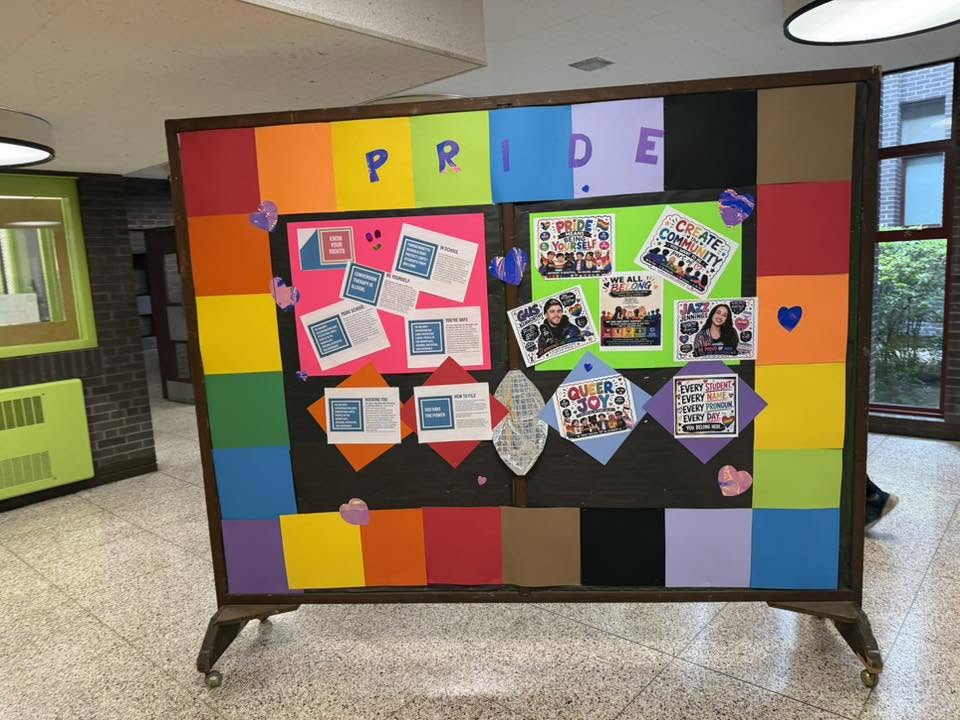
2026 Pride week display at Amherst Regional Middle School. Photo: LGBTQIA+ Caucus of Amherst
This is the third article in a five-part series that the LGBTQIA+ Caucus of Amherst has prepared for Pride Month, 2026. The Indy will publish one piece each week during the month of June. Look here and here for the first two articles in the series.
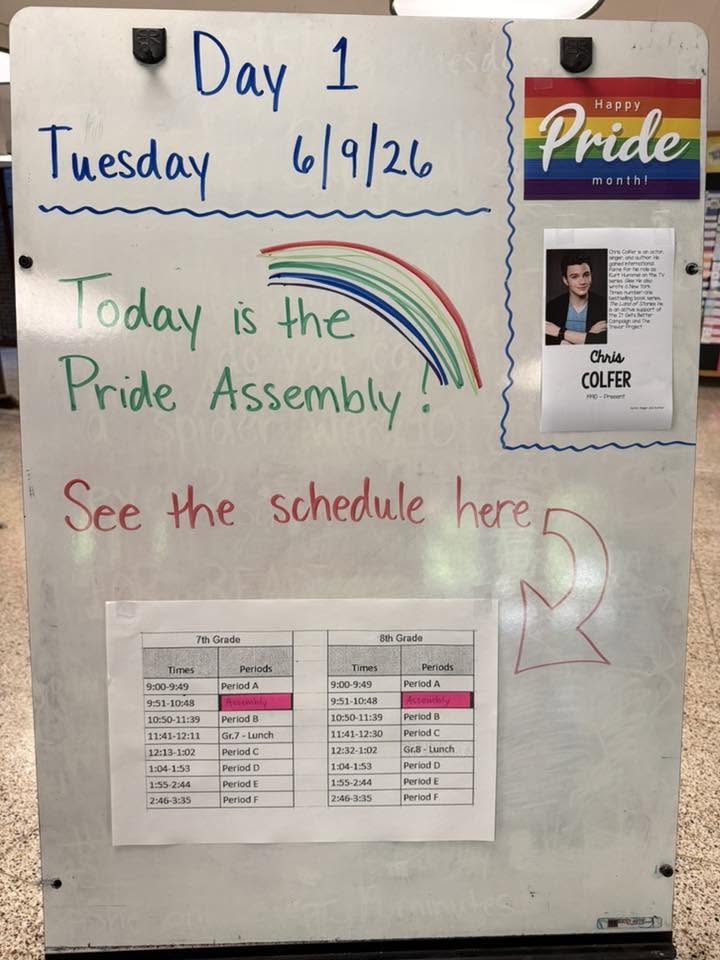
This was supposed to be an article celebrating a Pride Month assembly the LGBTQIA+ Caucus of Amherst organized for Amherst Regional Middle School (ARMS) on June 9, but just one day after the event it is proving challenging to write, given the ways circumstances have shifted in the 24 hours following the assembly. This piece describes both the assembly and what has transpired since.
The Pride Month Assembly at Amherst Regional Middle School
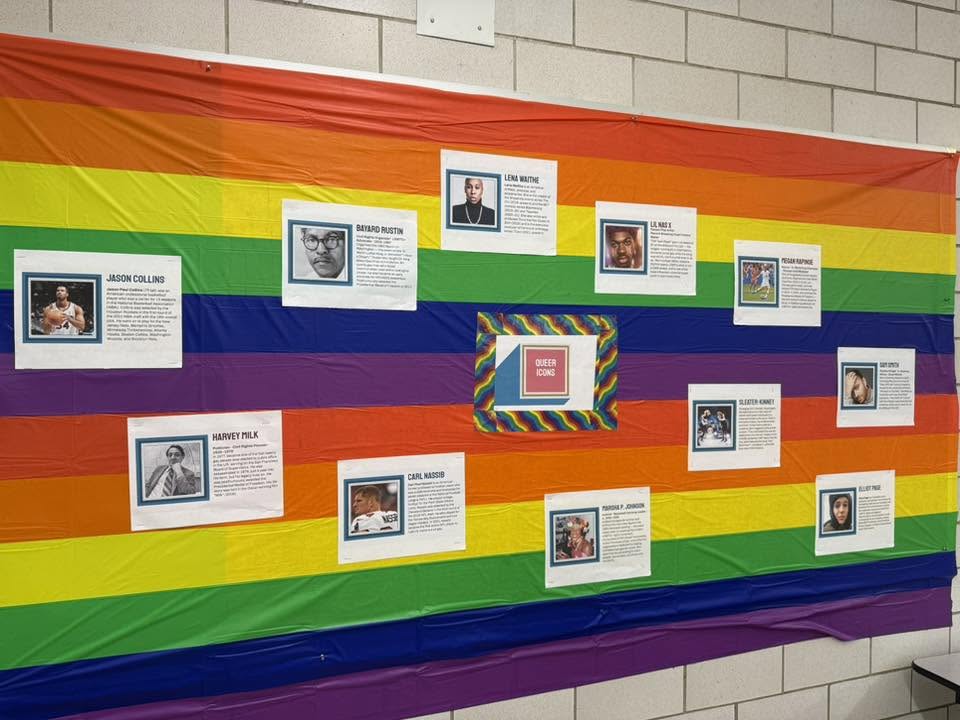
At the beginning of Pride month, the LGBTQIA+ Caucus decorated several bulletin boards at ARMS to welcome students and create messages of Pride. The caucus also worked with the Amherst Regional Middle School administration and PGO to organize a Pride Month assembly centered on expressions of Queer joy in the form of music, dance, poetry, and a trivia game led by the world’s most fabulous game show host, Bella Santarella.
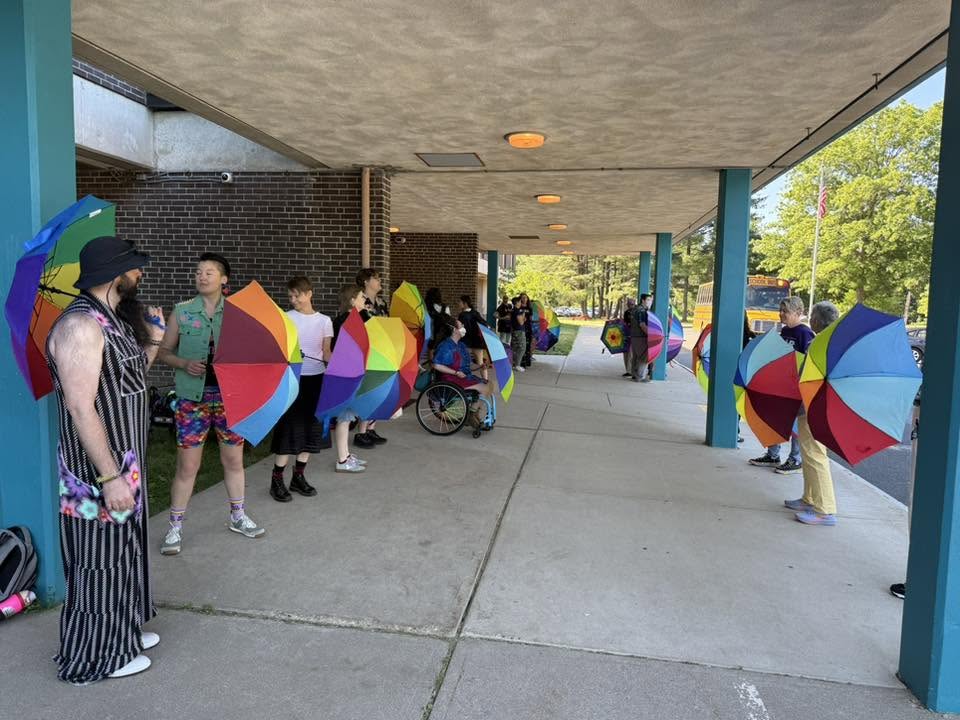
On Tuesday morning, ROAR (Rainbow Organizing and Response) volunteers holding rainbow umbrellas stood outside the school blowing bubbles and playing music to welcome students as they arrived. Later, they joined the assembly and set a celebratory tone for the event. As the middle schoolers found their seats, they were serenaded by the Queer Joy Chorus, who repeated the lyrics, “cause they did not give it, they cannot take it away, joy, unspeakable joy, in my heart so I won’t let them steal my…” The music crescendoed until everyone was seated and ready to begin.
Students affiliated with the middle school’s Sexuality and Gender Alliance (SAGA) club and the middle school chorus participated in the assembly, along with guest performers: Bella Santarella, the Queer Joy Chorus (a program of the Queer Joy Collaborative), and two slam poets from UMass Amherst’s competitive spoken-word team, Slamherst — Joel Blandon (he/him) and Kai Treadway (they/she/he). Throughout the fifty-minute assembly the students and staff in attendance at the Amherst Regional Middle School honored the contributions of the performers and joined them in celebrating queer and trans identities. The auditorium was full of attentive and enthusiastic students — enjoying the performances, cheering on their friends, and experiencing and expressing joy in many forms.
Caucus spokesperson Ali Wicks-Lim described the intention behind the organizing of the assembly this way: “Kids are hearing a lot these days about all the challenges the LGBTQIA+ community is facing. They may not be hearing enough about the beauty, creativity, resilience and joy within queer and trans communities. For this assembly we just wanted it to feel great to witness and experience queer joy, which is in itself a powerful form of resistance.”
The Caucus would like to thank all of the performers and volunteers who took the time to bring their incredible energy and commitment to this special event. We would also like to express appreciation to the administration for their support of the event and most of all to the brave, powerful and fabulous students who helped plan and create it. Each of these leaders showed up in important ways to help make this assembly possible and to demonstrate that leadership can be allyship.
What Happened Next
Unfortunately, the day prior to the assembly, signs appeared at the school entrance advertising an end-of-year school celebration that many students — particularly LGBTQIA+ students — could not safely access. The sign did not indicate a place or time for the celelbration and it required students to get information and admission passes by connecting with a staff member for whom many have no contact orders because of this person’s documented actions that harmed LGBTQIA+ students (see also here). The caucus first became aware of the flyers on June 8, and a message was sent to the administration with concerns about its exclusionary nature. No response was received.
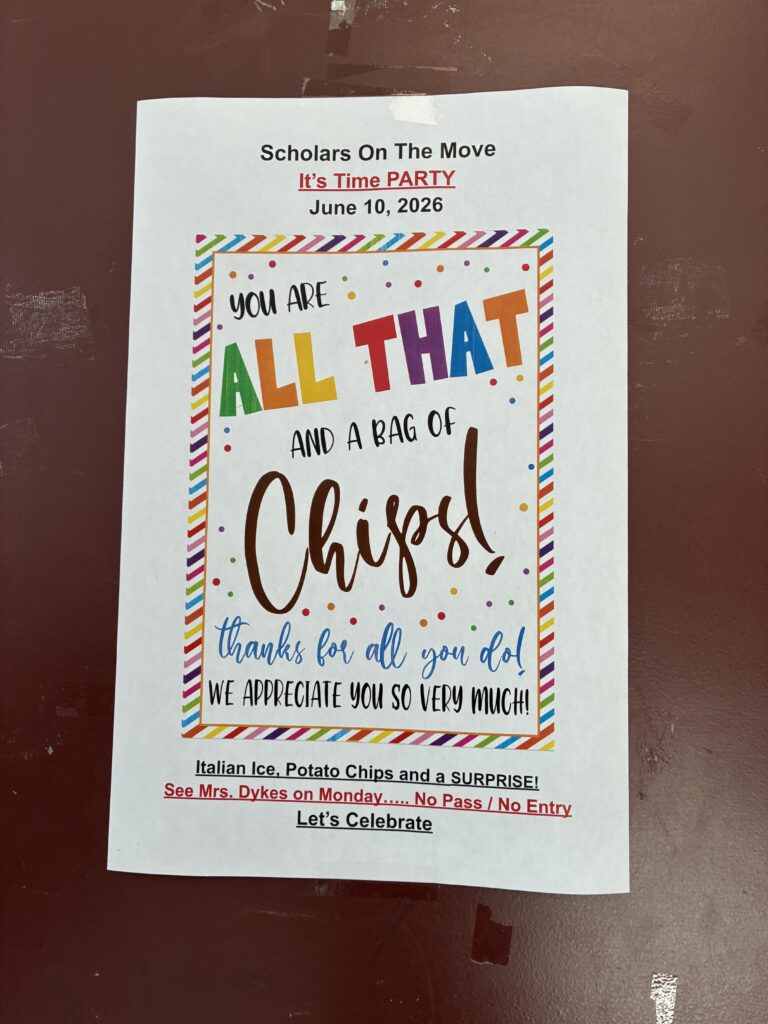
An end-of-year celebration for students should not feel this complicated, but the current dynamics within the Middle School present a unique set of challenges. If any group were holding an event that was only for a specific club or activity, they’d communicate with the members of that group and no further advertising would be necessary. If an event were being held for the entire school, typically a flyer would simply list a time and place and indicate what group(s) of students are invited. Posting flyers without those details and requiring students to obtain a ticket from a specific staff member who some students, particularly LGBTQIA+ students, cannot communicate with safely, creates a barrier to access.
Throughout the year, students and staff have repeatedly observed this staff member providing privileges, snacks, games, and prizes to some students in the presenece of other students who have no contact orders for her. Advertising a party with treats and a “SURPRISE!” while knowing that some students will be unable to participate or whose participation would place them in an uncomfortable position is disruptive and discriminatory and not in the best interest of all students, and in particular LGBTQIA+ students.
The lines around who was and wasn’t invited are blurry. What was advertised as a party for students belonging to the club Scholars on the Move, ended up including students from the club People of Color United (POCU) as well. Some students were invited and were unsure of why because they were not affiliated with either group. Other students expressed wanting to attend because they were part of POCU, but wished the event had not been connected to the staff member for whom many LGBTQIA+ students have no-contact orders. The inequity of this party was amplified by the confusing ways it was organized.
To find out the time and location, students were required to contact a staff member with a documented history of harmful interactions with queer and trans students, and one from whom some families have obtained no-contact orders to protect their children. Students who were not on the list approved by this staff member were denied entry to the event. The LGBTQIA+ Caucus advocated vigorously for these issues to be addressed, but the event proceeded as planned, resulting in a lunch period during which some students attended a private party with special snacks and activities while others had their regular lunch in plain view of a celebration they could not safely attend. Queer or trans students also affiliated with POCU, which appeared to co-sponsor the event, were faced with the reality that participation in one club celebration put them in proximity to a person they were supposed to have no contact with. LGBTQIA+ students were faced with an impossible choice: attend an event organized by someone they did not feel safe around, or exclude themselves from the celebration. Neither option supports students’ sense of belonging.
We spoke with several students about this event. They said that students only get special privileges if they’re this staff member’s friend; they told us that they don’t feel good about talking to her. They talked to us about the complexity of being in a space where some kids are able to be around an adult and some aren’t — how do they honor their friends but also do something that sounds fun? Several students described feeling conflicted about attending because they wanted to participate in the celebration and enjoy the activities, but did not feel comfortable interacting with the organizer. They were acutely aware of the tension between wanting to be included and wanting to maintain boundaries they believed were important for their own wellbeing.
A Response from the LGBTQIA+ Caucus
In response, the caucus has written the following statement:
The district cannot publicly celebrate LGBTQIA+ students and allyship in one moment and then, within hours, permit actions that undermine the very sense of safety and belonging that the assembly was intended to celebrate.
This is not a disagreement about bulletin boards or competing events. It is a matter of governance, credibility, and trust. Given the years of community effort that have gone into rebuilding trust after failures that caused profound harm to queer and trans students and their families, this is deeply disappointing.
The caucus understood that an agreement had been reached that competing displays or programming would not be present around Pride Month materials during June so as not to signal alignment between Pride and events that might not be safe or healthy for LGBTQIA+ students. Based on what we observed yesterday and today, that agreement was not honored.
More importantly, we are concerned about the impact of this misalignment of messaging on students. The central message of the Pride assembly was that LGBTQ+ students belong, are valued, and deserve to feel safe in their school community. Yet students were simultaneously directed toward an activity that required engagement with a staff member from whom some students have no-contact orders. Regardless of intent, that creates an inherently unequal situation in which some students cannot safely access the same opportunities as their peers. In this case there were special snacks and games attached to the opportunity and it was in close proximity to the students who could not participate, a scenario that would be difficult for most middle-schoolers. The administration was aware of these factors and allowed the event to continue as organized.
When the district publicly affirms that LGBTQIA+ students belong and are safe, those commitments must be reflected in practice. Otherwise, the message becomes contradictory, trust is eroded, and the district risks repeating the very mistakes it has spent years attempting to repair.
The Amherst LGBTQIA+ Caucus was formed because students and families raised serious concerns about safety, belonging, and equitable treatment. We have appreciated the school administration’s willingness to engage with those concerns in good faith and to help move the district forward. For that reason, this situation is particularly troubling.We had hoped the district’s response to this event would have reflected the same commitment to student safety, inclusion, and accountability that it publicly endorsed just 24 hours earlier.
Ongoing Concerns About the District’s Support of Queer and Trans Students
One day after organizing a powerful Pride assembly, organizers find themselves asking a difficult question: did we set students up for disappointment? The lack of alignment between the messages of the assembly and their experience at school the following day was palpable.
The assembly was still valuable. Exposure to queer and trans culture — the music, the poetry, the joy — has real value in students’ lives beyond school walls, and that value doesn’t disappear. Unfortunately, we continue to have significant concerns about their safety and wellbeing at school, and we wish we had not tied those messages to a place that will not protect them.
Symbols matter. Pride celebrations matter. Messages of allyship matter. But they matter because they are supposed to represent something real. When institutions publicly signal safety, belonging, and inclusion, students should be able to trust that those communications will be reflected in practice.
Because we were aware of the exclusionary nature of some of the organizing taking place, caucus members made it clear to the administration that if those messages were to be posted alongside our Pride decorations we would need to remove our Pride decorations so as not to signal alignment or safety to queer and trans kids. On the day after the assembly, when the decorations and information about this event moved into the main areas of the school, the caucus made the difficult decision to remove the Pride Month decorations we’d posted throughout the Middle School for the following reasons:
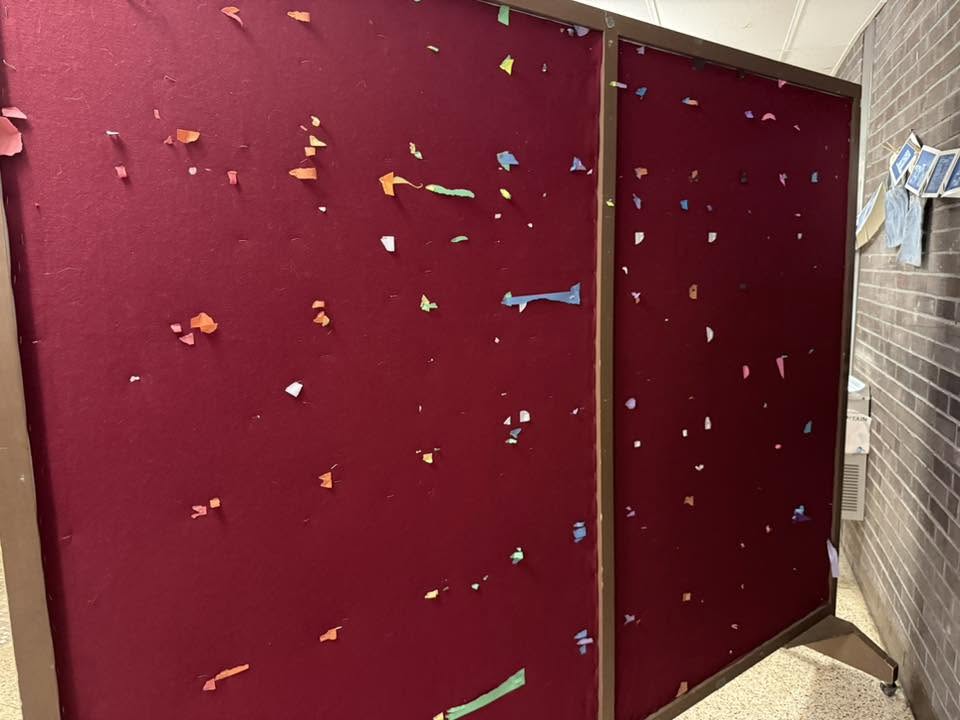
- Based on the events described above, the caucus does not currently believe Amherst Regional Middle School is providing a safe and affirming environment for LGBTQIA+ students.
- Celebrating Pride Month while failing to protect queer and trans kids is disingenuous and dangerous. It is a safety issue to flag allyship where it doesn’t exist.
- It is the responsibility of queer adults not to flag a place as safe if it is not safe. We need to model for the kids that the truth is more important than what feels good or comfortable.
- We had been clear from the beginning that the Pride decorations were intended to create a welcoming and queer/trans-affirming space. Once the exclusionary event was allowed to be advertised and held in a way that excluded students and jeopardized their sense of belonging, ARMS ceased to be a welcoming and affirming space for LGBTQIA+ people. The administration was made aware of this before the decorations were removed and had the opportunity to choose to address the issue of the exclusionary event, but they did not.
There were some staff members who struggled with that last point as they saw the bulletin boards coming down. They expressed that it will be sad for students not to see them anymore, and that we signal defeat by removing them. We imagine some parents may feel the same way. We want to be clear that removing the bulletin boards was heartbreaking for us as well, but the truth, no matter how uncomfortable, matters. And the truth is that much like three years ago (see also here) – adults are failing to hold boundaries around problem behavior, and vulnerable kids are paying the price.
We agree that it is a prettier picture to have rainbows and positive messages of allyship in the hallways. It also comes with a responsibility to LGBTQIA+ people that ARMS is not willing to meet at this time. When the experiences of queer and trans students do not align with public messages about safety and inclusion, projecting that image risks undermining trust and creating confusion about where students can expect support. The lack of alignment is not healthy or safe for kids, and they can feel it.
Our message to those who are disappointed to see the signs come down: channel that feeling into action. Speak out. Organize. Push the administration to align its policies and practices with the allyship it publicly claims — so that one day the rainbows can go back up and mean something.
If you have concerns you’d like to share with the administration please write to the principal of the middle school, Juan Rodriguez, at rodriguezja@arps.org and Superintendent Dr. E. Xiomara Herman (Dr. Xi) at hermanx@arps.org.
This article is a collective effort of members of the LGBTQIA+ Caucus of Amherst.
The LGBTQIA+ Caucus of Amherst is a grassroots group formed in the fall of 2023 in response to a clear need to push for transparency, accountability, and equity from the local administration, and to mobilize greater advocacy and support for queer and trans students. The Caucus works with the community, including Amherst Regional Public Schools staff and administration to identify and meet the needs of LGBTQIA+ students. To protect its members from potential retaliation and intimidation within the community, the Caucus operates with an anonymous membership structure relying on a designated spokesperson for public communication. Caucus spokesperson Ali Wicks-Lim (they/them) can be contacted at CaucusLGBTQIA@gmail.com.
I work at the Amherst Regional Middle school. I was one of the people who asked why the bulletin boards were coming down. I feel that I was met with anger and a lecture. I was told that we, as a school, were not doing enough to stop this “celebration.” My question is how do you stop a tornado? It went from a pizza party that was to last over an hour to a bag of potato chips, Italian ice and only lasting 30 minutes. We went from an EF 5 to an EF1.
Please understand that most of the employees that I spoke with did not want this party to happen. Yes, it was done by invitation only, and no it was not mandatory that you go. But really, what middle school student is going to say no to a free bag of chips?
For most of the school year, the author of this article has been a volunteer in the cafeteria, mostly talking to the adults and observing. On the day of the “celebration” instead of going into the cafe, they immersed themselves into the party. Asking questions and getting frustrated. If students were feeling uncomfortable in the party, why did they not say, let’s find a different place for you to go so you can feel safe. The result of this was them getting mad taking down the three beautiful bulletin boards that they worked so hard on.
I saw their reaction to be on the level of, Its my ball, you’re not playing the game I want to play so I am going to take it and go home.
In the end, I feel that these people did a dishonor to the students and the staff who identify in the LGBTQIA+ community by taking down the bulletin boards.
Pride month is the whole month of June, not just when it’s easy for you.
Sad to see the boards come down, but I think it’s the right choice. It’s very clear that ARMS is more interested in the *appearance* of allyship than offering material support to their queer students.
As a gay and trans person, I have no time for “allies” like the previous commenter, who talk over us and our work while offering no substantial support. I and many others have spent massive amounts of time and energy organizing to protect queer and trans kids from fascist violence. To hear a school employee moan about how stopping a pizza party is too hard is beyond laughable.
Spare us the lectures and join us in the work.
Thank you LGBTQI+ Caucus of Amherst. Thank you for your work, the possibilities you offer the students first and the possibilities you offer us all, and for your words and heart. As a lesbian who has been doing this work for nearly 5 decades I know the joy and heartbreak of what you are doing. The article is powerfully and beautifully written. I love how it offers explanation and truth telling. I hope, first, that the queer and trans community feels the love and joy. I hope too that our allies, including those who don’t get it (yet) do their work to understand why removing the bulletin boards was necessary and a powerful action. I hope they can get behind and support you in this. I hope those allies who do understand why this was needed will help other allies understand this. I hope all those who call themselves allies will step up and be more active and take action. Actions could be collaborating with and following the lead of the LGBTQI+ Caucus to support the students, holding listening sessions with the Caucus to know how to follow their lead, documenting any unkind or harassing or bullying behavior towards LBGTQI+ students. Oh, there are so many things our allies can do. Allies – we, all of us and especially the students, want you to step up.
To the staff member at ARMS who asked about the bulletin boards coming down and anyone else who is questioning this, please know that a gathering that excludes me because I’m queer, no matter how long or short it is, no matter what the snacks are, is a clear message to me and my queer and trans friends that we are not worthy, not valued, and we are expendable at any cost. Even if it is not mandatory, the fact that my choice to attend is taken away from me, that is not okay. Offering a free bag of chips only adds insult to injury, because yes, other kids will want the chips. The transactional nature of the event only complicates it for kids and ensures the insidious discrimination has many ways in.
If one, or most of the employees at ARMS didn’t want the party to happen, then this is another beautiful opportunity for action! You get to speak up to your administration, organize your staff members, write letters to the powers that be, make it clear to your colleague that this is not okay and that you will do all you can to remove such a harmful even that is taking place in your school and under your watch. The students are watching what you do and don’t do.
Students are unlikely to say they are uncomfortable in the party – they have been offered a treat and attention, and if they were like me at that age, they want and need that, even with discomfort or at the risk of hurting their friends. The conversations and the work is hard. I know that personally. I also know personally that there is no substitute for those hard conversations and the hard work of action.
Please honor us, all year long, by learning to understand why taking down the bulletin boards was an act of love and power for our community and the students.
Again, to the Caucus – thank you for your truth telling and power and joy that you offer all of us. To the students — may you learn and understand complexities and power, have safety and joy in your school and world. We are here and we will continue to act to support you.
LGBTQIA+ children are at higher risk for mental health consequences exactly because of the cumulative minority stress caused by situations like this–schools that allow for exclusivity to persist.
Performative allyship without protective action is empty and even dangerous. This sends mixed messages to kids and can register in children’s minds as gaslighting, lies from people who were supposed to be helpers. It can leave a child’s nervous system questioning, “Am I safe here?”.
I want to highlight two powerful points from article above from the LGBTQIA+ Caucus of Amherst:
“- Celebrating Pride Month while failing to protect queer and trans kids is disingenuous and dangerous. It is a safety issue to flag allyship where it doesn’t exist.
– It is the responsibility of queer adults not to flag a place as safe if it is not safe.”
These LGBTQIA+ kids need real advocates! Truth and action are antidotes for discrimination.
In this case, real action was needed to send a poignant message to the school admin, faculty, staff, and most importantly, the LGBTQIA+ students– an exclusive party hosted by a person who is harmful to LGBTQIA+ children the day after a Pride celebration is *unacceptable*.
ARMS, do better!
“What middle school student is going to say no to a free bag of chips?”
I see this question in another comment on this article and I’m really disappointed to see how completely this staff member at ARMS missed the point.
That bag of chips was an exclusive invitation for SOME students to participate in a celebration that excluded other students – specifically some LGBTQIA+ students. The question is so horribly misguided because the chips (and party, etc.) ARE tempting. Kids DON’T want to turn that down. So someone who has directly mistreated LGBTQIA+ students is continuing to do so while the adults in the building call this 30 minute party a “tornado” that can’t be stopped.
It’s possible that Julie Woynar isn’t the only one who’s misunderstanding these circumstances, so I want to clarify:
1. Leaving Pride decorations up alongside RAINBOW-colored announcements for a party designed to exclude and “other” LGBTQIA+ students implies a partnership between the LGBTQIA+ organizers and the party organizer, which is dangers.
2. Leaving them up at all in a school with adults like Woynar, who will minimize discriminatory behaviors while complaining to the VOLUNTEERS literally trying to create a safe and joyful space in a building that has failed certain students for years, sends an inappropriate message.
3. It is DANGEROUS to create the illusion that the school is a safe space for these students while it literally demonstrates that it is not. The students need to know that the staff and administration are willing to allow discrimination against them – that those adults in their lives cannot be trusted.
4. Woynar is emblematic of the problem. She embodies the notion that discrimination can be explained away because it’s too hard to do anything about, while chastising people in the building who are doing something about it: literal volunteers who are doing the work to protect these students.
Pride month is never easy, Julie.
It was born from brave trans people standing against oppression. And the folks who continue to bear the brunt of that oppression today deserve a little time to just feel joy in being celebrated for who they are. A space that discriminates against them doesn’t get to advertise itself as a safe place for that celebration.
Maybe before you try to suggest that the volunteers who have put so much work (into a massive event, school-wide decorations, and years of advocacy) are doing something easy, put in a little work yourself. Speak up. Defend the vulnerable students who were discriminated against with that party.
DO SOMETHING or at the very least keep your mouth shut when someone else is doing the work.
This is in response to Julie’s comment, and is coming from me personally, not from the Caucus.
1.) You approached two queer people who were already struggling with a difficult moment, identified yourself as an ally and then proceeded to tell us that we were hurting you personally as well as students by removing the decorations, and accused us of letting the staff member “win.” When we tried to explain that what we were doing was protective of queer and trans students, who need to know when a space is truly safe and when it isn’t, you told us we were lecturing you and re-centered your own feelings. When we tried to explain that this was not a spontaneous act of frustration, it was something the caucus had thought about and communicated would be necessary if the exclusionary party went forward you spoke over us, unwilling to hear our perspective about the work we had done over months. When we told you it was hurting us to have to do as well, you didn’t seem to care and declared the conversation over. That is not ally ship.
2.) You didn’t seem to read the article very closely, but if you had you might have understood that the kids at the party weren’t asking to be moved to a safe space, they were wanting the treats at the party and feeling conflicted about it because it put them in an uncomfortable place. We stood with them, listened to them, affirmed their feelings and let them know it is OK to draw boundaries. We expressed some frustration to adults. With the kids at the party we were focused on holding a safe space for them in a difficult environment.
3.) I want to respond to your last line “Pride month is the whole month of June, not just when it’s easy for you.” I don’t need a ‘lecture’ from you about Pride month. I organize and work for the LGBTQIA+ community year-round. I spend Pride Month working multiple events a week, providing support for Pride events. It’s never easy because I understand exactly what’s at stake for the people I’m showing up for (and with) because we share a lived experience. You could be open to learning from us, even when that may feel uncomfortable to you, but instead you feel entitled to make our jobs/ lives harder. That is also not ally ship. Please reconsider introducing yourself to queer people as an ally. Ally ship is not conditional upon keeping you comfortable.
How can there be space for celebration when students are being separated and harmed? Pride displays are supposed to announce to all who enter that “you are safe here” and that is not the case at ARMS. It’s like still shopping the Pride collection at Target. What you see is not what you get.
I am extremely disappointed to see that someone calling themselves an ally is trying to shout down people she claims to be allied with. Your entire role as an ally, should you choose to really accept it, is to be compassionately curious when you don’t understand something that directly affects the community you purportedly support. There is no room for negotiation or minimization (“went from an hour-long pizza party down to 30 minutes and a bag of chips”) when children’s safety is at stake. Period.
As a professional in the field of child development, and the parent of a trans child, I fully support the Caucus’ decision to take the bulletin boards down. What the ARMS educator who commented above and the school administration don’t seem to understand is that it is NOT ONLY queer kids’ and staff’s safety at risk with these actions. It is a basic social safety lesson for children to know what REAL safety looks like. To do anything else puts children at risk of exploitation and harm of many kinds, whether they identify as LGBTQIA+ or not. The school administration, and educators like the one who commented above, expect children to sacrifice their own sense of belonging and safety so that others can *feel like* they are doing a good thing. So everyone else can pretend like these very real and current problems don’t exist. That is exactly how abuse works. Not okay. It is a very good lesson for children — especially middle school age — to see adults modeling the kind of truth-telling and fighting for protections and justice that the Caucus is engaged in.
The adults who took down the board made the right decision. Leaving them up not only instills a harmful (if not outright dangerous) false sense of security for LGBTQIA kids, it lets the adults in this school sweep their own failures under the rug.
Another comment here said the school “took it from an F5 to an F1.” But that’s a false equivalence. An adult who has repeatedly harmed LGBTQIA kids neong allowed to a) remain on staff and b) organize events or serve as any type of group leader isn’t a tornado. It’s a man made disaster, courtesy of the adults who allowed this harmful person to continue their harmful behaviors.
Pride month IS the whole month of June. But queer kids are queer all 12 months of the year. Protecting them, even when that means making other adults uncomfortable, is a 24/7/365 effort. Not just when it’s easy for you. And not just when it makes you feel better about yourself as an “ally.”
(P.s., allyship involves listening to and amplifying the voices of the people with whom you ally yourself. It isn’t telling them that they’re reacting incorrectly to harm done, or demanding that they pat you on the head for your virtue, or criticizing them for being frustrated by uninterrupted harm done to members of their community. Do better.)
I am the parent of two ARMS/ARHS graduates. One of my children, I am proud to say, is a Trans teacher at an eastern Ma middle school where they feel safe and welcomed. This was not the case when my child was a student in Amherst. They told me of homophobic hallway harassment even though the adults all thought the school was welcoming to LGBTQIA+ students. Unfortunately, there continues to be a problem at ARMS. I support the decision to take down the Pride bulletin boards.
As a retired early childhood educator, I have seen how children can assess when they are being excluded. All it takes is having a peer block access to a toy or piece of equipment, and a young child knows what is happening and they feel bad about it. Without adult intervention, they may begin to feel bad about themselves, or exhibit challenging behavior. Even the youngest children can understand when an adult’s words don’t match their actions. Middle schoolers are more mature and sophisticated and they can tell when the words they are hearing don’t line up with their lived experience. It is easy to imagine the hushed conversation between them: “that Pride bulletin board LOOKS good, too bad it’s not REAL. There’s this party being led by a staff member who makes my LGBTQIA+ friends feel unsafe. Too bad these adults don’t have their act together”. To these kids, the bulletin board doesn’t bring a good feeling. Our kids need the adults in their lives to show that we will show up for them and not fall back on images that don’t have actions and values that hold them up.
I thank the Caucus for making the difficult decision to take down the Pride bulletin board. I hope the ARMS and Amherst Schools administration continues to seek them out for guidance as to how to be good allies to LGBTQIA+ youth.